Tharoor Meets Niramai Team on Breast Cancer Screening Tech
Synopsis
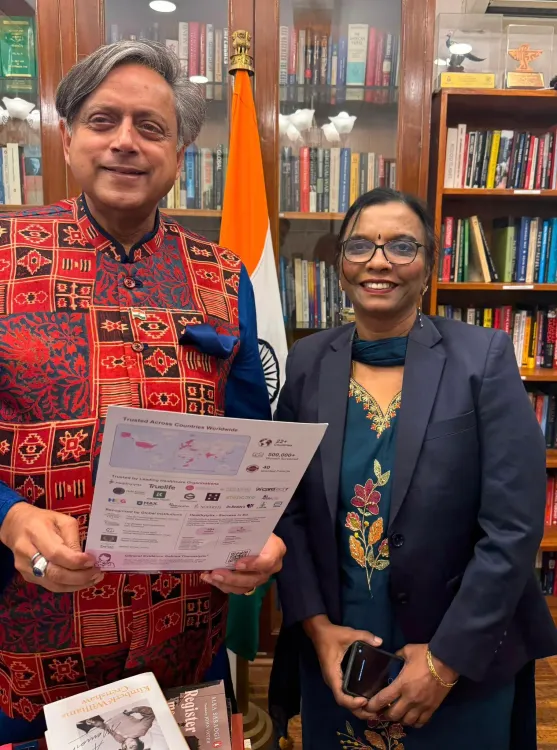
Congress MP Dr. Shashi Tharoor met the Niramai Health Analytix team on 5 July 2026 to learn about Thermalytix, a thermal-imaging breast cancer screening tool designed to expand early detection access for women in India, including in Kerala, without requiring conventional mammography infrastructure.
Key Takeaways
Shashi Tharoor , Congress MP from Thiruvananthapuram , met the Niramai Health Analytix team on 5 July 2026 .
Thermalytix uses thermal imaging instead of radiography, removing the need for expensive mammography machines and trained radiologists.
The technology is operable by semi-skilled healthcare workers and is suitable for younger and pregnant women , expanding its potential user base.
The discussion highlighted the role of innovation in strengthening preventive healthcare and early detection across India, with specific focus on Kerala .
India's Ayushman Bharat Health and Wellness Centres , launched in 2018 , have a mandate for population-based breast cancer screening, creating a policy opening for such tools.
State-level integration into Kerala's health infrastructure and national health technology assessment guidelines are the key next steps to watch.
Congress MP Dr. Shashi Tharoor on Sunday, 5 July 2026 met the team from Niramai Health Analytix to discuss their thermal-imaging-based breast cancer screening solution, Thermalytix, which aims to expand early detection access across India and specifically in Kerala.
Context
Dr. Tharoor described the meeting as 'an interesting discussion on how innovation can help strengthen preventive healthcare and early detection across India.' The Niramai team outlined how Thermalytix uses thermal imaging rather than conventional radiography, making it operable by semi-skilled healthcare workers and suitable for younger women as well as pregnant women — two groups for whom standard mammography is often considered unsuitable.
The technology is positioned as an alternative to conventional mammography, which requires expensive equipment, trained radiologists, and exposes patients to low-dose radiation. By removing those barriers, the solution targets settings where mammography machines are unavailable or underutilised.
Policy Backdrop
India's approach to cancer screening has evolved significantly since the National Cancer Control Programme was launched in 1975. Subsequent revisions focused on building regional cancer centres and promoting early detection at the community level.
The landmark Ayushman Bharat scheme, launched in 2018, established Health and Wellness Centres with a specific mandate for population-based screening of common cancers, including breast cancer. The push toward low-cost, non-radiographic diagnostic tools has grown in parallel, driven by persistent shortages of mammography machines and trained radiologists — particularly in primary and rural care settings.
Kerala, which consistently ranks among India's top states on health indicators, has previously piloted community-level screening models that integrate technology with existing health worker networks, making it a natural testbed for innovations like Thermalytix.
Stakeholders and Impact
The primary beneficiaries of accessible thermal-imaging screening are women in rural and semi-urban areas who currently have limited or no access to mammography facilities. Semi-skilled healthcare workers stand to gain a new diagnostic role, potentially expanding the frontline health workforce's capacity for cancer detection.
State health departments, particularly in Kerala, are key stakeholders who would need to integrate such tools into existing screening protocols. For the broader national health system, scaling a radiation-free, low-infrastructure screening option could meaningfully shift breast cancer outcomes by enabling earlier-stage detection.
What's Next
Attention will now turn to whether state-level pilots integrating thermal imaging tools into Kerala's Health and Wellness Centres move forward, and whether Thermalytix or similar technologies are considered for inclusion in national health technology assessment guidelines under the Ayushman Bharat framework.
Dr. Tharoor's engagement signals legislative interest in bridging the gap between health-tech innovation and public health delivery — a conversation likely to gain momentum as India confronts rising breast cancer incidence with constrained screening infrastructure.
Point of View
And a successful demonstration there could build the evidence base for national adoption. The framing around semi-skilled workers and radiation-free screening directly addresses two of India's most persistent bottlenecks in cancer care: workforce depth and equipment access. Whether this legislative interest translates into procurement or policy inclusion under Ayushman Bharat will determine the real-world impact of such engagements.
NationPress
5 Jul 2026
Frequently Asked Questions
What is Thermalytix and how does it work?
Thermalytix is a breast cancer screening tool developed by Niramai Health Analytix that uses thermal imaging rather than conventional radiography or mammography. It detects heat patterns associated with abnormal tissue growth and is designed to be operable by semi-skilled healthcare workers, making it suitable for settings with limited medical infrastructure.
Why is thermal imaging considered better than mammography for India?
Conventional mammography requires expensive machines, trained radiologists, and exposes patients to low-dose radiation, making it difficult to scale in rural or semi-urban India. Thermal imaging tools like Thermalytix do not require radiation, cost less to deploy, and can be used by semi-skilled workers, addressing key infrastructure and workforce gaps.
Is Thermalytix suitable for younger women and pregnant women?
Yes, according to the details shared with Dr. Tharoor, Thermalytix is suitable for younger women as well as pregnant women — groups for whom standard mammography is often considered less appropriate due to radiation exposure and breast tissue density considerations.
What is India's current policy on breast cancer screening?
India's breast cancer screening policy is anchored in the Ayushman Bharat scheme launched in 2018, which tasked Health and Wellness Centres with population-based screening for common cancers including breast cancer. The National Cancer Control Programme, dating to 1975, also established a framework for regional cancer centres and early detection.
What is Kerala's role in advancing breast cancer screening in India?
Kerala, with its strong public health infrastructure and high health indicators, has previously piloted community-level screening models integrating technology with existing health worker networks. This makes it a natural candidate for early adoption of innovations like Thermalytix, and Dr. Tharoor specifically highlighted Kerala in his discussion with the Niramai team.