Tharoor Shares Rahat Indouri Verse on Defiance

Synopsis
Congress MP Dr. Shashi Tharoor shared a celebrated defiant verse by the late Urdu poet Rahat Indouri on X on 22 July 2026, invoking the power of poetry against intimidation — a move consistent with Indian opposition leaders' tradition of using shayari as political signal.
Key Takeaways
Shashi Tharoor , Congress MP from Thiruvananthapuram , posted a verse by Rahat Indouri on 22 July 2026 .
The verse declares fearlessness in the face of a sword-wielding adversary and asserts that a single couplet of poetry can vanquish a challenger.
Rahat Indouri , who passed away in August 2020 , was one of India's foremost Urdu poets; his work gained political currency during the 2019 CAA protests .
Tharoor offered no explicit prose commentary, letting the verse stand as its own statement — a common device among Indian opposition figures.
The post aligns with a broader pattern of Congress leaders using cultural references to signal resilience without direct partisan statements.
Congress MP Dr. Shashi Tharoor on Wednesday, 22 July 2026 shared a defiant verse by the late Urdu poet Rahat Indouri on X, invoking themes of fearlessness and the power of poetry against intimidation.
The Verse and Its Translation
The post reproduced a well-known sher by Rahat Indouri in its original Hindi-Urdu script. In translation, the lines read: 'Utha shamsheer, dikha apna hunar, kya lega?' ('Draw your sword, show your skill — what will you take?'). The verse continues: 'Here is my life, here is my neck, here is my head — what will you take?' The closing couplet declares that a single verse of poetry will reduce the challenger to dust, mocking the idea that a poet is powerless.
Tharoor attributed the verse directly to Rahat Indouri, the celebrated Urdu poet and lyricist who passed away in August 2020. No additional commentary accompanied the post.
Context: Who Was Rahat Indouri?
Rahat Indouri was one of the most prominent Urdu poets of his generation, renowned for his mushairas, his ghazals, and nazms that blended romantic imagery with sharp social commentary. Born in Indore, Madhya Pradesh, he taught Urdu literature and built a following that extended well beyond literary circles into mainstream popular culture.
His poetry gained particular political resonance during the 2019 nationwide protests against the Citizenship Amendment Act, when his verses — especially the famous couplet 'Sabhi ka khoon hai shamil yahan ki mitti mein' — were widely recited at demonstration sites across India. His death in 2020 was mourned across the political spectrum, and his work has continued to circulate on social media as a shorthand for resistance and dignity.
Policy Backdrop: Shayari as Political Signal
Indian opposition politicians have a long tradition of deploying Urdu shayari on social media to convey political sentiment without making explicit partisan statements. The practice allows leaders to invoke defiance, critique, or solidarity through the established moral authority of poets, sidestepping the direct accusation that a prose statement might invite.
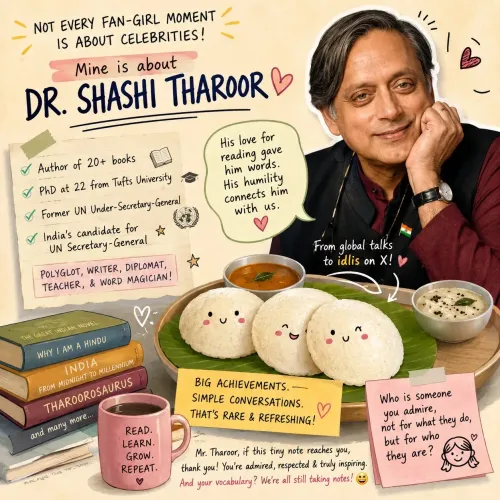
Dr. Tharoor, known for his command of language and his literary sensibility, has previously used poetry and cultural references on social media to engage both his literary and political audiences. The Congress MP from Thiruvananthapuram, a former UN Under-Secretary-General and former Union Minister of State for External Affairs and Human Resource Development, regularly draws on this tradition to communicate with a broad following.
Stakeholders and Broader Impact
The post resonated with the literary community as well as opposition circles, where Indouri's verse is read as an assertion of courage in the face of power. The imagery of sword versus word — with the word declared supreme — carries an implicit argument about the enduring relevance of free expression and artistic dissent.
Tharoor's amplification of the verse keeps Indouri's legacy in public conversation and signals, consistent with Congress figures' broader communication strategy, a posture of resilience. The specific political trigger, if any, for the 22 July 2026 post is not established.
What's Next
Observers of Dr. Tharoor's social media activity and his interventions in Parliament will watch whether subsequent posts or speeches elaborate on the themes of free expression and cultural assertion raised by the Indouri verse. The use of this particular poem — one associated with protest and defiance — is likely to prompt discussion in both literary and political circles about the context in which it was shared.
Point of View
And Tharoor, as a former diplomat and minister, is especially deliberate in his public communications. The selection of Indouri, whose legacy is inseparable from the 2019 CAA protest movement, adds a layer of associative meaning that his audience will read fluently. Whether the post is a response to a specific provocation or a general assertion of defiance, it reinforces the Congress's broader positioning of itself as the custodian of India's pluralist, literary tradition.
NationPress
22 Jul 2026
Frequently Asked Questions
What poem did Shashi Tharoor share on X in July 2026?
Dr. Shashi Tharoor shared a well-known defiant verse by late Urdu poet Rahat Indouri that begins 'Utha shamsheer, dikha apna hunar, kya lega?' — challenging an adversary who wields a sword and asserting that a single couplet of poetry can destroy such a challenger.
Who was Rahat Indouri?
Rahat Indouri was a celebrated Urdu poet and lyricist from Indore, Madhya Pradesh, known for his mushairas and socially resonant ghazals. He passed away in August 2020 and his poetry became widely associated with the 2019 protests against the Citizenship Amendment Act.
Why do Indian politicians share Urdu shayari on social media?
Indian opposition politicians, including Congress leaders, regularly share Urdu shayari to convey political sentiment — defiance, solidarity, or critique — through the moral authority of poets rather than through direct partisan statements, allowing the verse to carry the message.
What is the meaning of the Rahat Indouri verse Tharoor posted?
The verse dares an opponent to draw a sword and show their strength, then offers up the poet's own life and neck fearlessly, before declaring that a single sher (couplet) of poetry will reduce the challenger to dust — asserting the supremacy of words over force.
Is Shashi Tharoor the Congress MP from Thiruvananthapuram?
Yes, Dr. Shashi Tharoor is the Congress MP from Thiruvananthapuram, Kerala. He is also a former UN Under-Secretary-General and former Union Minister of State for External Affairs and Human Resource Development.