Tharoor Slams Ministry Over UGC Fellowship Gaps, Stale Stipend
Synopsis
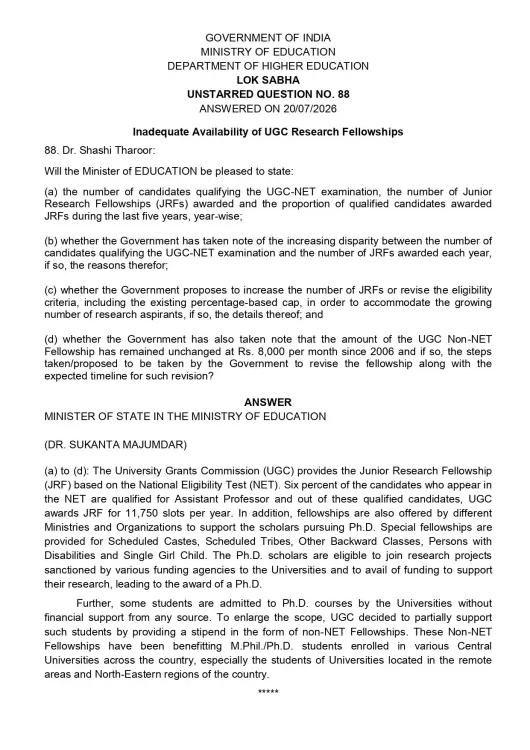
Congress MP Dr. Shashi Tharoor has publicly rebuked the Education Ministry for a parliamentary reply he calls evasive, highlighting the Rs. 8,000 UGC Non-NET Fellowship stipend frozen since 2006, the growing gap between NET qualifiers and JRF awards, and the absence of any government commitment to reform research fellowship support.
Key Takeaways
Shashi Tharoor called the Education Ministry's parliamentary reply on UGC fellowships 'disappointing' on 21 July 2026 .
The UGC Non-NET Fellowship stipend of Rs.
8,000 per month has remained unchanged since its introduction in 2006 .
The Ministry did not provide year-wise data on UGC-NET qualifiers and JRF awardees as requested.
Tharoor had previously raised the Non-NET stipend issue via a Zero Hour intervention in Parliament in 2023 , with no government commitment since.
He called for expanded JRFs, revised eligibility criteria, stronger institutional infrastructure, and effective grievance redressal for research scholars.
The Government has offered 'neither a commitment nor a timeline' for revising the Non-NET fellowship stipend, according to Dr.
Congress MP Dr. Shashi Tharoor on Tuesday, 21 July 2026, publicly criticised the Education Ministry's response to his parliamentary questions on research fellowship support, calling it 'a disappointing answer' that sidesteps core concerns about the widening gap between qualified candidates and available fellowships.
Context
Dr. Tharoor's post responds to what he describes as a Ministry reply that 'merely provides a broad overview of the existing UGC fellowship framework' without furnishing the year-wise data he requested on UGC-NET qualifiers and JRF awardees. He argues the response relies on 'a general description of the existing scheme and alternative sources of research funding' rather than addressing the specific gaps he raised. The Thiruvananthapuram MP has been a consistent voice on research funding, having raised the Non-NET stipend issue through a Zero Hour intervention in 2023.
Policy Backdrop
The UGC Non-NET Fellowship, introduced in 2006, provides a monthly stipend of Rs. 8,000 to research scholars who qualify for lectureship via UGC-NET but do not receive a Junior Research Fellowship (JRF). Dr. Tharoor pointedly notes this figure has remained 'unchanged since 2006 despite periodic revisions being the norm.' By contrast, stipends for JRF and Senior Research Fellowship (SRF) holders have seen periodic upward revisions over the same period, creating a growing disparity in support for different categories of research scholars.
The University Grants Commission (UGC), the statutory body that regulates and funds higher education in India, administers both the JRF and Non-NET fellowship schemes. Dr. Tharoor's criticism centres on the Ministry's silence on whether the Government has examined the gap between the number of NET qualifiers and the limited pool of JRF awards, and whether it intends to expand JRF numbers or revise eligibility criteria.
Stakeholders and Impact
The issue directly affects PhD students and research scholars across Indian universities who depend on fellowship support to pursue full-time doctoral research. A static Non-NET stipend of Rs. 8,000 per month — unchanged over two decades — has eroded significantly in real terms against inflation, limiting the financial viability of research careers for those outside the JRF bracket. Dr. Tharoor also flags structural concerns beyond stipends, calling for 'adequate academic supervision, effective grievance redressal mechanisms, and a comprehensive review of research fellowship support' to ensure India's research ecosystem keeps pace with scholar aspirations.
The broader pattern, as reflected in successive UGC frameworks, has seen growth in the number of NET-qualified candidates outpace the expansion of JRF slots and non-NET support, intensifying competition and financial pressure on the research community.
What's Next
Dr. Tharoor's post signals he intends to keep parliamentary pressure on the Ministry, noting that despite his 2023 Zero Hour intervention, 'the Government continues to offer neither a commitment nor a timeline' for revising the Non-NET stipend. Observers will watch for any Education Ministry clarification or UGC notification in the current Parliament session, as well as any reference to fellowship expansion or stipend revision in the upcoming Union Budget. Until concrete timelines emerge, India's research scholars remain in a holding pattern — qualified, but inadequately supported.
Point of View
000 stipend frozen since 2006, he frames the Government's inaction as indifference to the financial precarity of India's research community. The post fits a wider Opposition strategy of using parliamentary questions and Zero Hour interventions to force accountability on higher-education funding, an area where the gap between policy ambition and ground-level support has widened. Coming amid national-level conversations about strengthening India's innovation capacity, the critique lands with particular force: a country aspiring to be a global knowledge economy cannot afford to leave its doctoral scholars financially stranded. The Ministry's silence on timelines gives the issue legs well beyond this parliamentary session.
NationPress
21 Jul 2026
Frequently Asked Questions
What is the UGC Non-NET Fellowship and how much is the stipend?
The UGC Non-NET Fellowship is a monthly stipend scheme for research scholars who qualify for lectureship via UGC-NET but do not receive a Junior Research Fellowship (JRF). The stipend is Rs. 8,000 per month, a figure set when the scheme was introduced in 2006 and unchanged since.
Why is Shashi Tharoor criticising the Education Ministry over UGC fellowships?
Dr. Tharoor says the Ministry's parliamentary reply failed to provide year-wise data on UGC-NET qualifiers and JRF awardees, did not address the growing gap between qualified candidates and available fellowships, and remained silent on revising the stagnant Rs. 8,000 Non-NET stipend despite his 2023 Zero Hour intervention on the same issue.
What is the difference between a JRF and a UGC Non-NET Fellowship?
A Junior Research Fellowship (JRF) is awarded to top performers in the UGC-NET exam and carries a higher stipend to support full-time doctoral research. The UGC Non-NET Fellowship is a lower-stipend scheme for those who clear the NET for lectureship eligibility but do not rank high enough to receive a JRF.
Has the UGC Non-NET stipend ever been revised?
No. The UGC Non-NET Fellowship stipend of Rs. 8,000 per month has not been revised since the scheme was introduced in 2006, even as JRF and SRF stipends have seen periodic upward revisions over the same period.
What reforms is Tharoor demanding for India's research fellowship system?
Dr. Tharoor is calling for year-wise data disclosure on NET qualifiers and JRF awardees, expansion of JRF numbers, revision of eligibility criteria, an immediate hike in the Non-NET stipend, stronger institutional research infrastructure, adequate academic supervision, and effective grievance redressal mechanisms for research scholars.