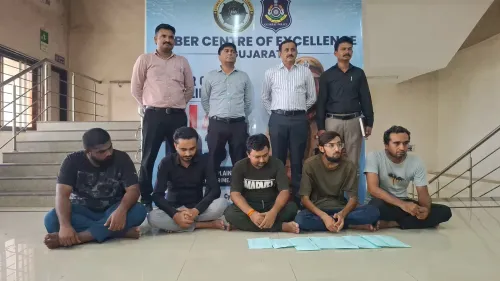
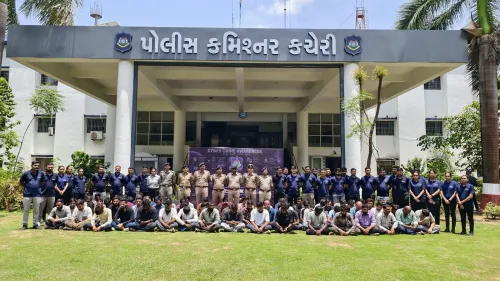
Gujarat: Three Uttarakhand men arrested in ₹1.63 crore fake gold scam
Synopsis
A Surat resident lost over ₹1.63 crore to a fake gold mining scheme run through a Facebook persona and a sham trading app — and the money was funnelled out via mule accounts supplied by three men in Kashipur, Uttarakhand, each paid a small per-account commission. The cross-state bust reveals how organised mule networks are the silent infrastructure behind India's surging cyber fraud epidemic.
Key Takeaways
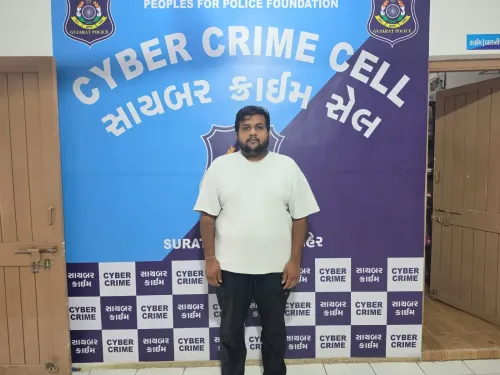
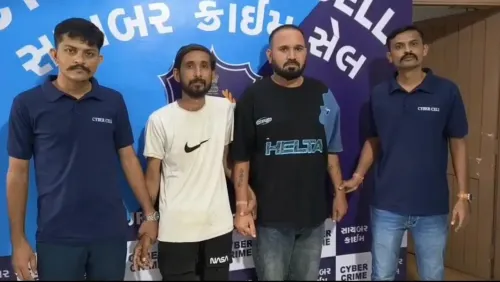
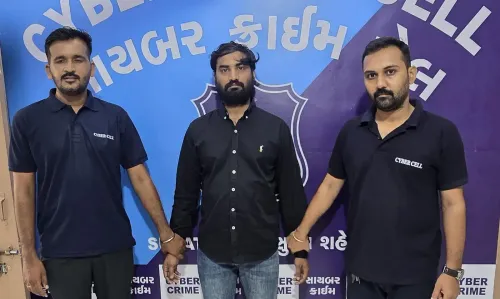
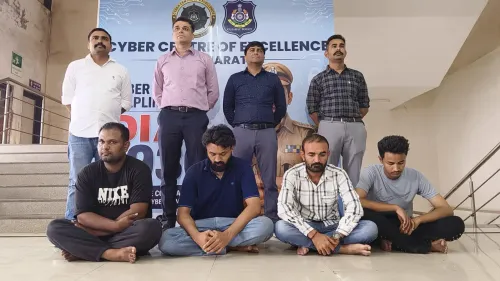
Three men from Kashipur, Uttarakhand arrested by Surat City Cyber Crime Cell for allegedly enabling a ₹1,63,98,012.70 cyber fraud.
The fraud ran from 10 December 2024 to 25 April 2025 via a fake scheme called GRGC (Gold Rush Global Capital) .
Accused Mohammad Izhar (48) , Mohammad Sumair (24) , and Mohammad Uvesh (24) allegedly provided bank accounts for commissions ranging from ₹5,000 to ₹20,000 per account .
One HDFC Bank account linked to the case was connected to three separate NCCRP complaints totalling ₹11,37,217 .
FIR registered under Bharatiya Nyaya Sanhita, 2023 and Section 66(D) of the IT Act, 2008 .
Cyber Crime Cell has warned the public against sharing banking credentials or lending accounts for commissions.
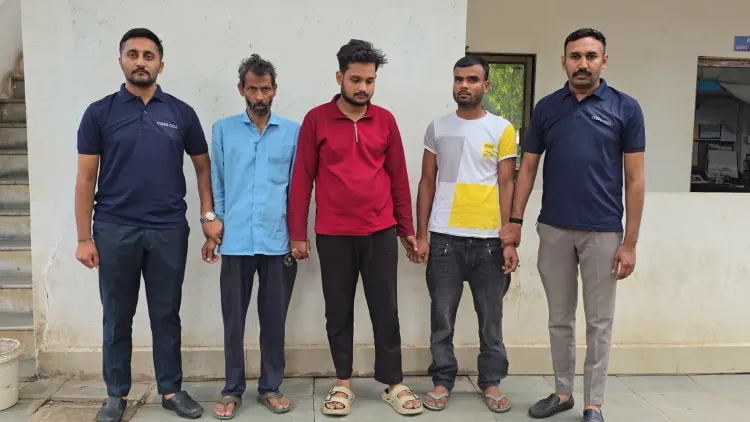
Three men from Kashipur, Uttarakhand, have been arrested by the Surat City Cyber Crime Cell for allegedly facilitating a cyber fraud in which a Surat resident was duped of ₹1,63,98,012.70 through a fake gold mining investment scheme. Investigators allege the trio provided bank accounts used to channel the stolen funds, with the fraud running from 10 December 2024 to 25 April 2025.
How the Scam Operated
The victim was reportedly contacted via a Facebook profile named 'Anjali Modi' and a WhatsApp handle, and was drawn into a purported investment scheme called GRGC (Gold Rush Global Capital). The fraudsters used a fake trading application and the email address 'info@grglobalco.com' to lend the operation an air of legitimacy.
According to investigators, the victim was promised high daily and monthly returns on so-called 'Gold Mining Trading' investments. 'The accused gained the complainant's confidence before collecting money under various pretexts, including initial investment, tax, margin money, credit score charges, audit fees, international transfer fees, high-risk deposits and withdrawal charges,' officials said.
The complainant was shown fictitious profits on the fake trading application and repeatedly assured the invested amount was secure and would be refunded — but, according to police, 'no money was returned.'
FIR and Legal Sections Invoked
After the victim filed a complaint with the National Cyber Crime Helpline, the Cyber Crime Cell conducted a preliminary inquiry and registered an FIR under Sections 318(4), 336(2), 338, 336(3), 340(2), 61(2) and 3(5) of the Bharatiya Nyaya Sanhita, 2023, along with Section 66(D) of the Information Technology Act, 2008.
Who Was Arrested and Their Alleged Roles
A team led by Police Inspector N.R. Patel and Police Sub-Inspector V.B. Prajapati used technical analysis to trace and apprehend the three suspects in Kashipur, Udham Singh Nagar district.
The first accused, Mohammad Izhar, 48, a businessman from Kashipur, allegedly handed over his HDFC Bank account and banking kit to co-accused in exchange for a commission of ₹8,500. The second accused, Mohammad Sumair, 24, also a businessman from Kashipur, allegedly arranged multiple bank accounts — including his own and those of other individuals — for use in the fraud, reportedly retaining ₹6,500 per account as commission. The third accused, Mohammad Uvesh, 24, an electrician, allegedly collected his own account and those of six other individuals after being promised ₹20,000 per account, keeping ₹5,000 per account for himself.
Notably, one HDFC Bank account allegedly used in the fraud had been linked to three separate complaints on the National Cyber Crime Reporting Portal (NCCRP), involving transactions totalling ₹11,37,217. Of that amount, ₹9,95,000 was allegedly withdrawn through ATMs in the Kashipur area.
Public Advisory from Cyber Crime Cell
The Surat City Cyber Crime Cell urged citizens not to share bank account details, ATM cards, UPI PINs, net banking passwords, or one-time passwords with anyone. It also warned against allowing others to use personal bank accounts, ATM cards, cheque books, passbooks, SIM cards, or internet banking facilities in exchange for commissions, rent, or any other inducement.
With mule-account networks increasingly enabling large-scale cyber fraud across state lines, this case underscores the growing challenge of tracing and dismantling such operations — and the need for tighter bank-account verification at the point of onboarding.
Point of View
Raising questions about why banks are not flagging or freezing such accounts proactively. Until financial institutions are held accountable for mule-account proliferation, law enforcement will keep catching the bottom rung while the architects of these schemes operate freely.
NationPress
20 Oct 2026
Frequently Asked Questions
What was the GRGC gold mining investment scam in Surat?
GRGC, or Gold Rush Global Capital, was a fraudulent investment scheme that lured a Surat resident into investing over ₹1.63 crore between December 2024 and April 2025 by promising high returns on 'Gold Mining Trading.' The fraudsters used a fake Facebook profile, a sham trading app, and a fabricated email address to appear legitimate, then vanished with the money.
Who were the three men arrested and what were their alleged roles?
The three arrested — Mohammad Izhar (48), Mohammad Sumair (24), and Mohammad Uvesh (24), all from Kashipur, Uttarakhand — allegedly supplied bank accounts used to route the fraud proceeds. Each was paid a per-account commission ranging from ₹5,000 to ₹20,000, acting as what investigators call 'mule account' providers.
How did the Surat Cyber Crime Cell trace the accused to Uttarakhand?
A team led by Police Inspector N.R. Patel and Police Sub-Inspector V.B. Prajapati used technical analysis of the bank accounts into which the fraud proceeds were transferred to trace the suspects to Kashipur in Udham Singh Nagar district, where they were subsequently arrested.
What legal sections have been invoked in this cyber fraud case?
An FIR has been registered under Sections 318(4), 336(2), 338, 336(3), 340(2), 61(2), and 3(5) of the Bharatiya Nyaya Sanhita, 2023, along with Section 66(D) of the Information Technology Act, 2008.
How can people protect themselves from similar fake investment scams?
The Surat City Cyber Crime Cell advises citizens never to share bank account details, ATM cards, UPI PINs, net banking passwords, or OTPs with anyone. It also warns against lending personal bank accounts, SIM cards, or internet banking access to others in exchange for commissions or rent, as doing so can make account holders liable under cyber crime laws.