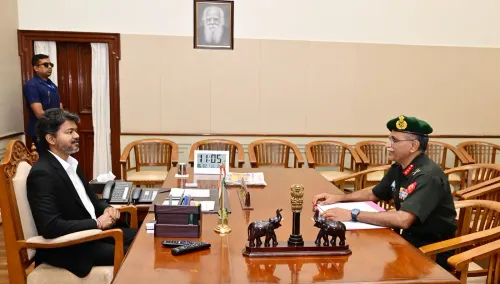
TN CM Joseph Vijay meets Coast Guard Eastern Region chief
Synopsis
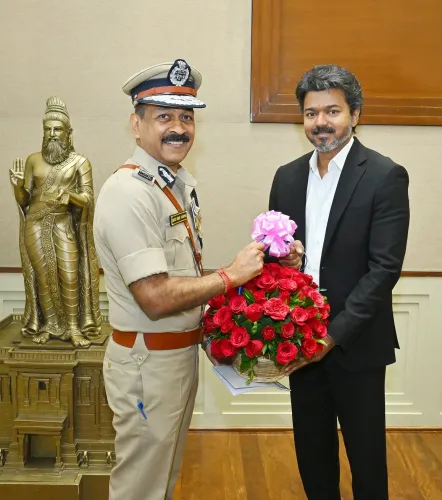
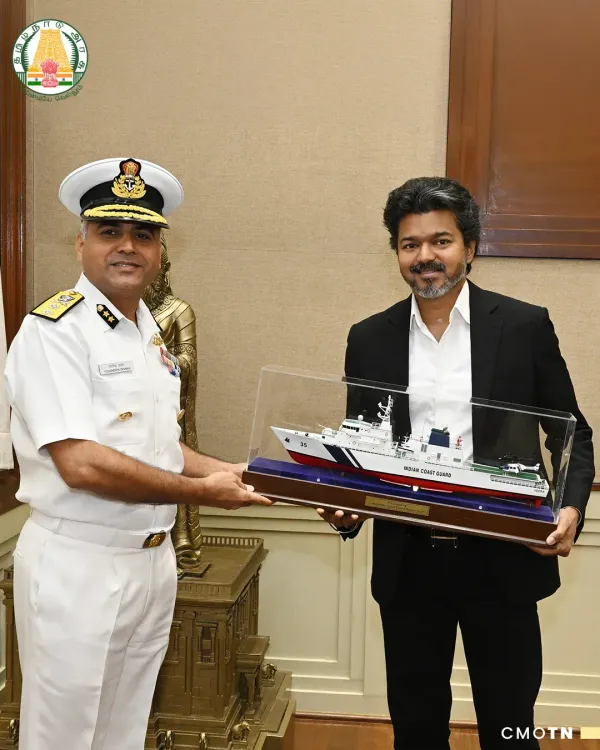
Tamil Nadu Chief Minister C. Joseph Vijay on 8 July 2026 received Inspector General Yoginder Dhaka, Commander of the Indian Coast Guard's Eastern Region, at the Chennai Secretariat. The meeting reflects ongoing centre-state coordination on maritime security along Tamil Nadu's 1,076 km coastline.
Key Takeaways
Joseph Vijay met Inspector General Yoginder Dhaka, TM of the Indian Coast Guard's Eastern Region on 8 July 2026 .
The meeting was held at the Chief Secretariat, Chennai and was announced by the official Tamil Nadu CMO account on X.
Tamil Nadu has a coastline of approximately 1,076 km , falling within the Coast Guard's Eastern Region operational jurisdiction.
Key maritime concerns in the region include Palk Bay fishermen's safety, anti-smuggling operations, and cross-border incidents near Sri Lanka .
India expanded its coastal security framework after the 2008 Mumbai attacks through the National Maritime Domain Awareness project.
No specific outcomes or agenda items were disclosed in the official post.
The Chief Minister's Office of Tamil Nadu announced on 8 July 2026 that Chief Minister C. Joseph Vijay met Inspector General Yoginder Dhaka, TM, Commander of the Indian Coast Guard's Eastern Region, at the Secretariat in Chennai. The meeting marks a formal centre-state interaction on maritime security coordination along Tamil Nadu's extensive coastline.
Context
The CMO's post, written in Tamil, states that Inspector General Dhaka called on Chief Minister Vijay at the Thalaimai Chelvalagam (Chief Secretariat) on 8 July 2026. No agenda was formally disclosed in the post, but such meetings between state chief executives and Coast Guard regional commanders are a standard feature of centre-state maritime governance.
Tamil Nadu's coastline stretches approximately 1,076 km, placing it squarely within the Indian Coast Guard's Eastern Region operational area. The region oversees waters spanning the Palk Bay, the Gulf of Mannar, and the broader Bay of Bengal.
Policy Backdrop
India significantly expanded its coastal security architecture following the 2008 Mumbai attacks, with the National Maritime Domain Awareness project bolstering the Coast Guard's surveillance and response capabilities along the eastern seaboard. Tamil Nadu, given its proximity to Sri Lanka and the sensitivities of the Palk Strait, has been a focal point of this expanded mandate.
The Indian Coast Guard operates under the Ministry of Defence and is responsible for maritime law enforcement, search-and-rescue operations, anti-smuggling patrols, and protection of marine resources within India's territorial waters and Exclusive Economic Zone. Coordination with state governments is essential for implementing national maritime policy at the local level, particularly on issues such as fishermen's safety and cross-border incidents.
Stakeholders and Impact
Tamil Nadu's coastal fishing community — among the largest in India — is directly affected by the operational priorities that emerge from such meetings. Issues including the safety of Indian fishermen venturing near the international maritime boundary, anti-poaching enforcement, and disaster preparedness in cyclone-prone coastal districts all fall within the ambit of Coast Guard-state coordination.
Maritime security agencies at both the central and state level stand to benefit from improved joint protocols, particularly for patrolling the Palk Bay and Gulf of Mannar, where illegal fishing and cross-border movement have historically posed challenges.
What's Next
Observers of Tamil Nadu's maritime affairs will watch for any follow-up announcements regarding new Coast Guard stations, expanded joint patrolling agreements, or resource allocations for coastal districts. Such meetings frequently precede operational decisions on infrastructure or inter-agency protocols, though no specific outcomes have been confirmed at this stage.
The broader pattern of chief ministers engaging directly with regional Coast Guard commanders suggests that Tamil Nadu is actively engaging with the federal security apparatus to address the unique challenges of its long and strategically sensitive coastline.
Frequently Asked Questions
Why did Tamil Nadu CM Joseph Vijay meet the Coast Guard commander?
Chief Minister C. Joseph Vijay met Inspector General Yoginder Dhaka of the Indian Coast Guard's Eastern Region on 8 July 2026 at the Chennai Secretariat. Such meetings are a standard part of centre-state coordination on maritime security, fishermen's safety, and coastal law enforcement.
Who is Inspector General Yoginder Dhaka?
Inspector General Yoginder Dhaka, TM, is the Eastern Region Commander of the Indian Coast Guard, the central agency responsible for maritime law enforcement and search-and-rescue in India's territorial waters and Exclusive Economic Zone.
What does the Indian Coast Guard Eastern Region cover?
The Indian Coast Guard's Eastern Region covers the Bay of Bengal coastline, including Tamil Nadu's approximately 1,076 km coast, the Palk Bay, and the Gulf of Mannar, overseeing anti-poaching, anti-smuggling, and disaster response operations.
What are the key maritime security issues in Tamil Nadu?
Tamil Nadu's key maritime concerns include the safety of fishermen in the Palk Bay near the India-Sri Lanka maritime boundary, illegal fishing, cross-border smuggling, and disaster preparedness along its cyclone-prone coastline.
What was decided in the Tamil Nadu CM and Coast Guard meeting?
No specific decisions or agenda items were disclosed in the official announcement from the Chief Minister's Office. Follow-up statements from the state government or Coast Guard would be needed for details on any outcomes.