Tamil Nadu petrol pump dealers threaten to halt UPI payments over account freezes
Synopsis
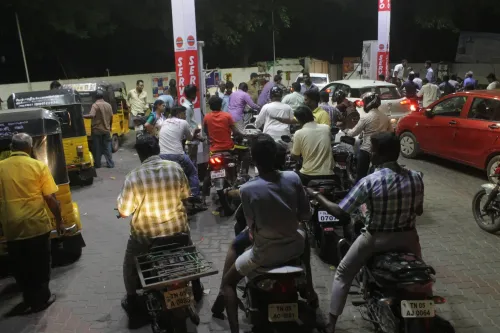
Tamil Nadu's 5,000 petrol pump dealers are threatening to pull the plug on UPI and digital payments — not because they oppose cashless transactions, but because accepting them is getting their bank accounts frozen and landing them in police stations. The TNPDA's letter to CM Vijay exposes a systemic gap: high-volume merchants have no way to screen whether incoming payments carry a cybercrime taint, yet they bear the full legal and financial consequences when investigators come knocking.
Key Takeaways
The Tamil Nadu Petroleum Dealers Association (TNPDA) , representing around 5,000 fuel outlets, has threatened to discontinue UPI and digital payment facilities statewide.
The association has written to Chief Minister C.
Joseph Vijay seeking urgent intervention over bank account freezes and police action.
An average petrol station in Tamil Nadu processes 200–500 digital transactions daily; at some outlets, cashless payments exceed 50% of revenue.
TNPDA president K.P.
Murali said dealers are being drawn into cybercrime probes despite having no role beyond receiving legitimate customer payments.
Dealers allege they have been summoned for questioning in early morning hours without clear details of the disputed transaction.
Without a protective framework for innocent merchants, the association warns Tamil Nadu's fuel sector may fully revert to cash transactions.
Petrol pump operators across Tamil Nadu have threatened to stop accepting UPI and other digital payments, citing a surge in bank account freezes and police action triggered by transactions later linked to cybercrime investigations. The warning, issued by the Tamil Nadu Petroleum Dealers Association (TNPDA), which represents around 5,000 fuel outlets across the state, has been escalated to Chief Minister C. Joseph Vijay through a formal letter seeking urgent intervention.
What the Association Has Demanded
TNPDA president K.P. Murali wrote to the Chief Minister stating that fuel dealers are being drawn into cybercrime investigations despite having no role beyond receiving legitimate payments from customers purchasing petrol or diesel. The association has urged the state government to establish clear safeguards ensuring that bonafide merchants are not subjected to sweeping account freezes or coercive police action over transactions that are entirely outside their control.
How the Problem Unfolds
According to the association, the issue arises when a payment received by a petrol pump is subsequently flagged during a cybercrime probe. Banks, acting on instructions from investigating authorities, may place a lien on the disputed amount or, in some cases, freeze the dealer's entire bank account. Dealers argue that such blanket freezes on operational accounts — over individual disputed transactions — can cripple businesses that process between 200 and 500 digital payments daily. At some outlets, UPI and other cashless modes account for more than half of total revenue.
Fuel outlets depend on continuous banking access to purchase stock, pay staff, and meet routine operational costs. A freeze, even if temporary, can cascade into supply disruptions and payroll defaults.
Concerns Over Police Conduct
The TNPDA has also flagged instances in which petrol pump operators were summoned for questioning during early morning hours without being initially provided clear details about the disputed transaction under investigation. The association maintained that dealers should not be treated as suspects merely for accepting payments through authorised digital channels. It described such conduct as disproportionate and damaging to the credibility of India's broader push toward a cashless economy.
The Structural Gap at the Heart of the Issue
Central to the dealers' grievance is a systemic blind spot: petrol pumps have no mechanism to verify whether money transferred through UPI or other platforms has previously passed through an account connected to an alleged cyber fraud. This is not unique to Tamil Nadu — fuel retailers across India operate under the same constraint, accepting payments in real time with no access to the fraud-flagging infrastructure available to banks and law enforcement. Notably, this concern comes at a time when India's digital payments ecosystem is processing record volumes, making incidental exposure to tainted funds statistically inevitable for high-throughput merchants.
What Happens Next
The association has warned that unless a workable mechanism is introduced — one that distinguishes between complicit actors and innocent merchants caught in the payment trail — petrol pumps across Tamil Nadu may revert entirely to cash-based transactions. Such a rollback would undercut the state's digital payment adoption, which has grown significantly in the fuel retail segment. The ball is now in the Tamil Nadu government's court to coordinate with banks, the Reserve Bank of India (RBI), and law enforcement to craft a framework that protects legitimate commerce without shielding bad actors.
Point of View
Yet neither the RBI's merchant protection guidelines nor state police SOPs have caught up. If Tamil Nadu's government does not act, and dealers do revert to cash, it will be a visible and embarrassing step backward for a state that has championed digital financial inclusion. The real fix requires coordination between banks, the RBI, and police — not just a reassuring letter from the Chief Minister's office.
NationPress
12 Aug 2026
Frequently Asked Questions
Why are Tamil Nadu petrol pump dealers threatening to stop UPI payments?
Dealers are threatening to halt UPI and digital payments because transactions they receive are later being linked to cybercrime complaints, resulting in bank account freezes and police summons. The Tamil Nadu Petroleum Dealers Association says dealers have no means to screen incoming payments for prior fraud links and should not bear legal consequences for transactions beyond their control.
What is the TNPDA and how many fuel outlets does it represent?
The Tamil Nadu Petroleum Dealers Association (TNPDA) is the representative body for petrol pump operators in Tamil Nadu. It represents around 5,000 fuel outlets across the state and has formally written to Chief Minister C. Joseph Vijay seeking government intervention.
How do bank account freezes affect petrol pump operations?
When a bank freezes a dealer's operational account — even over a single disputed transaction — the outlet loses access to funds needed to purchase fuel stock, pay employees, and meet daily expenses. Given that some outlets process over 500 digital transactions a day, the risk of a freeze is not negligible and can cause immediate business disruption.
What safeguards has the TNPDA asked the government to introduce?
The association has urged the Tamil Nadu government to establish a framework that prevents blanket account freezes on legitimate merchants and stops coercive or unexplained police action against dealers for transactions they did not initiate. It wants a mechanism that distinguishes innocent merchants from actual cybercrime suspects.
What happens if petrol pumps stop accepting UPI in Tamil Nadu?
A statewide rollback to cash-only transactions at fuel outlets would significantly disrupt daily commuters and businesses that rely on cashless convenience, and would undercut Tamil Nadu's digital payment adoption in a high-volume retail segment. It would also signal a broader failure of policy coordination between law enforcement, banks, and the RBI on merchant protection.