Will TN's Thoothukudi Salt, Authoor Poovan Banana, and Villiseri Lemon Receive GI Tag?
Synopsis
Three cherished agricultural products from Thoothukudi, Tamil Nadu, are vying for Geographical Indication status. This potential recognition not only seeks legal protection but also aims to preserve age-old practices and boost market visibility. Discover how these products are rooted in tradition and contribute to local heritage.
Key Takeaways
Thoothukudi salt is produced using traditional solar evaporation methods.
Authoor Poovan banana is celebrated for its unique taste due to mineral-rich irrigation.
Villiseri lemon is valued for its robust aroma and extended shelf life.
Applications for GI tags aim to protect and promote regional products.
The GI tag could significantly enhance market visibility for these products.
Chennai, Dec 17 (NationPress) The producers of three legendary agricultural products hailing from Thoothukudi district in Tamil Nadu—Thoothukudi salt, Authoor Poovan banana, and Villiseri lemon—have submitted applications for the Geographical Indication (GI) tag. This initiative aims to ensure legal protection, safeguard traditional methodologies, and enhance the visibility of these regional products in the marketplace.
The applications were supported by the National Bank for Agriculture and Rural Development (NABARD), Chennai, in collaboration with the NABARD-Madurai Agribusiness Incubation Forum (MABIF), which assisted producer groups with necessary documentation and filing processes.
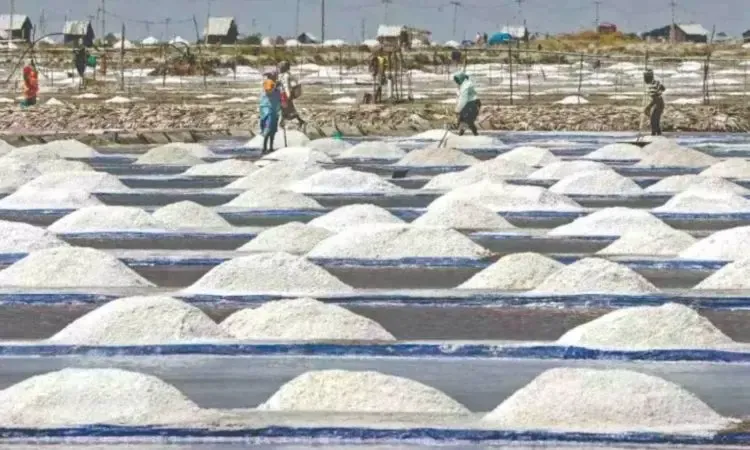
The application for Thoothukudi salt was presented by the Thoothukudi Uppu Urapathiyalargal Sangam. This salt is traditionally produced using the solar evaporation technique, where seawater or sub-soil brine is directed into expansive salt pans and evaporated under the sun's intense heat. This natural method results in large, white crystalline salt noted for its exceptional purity and quality.
Nearly 30 percent of India's total salt production comes from Thoothukudi, with approximately 25,000 to 30,000 acres of salt pans located in villages such as Vepalodai, Tharuvaikulam, Muttayapuram, and Ottapidaram. Both edible and industrial-grade salt produced in this region is distributed to households and various industries, including chemical, leather, textile dyeing, and pharmaceuticals.
Historical documentation referenced in the application underscores the deep-rooted tradition of salt production in this area.
Literary works from Tamil Sangam, such as Pattinappaalai and Puranaanuru, discuss coastal trade involving salt, pearls, and fish from the Gulf of Mannar. During the Pandya period, salt production was promoted as a revenue source for the state, and temple inscriptions from southern Tamil Nadu record taxes on salt traders.
Records from the Chola dynasty in the 11th century indicate that Tuticorin served as a significant export port, with salt shipped along with pearls and spices. European powers, including the Portuguese, Dutch, and British, later utilized Tuticorin as a strategic port for salt trade.
Reports from the British Salt Revenue in the 19th century categorized the town as a major salt production hub within the Madras Presidency.
Following India's independence, the Salt Commissioner’s Organisation officially recognized Thoothukudi as a vital salt production center, a status further solidified by the establishment of the V.O.C. Port.
The GI application for Authoor Poovan banana was submitted by the Authoor Poovan Valai Urpathiyayalargal Sangam. Grown in Authoor village and the adjacent hamlets along the Tamiraparani canal irrigation belt, this banana variety is celebrated for its unique flavor, attributed to the mineral-rich irrigation water.
The third application, presented by the Villiseri Lemon Urpathiyayalargal Sangam, seeks GI recognition for the Villiseri lemon from Kovilpatti. This traditional citrus variety is prized for its robust aroma, high juice yield, distinct acidity, minimal seeds, and naturally extended shelf life compared to other lemon types.
Point of View
The movement to secure a Geographical Indication tag for these prominent agricultural products from Thoothukudi highlights the importance of protecting regional identities and traditional practices. As we advance towards a more globalized economy, recognizing the uniqueness of local produce is essential for their sustainability and market competitiveness, reinforcing our commitment to supporting indigenous industries.
NationPress
21 Sept 2026
Frequently Asked Questions
What is a Geographical Indication (GI) tag?
A Geographical Indication (GI) tag is a sign used on products that have a specific geographical origin and possess qualities or a reputation that are due to that origin. It helps in protecting products that are unique to a region.
Why is the GI tag important for Thoothukudi salt?
The GI tag will provide legal protection to Thoothukudi salt, preserve traditional production methods, and enhance the product's visibility in the market, ensuring fair compensation for local producers.
What makes Authoor Poovan banana unique?
Authoor Poovan banana is known for its distinctive taste, attributed to the mineral-rich irrigation water from the Tamiraparani canal, setting it apart from other banana varieties.
What are the benefits of obtaining a GI tag?
Obtaining a GI tag can lead to increased market value, protection against misuse, and the promotion of local traditions and practices associated with the product.
How does the GI application process work?
The GI application process involves documentation of the product's uniqueness, historical significance, and traditional production methods. It is submitted to the relevant authorities for evaluation and approval.