Tricolour corals off Minicoy offer clues to climate resilience
Synopsis
A single underwater photograph off Minicoy has handed coral scientists a rare natural experiment: two colonies of the same species, growing side by side, yet one bleached and one thriving. CMFRI says the tricolour formation could unlock clues to thermal resilience that laboratory conditions rarely replicate — critical knowledge as warming oceans accelerate reef loss globally.
Key Takeaways
CMFRI research scholar Alvin Anto photographed a rare tricolour coral formation off Minicoy island , Lakshadweep , during a marine mammal survey.
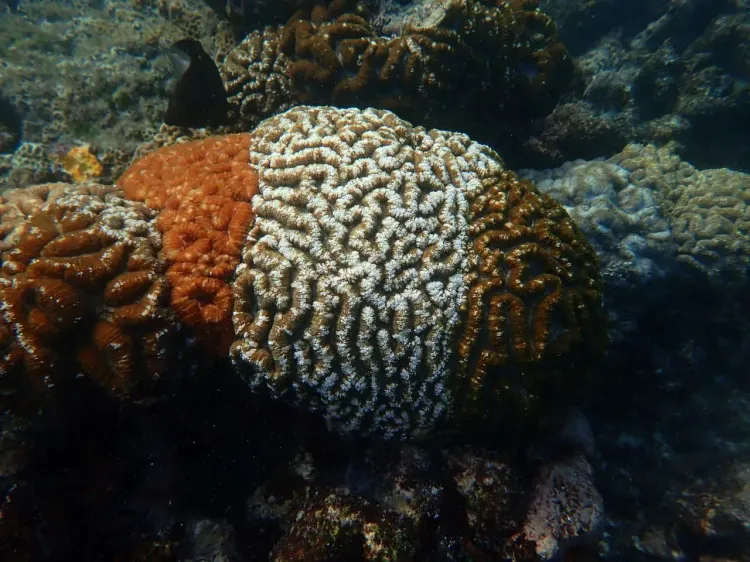
The formation includes Lobophyllia corymbosa (orange) and Lobophyllia radians (white and green), with two neighbouring L. radians colonies showing opposite responses to thermal stress.
One colony has undergone bleaching while the adjacent colony remains healthy — offering a rare natural comparison under identical environmental conditions.
CMFRI Director Dr Grinson George said the find could advance understanding of thermal stress tolerance and inform coral reef restoration efforts.
CMFRI is scaling up artificial reef deployment and sea-ranching programmes with Centre support to build climate-resilient marine ecosystems.
A rare underwater formation of orange, white, and green corals photographed off Minicoy island in Lakshadweep is giving scientists at the ICAR-Central Marine Fisheries Research Institute (CMFRI) fresh insight into why some coral colonies withstand rising sea temperatures while others do not. The sighting, captured during a marine mammal survey, has been described by researchers as a natural experiment in thermal stress tolerance.
What Was Spotted
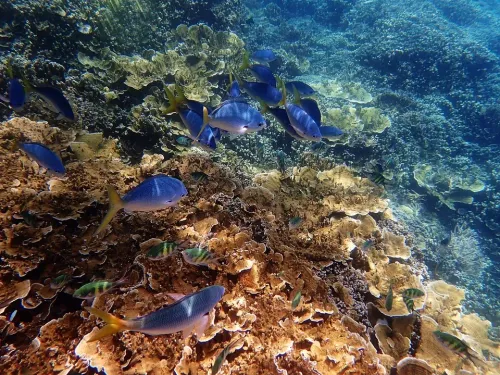
The formation was photographed by CMFRI research scholar Alvin Anto and features two distinct species: Lobophyllia corymbosa, displaying vibrant orange hues, and Lobophyllia radians, appearing in both white and green. What has particularly drawn scientific attention is the contrasting condition of two neighbouring colonies of L. radians growing virtually side by side. One colony has undergone bleaching — having lost its symbiotic algae — while the other remains visibly healthy and green despite experiencing identical environmental conditions.
Why This Matters for Coral Science
Coral bleaching occurs when environmental stress, chiefly elevated sea temperatures, forces corals to expel their symbiotic algae. These algae provide corals with the bulk of their energy and pigmentation. Prolonged bleaching can ultimately lead to coral death, making bleaching events one of the most visible markers of climate-driven marine degradation.
The Minicoy observation is significant precisely because it presents a natural side-by-side comparison of the same species responding differently to the same stressor — a scenario that is difficult to replicate under controlled laboratory conditions. Researchers say this could yield valuable data on the genetic or physiological traits that confer thermal resilience in certain coral colonies.
What CMFRI Scientists Said
CMFRI Director Dr Grinson George said the formation carries meaning beyond its visual appeal. 'This is not merely a symbol of India's rich marine biodiversity. It tells the story of both resilience and vulnerability to climate stress,' he said. Dr George added that the contrasting response of the two neighbouring colonies could provide valuable insights into thermal stress tolerance, with potential applications in coral reef restoration and climate adaptation research.
CMFRI's Broader Conservation Push
The institute is simultaneously scaling up efforts to strengthen marine ecosystems against climate pressures. With support from the Centre, CMFRI is expanding artificial reef deployment along coastal waters to revive degraded habitats, enhance biodiversity, and support artisanal fishing communities. Parallel programmes on fish breeding, seed production, and sea-ranching are also under way to replenish depleted marine resources.
According to Dr George, restoring natural habitats through artificial reefs can contribute to building more climate-resilient marine ecosystems over the long term. The colourful assemblage off Minicoy has, in that sense, delivered something more enduring than a striking photograph — a natural clue that could shape how scientists approach coral conservation as warming seas put reef systems under accelerating pressure.
Point of View
Yet systematic in-situ observation of resilient colonies remains underfunded. CMFRI's artificial reef and sea-ranching programmes are necessary, but without a parallel investment in mapping and protecting naturally heat-tolerant coral genotypes, restoration efforts risk rebuilding with the same vulnerable stock. The tricolour formation off Minicoy is a data point; the question is whether Indian marine science has the institutional bandwidth to follow it through.
NationPress
28 Sept 2026
Frequently Asked Questions
What did CMFRI researchers discover off Minicoy in Lakshadweep?
Researchers at the ICAR-Central Marine Fisheries Research Institute photographed a rare formation of orange, white, and green corals growing together off Minicoy island in Lakshadweep. The find is significant because two neighbouring colonies of the same species, Lobophyllia radians, showed opposite responses to thermal stress — one bleached, one healthy.
What is coral bleaching and why is it a concern?
Coral bleaching occurs when elevated sea temperatures or other environmental stressors cause corals to expel their symbiotic algae, stripping them of colour and energy. Prolonged bleaching can lead to coral death, making it one of the most serious consequences of climate-driven ocean warming.
Why is the Minicoy coral observation scientifically important?
The observation presents a natural side-by-side comparison of two colonies of the same coral species responding differently to identical environmental conditions. This is difficult to replicate in laboratory settings and could help scientists identify the traits that confer thermal resilience, with direct applications in reef restoration.
What is CMFRI doing to protect coral reefs?
CMFRI is scaling up artificial reef deployment along India's coastal waters with support from the Centre to revive degraded marine habitats and support artisanal fishing communities. The institute is also running fish breeding, seed production, and sea-ranching programmes to replenish depleted marine resources.
Who photographed the tricolour coral formation?
The formation was photographed by Alvin Anto, a research scholar at CMFRI, during a marine mammal survey off Minicoy island in Lakshadweep.