UN climate chief hails India's solar rise, urges deeper clean energy push
Synopsis
The world's top UN climate official landed in New Delhi with a pointed message: India's solar rise is already historic — a 75-fold manufacturing surge since 2014 and $18 billion saved in fossil fuel costs last year — but the real opportunity lies ahead. With India importing 90 per cent of its crude oil, Stiell's push for deeper electrification is as much a national security argument as a climate one.
Key Takeaways
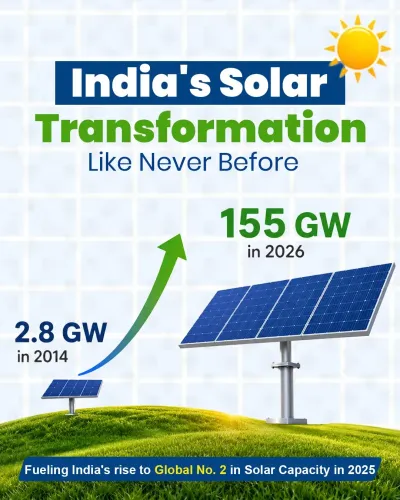
UN Climate Change Executive Secretary Simon Stiell visited New Delhi on 21 July , praising India's clean energy progress as 'truly extraordinary.' India's solar manufacturing capacity has grown 75-fold since 2014 ; IRENA ranks India the most competitive solar market globally on generation cost.
Renewables saved India an estimated $18 billion in fossil fuel purchases last year alone.
Stiell met Environment Minister Bhupender Yadav ; talks covered adaptation, climate finance, technology transfer, and just transition.
Developed countries must deliver $300 billion a year by 2035 in climate finance, on a pathway to $1.3 trillion annually , Stiell said.
India imports 90 per cent of its crude oil, making energy independence a central strategic argument for the clean energy push.
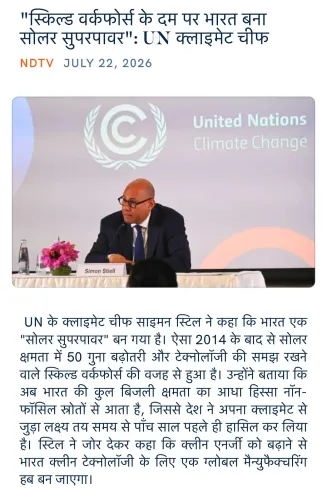
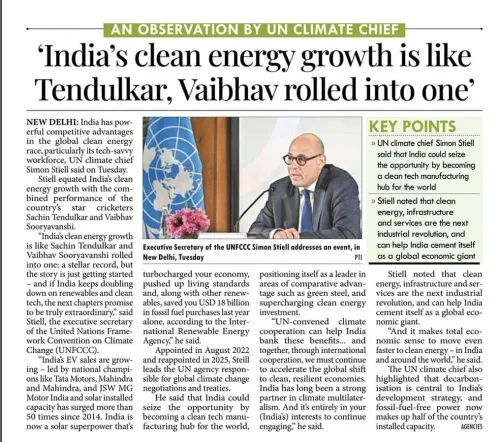
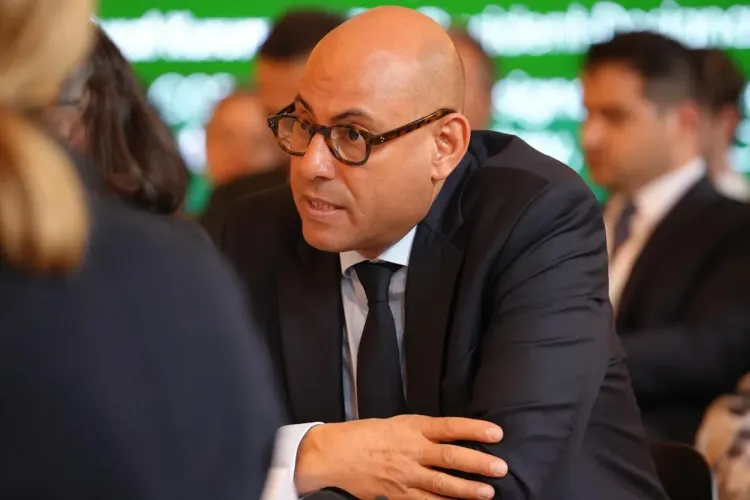
UN Climate Change Executive Secretary Simon Stiell on Tuesday, 21 July praised India's clean energy trajectory as one of the most consequential in the world, saying that if India continues to double down on renewables and clean technology, 'the next chapters promise to be truly extraordinary.' Speaking to the media in New Delhi, Stiell described India as a solar superpower with vast untapped economic and developmental opportunities in the global clean-tech race.
Key Remarks by Stiell
Stiell, who is the top official at UN Climate Change, drew a vivid analogy to frame India's position — comparing the country's clean energy growth to the cricketing arcs of Sachin Tendulkar and Vaibhav Sooryavanshi: a stellar record already in place, but with the most exciting chapters still ahead. The UN climate chief, who hails from the cricket-loving Caribbean, said a constant theme ran through his two days of meetings with ministers and business leaders: 'Climate action is game-changing for India, its economy and its people.'
He noted that India has long been a strong partner in climate multilateralism and argued it is firmly in the country's own interest to remain engaged. 'Almost 80 years since India won its Independence, this nation has the chance to achieve full energy independence, and lock in a next generation of economic might,' he said.
Meeting with Environment Minister Yadav
A day before his media address, Stiell called on Union Environment, Forest and Climate Change Minister Bhupender Yadav. According to a post on social media by Yadav, the discussions covered adaptation, technology transfer, climate finance, global stocktake, and just transition. Yadav noted that under Prime Minister Narendra Modi, India has not only submitted its enhanced Nationally Determined Contributions (NDCs) but also achieved them well ahead of the stipulated timeline.
India's Solar and Renewables Record
Citing an International Renewable Energy Agency (IRENA) report, Stiell highlighted that India's solar manufacturing capacity has increased 75-fold since 2014. New IRENA data shows India is currently the most competitive solar market in the world on generation cost, producing cheaper power than any other major economy. Renewables, he added, saved India an estimated $18 billion in fossil fuel purchases in the previous year alone.
Stiell also pointed to the broader global picture: last year, renewables overtook coal as the world's top electricity source, and over $2 trillion was invested in clean energy globally. 'Clean energy, infrastructure and services are the next industrial revolution,' he said.
Climate Finance and COP31 Targets
On international climate finance, Stiell was unequivocal: all commitments must be honoured in full. He called on developed countries to triple adaptation finance and deliver $300 billion a year by 2035, as part of a pathway to $1.3 trillion a year. He also noted that the UN carbon market has been recently operationalised, which he said could provide significant new funds for developing economies.
Referencing the upcoming COP31 in Turkey, Stiell said the presidency has set an Action Agenda target of raising the share of final energy demand met by electricity to 35 per cent by 2035. He described this electrification focus as a clear opportunity for India, pointing specifically to initiatives such as Delhi's new EV policy and the country's advances in electricity access and clean cooking.
Fossil Fuel Vulnerability and the Case for Energy Independence
Stiell was direct about the risks of continued fossil fuel dependence, noting that ongoing conflict in the Middle East has driven volatile costs for importing nations. India, he pointed out, imports 90 per cent of its crude oil, making it acutely exposed to supply disruptions and price shocks. 'Every step towards electrification means greater autonomy — helping to free India from volatile international energy markets, spiralling costs, and the whims of foreign powers waging unpredictable wars,' he said.
As India deepens its clean energy ambitions, Stiell's visit underscores the growing international expectation that New Delhi will not merely meet its climate targets but actively shape the terms of the global energy transition.
Point of View
And the praise is calibrated accordingly. The $18 billion fossil fuel savings figure and the 75-fold solar manufacturing surge are genuinely impressive, but India still imports 90 per cent of its crude oil, a structural vulnerability that clean energy rhetoric alone cannot resolve. The COP31 electrification targets are ambitious, but developed-country climate finance commitments have historically lagged pledges — and Stiell's call for $300 billion a year by 2035 is a demand that has been made, in various forms, for years without full delivery. The real test for India is whether its solar superpower status translates into reduced import dependency and industrial jobs, not just headline capacity numbers.
NationPress
20 Oct 2026
Frequently Asked Questions
What did UN Climate Change Executive Secretary Simon Stiell say about India?
Stiell praised India as a solar superpower, saying its clean energy growth is extraordinary and that continuing to invest in renewables and clean technology could make the next chapters 'truly extraordinary.' He cited IRENA data showing India is the world's most competitive solar market on generation cost and that solar manufacturing capacity has risen 75-fold since 2014.
How much did India save on fossil fuel imports through renewables?
According to an IRENA report cited by Stiell, India saved an estimated $18 billion in fossil fuel purchases last year through renewables. India currently imports 90 per cent of its crude oil, making this saving strategically significant.
What was discussed in the meeting between Stiell and Minister Bhupender Yadav?
According to a social media post by Environment Minister Bhupender Yadav, the discussions focused on adaptation, technology transfer, climate finance, global stocktake, and just transition. Yadav also noted that India has achieved its enhanced NDCs ahead of schedule under Prime Minister Narendra Modi.
What are the COP31 electrification targets mentioned by Stiell?
The COP31 Turkish presidency has set an Action Agenda target of raising the share of final energy demand met by electricity to 35 per cent by 2035. Stiell described this as a direct opportunity for India to build on its advances in electricity access, clean cooking, and transport electrification.
What did Stiell say about international climate finance?
Stiell called on developed countries to triple adaptation finance and deliver $300 billion a year by 2035, as part of a pathway to $1.3 trillion annually. He said all commitments must be honoured in full and noted that the UN carbon market has been recently operationalised to channel new funds to developing economies.