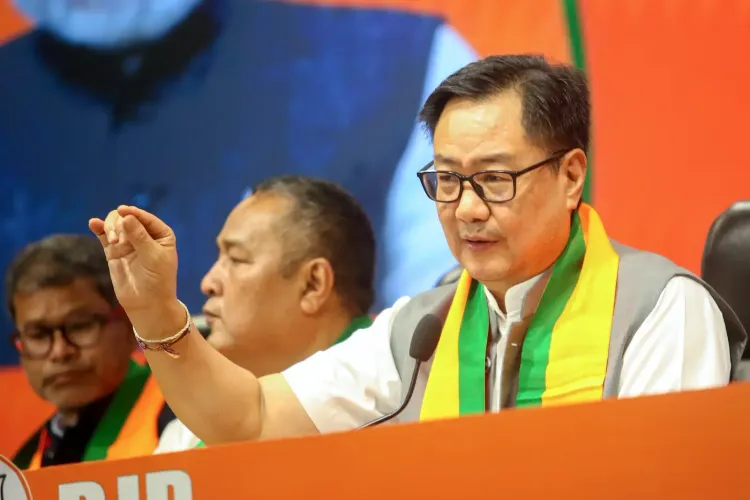
Rijiju poses 4 questions to Congress, demands apology for 1962 war defeat
Synopsis
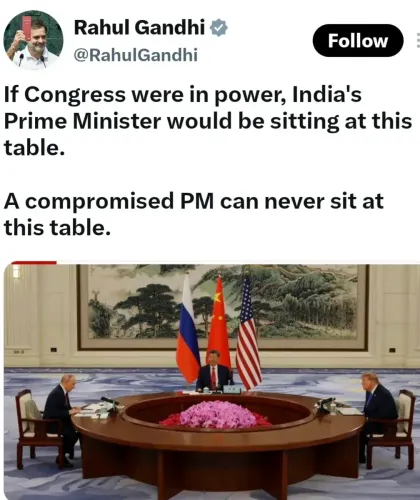
Union Minister Kiren Rijiju turned a foreign-policy spat into a history lesson — demanding Congress apologise for the 1962 war defeat and explain why India was once called the 'land of snake charmers.' The trigger: Rahul Gandhi's claim that a 'compromised PM' cost India a seat at the Trump-Xi-Putin table at APEC.
Key Takeaways
Union Minister Kiren Rijiju posted four questions to the Congress on X on Saturday, 21 November .
Rijiju demanded Congress apologise for the 1962 India-China war , noting his own village was occupied by China.
He also questioned why Congress 'kept India a poor nation' and why India was labelled the 'land of snake charmers' and its economy the 'Hindu rate of growth.' The remarks followed LoP Rahul Gandhi's post on X alleging that a 'compromised PM' cost India a seat at a trilateral Trump-Xi-Putin meeting at the APEC summit .
Rijiju separately accused Gandhi of 'colluding with foreign-based anti-India forces' and spreading 'falsehoods' about India's democracy and economy.
Union Minister Kiren Rijiju on Saturday, 21 November escalated his party's offensive against the Indian National Congress (INC), posting four pointed questions on X and demanding that the opposition party account for what he called the '1962 war humiliation', India's prolonged poverty, and the country's historically diminished global image. The remarks followed a sharp exchange triggered by Leader of Opposition (LoP) Rahul Gandhi's criticism of Prime Minister Narendra Modi over a high-profile trilateral meeting on the sidelines of the Asia-Pacific Economic Cooperation (APEC) summit.
The Four Questions Rijiju Raised
In his post on X, Rijiju listed four questions directed squarely at the Congress. First, he demanded to know whether the party would apologise for the 1962 India-China war, adding a personal dimension: 'My village was occupied by China in 1962. Will Congress apologise for the 1962 humiliation?' Second, he asked why the Congress had 'kept India a poor nation.' Third, he sought an explanation for why India was internationally described as the 'land of snake charmers' during the Congress era. Fourth, he questioned why India's economic trajectory was labelled the 'Hindu rate of growth' — a term historically used to describe the sluggish pre-liberalisation growth rate.
What Triggered the Remarks
The immediate provocation was a post by LoP Rahul Gandhi on X, in which Gandhi criticised Modi over a trilateral meeting involving US President Donald Trump, Chinese President Xi Jinping, and Russian President Vladimir Putin on the sidelines of the APEC summit in China on Thursday. Gandhi alleged that India was absent from a table where it should have been represented. 'If Congress were in power, India's Prime Minister would be sitting at this table. A compromised PM can never sit at this table,' Gandhi wrote.
Rijiju's Broader Allegations Against Gandhi
Speaking to reporters on Friday, Rijiju broadened his criticism beyond the APEC episode. He accused Gandhi of making statements that damage India's image both domestically and during his visits abroad, and alleged that the LoP was 'colluding with foreign-based anti-India forces' and spreading what he termed 'falsehoods' about India's democracy and economy. 'It is also possible that anti-India forces abroad and across the world keep provoking him. He has himself developed an anti-India mindset, focussing on how to undermine India, its civilisation, traditions, democracy and the Constitution. Rahul Gandhi has already opened a front against these institutions,' Rijiju alleged. The Congress has not publicly responded to these specific charges as of the time of reporting.
Context and Political Stakes
This comes amid a sustained pattern of verbal confrontations between the ruling Bharatiya Janata Party (BJP) and the Congress over foreign policy optics and national security narratives. The 1962 India-China war — fought under a Congress government led by then-Prime Minister Jawaharlal Nehru — remains a politically charged reference point that the BJP has repeatedly invoked. Rijiju, who represents Arunachal Pradesh, a state that borders China and whose territorial integrity has been a subject of ongoing diplomatic tension, carries particular personal weight when invoking the 1962 conflict. Notably, this is not the first time Rijiju has publicly challenged the Congress on the 1962 war or on Gandhi's overseas statements — making it a recurring axis of the BJP's opposition strategy ahead of state elections.
With both sides escalating their rhetoric on foreign policy credibility, the exchange is likely to intensify as Parliament's winter session approaches.
Point of View
And Rijiju's personal connection to Arunachal Pradesh sharpens that edge. What mainstream coverage underplays is the structural dynamic: every time Gandhi makes a foreign-policy critique, the BJP reframes it as an attack on India rather than on the government, effectively making dissent synonymous with disloyalty. Whether that framing holds with voters outside the BJP's base — particularly in border states — is the real test this exchange sets up.
NationPress
21 Nov 2026
Frequently Asked Questions
What four questions did Kiren Rijiju pose to Congress?
Rijiju asked whether Congress would apologise for the 1962 India-China war, why Congress kept India a poor nation, why India was described as the 'land of snake charmers,' and why India's economy was labelled the 'Hindu rate of growth.' He posted all four questions on X on Saturday, 21 November.
Why did Rijiju raise the 1962 India-China war?
Rijiju stated that his own village was occupied by China during the 1962 war, giving the reference personal weight. The 1962 conflict was fought under a Congress government and remains a recurring point of criticism that the BJP deploys against the opposition on national security debates.
What did Rahul Gandhi say about PM Modi at APEC that triggered the row?
Gandhi posted on X that India's Prime Minister was absent from a trilateral meeting involving US President Trump, Chinese President Xi Jinping, and Russian President Putin on the sidelines of the APEC summit in China. He alleged that 'a compromised PM can never sit at this table' and claimed India would have been represented had Congress been in power.
What allegations did Rijiju make against Rahul Gandhi beyond the APEC remarks?
Speaking to reporters on Friday, Rijiju accused Gandhi of colluding with 'foreign-based anti-India forces' and spreading falsehoods about India's democracy and economy. He alleged that Gandhi had 'developed an anti-India mindset' and was undermining India's civilisation, traditions, and Constitution.
Has Congress responded to Rijiju's questions?
As of the time of reporting, the Congress had not publicly responded to Rijiju's four specific questions or to his allegations about Gandhi colluding with anti-India forces. Gandhi's original APEC post on X remains his most recent public statement on the matter.