Uttarakhand CM Office: Solar Path Lighting Reaches Rural Villages
Synopsis
Uttarakhand's Chief Minister's Office announced on October 27, 2026, that solar-powered path lighting is now operational in rural areas of the state, with Nainital district highlighted — a move aligned with India's push for off-grid renewable energy in geographically challenging regions.
Key Takeaways
The Chief Minister's Office of Uttarakhand announced solar-powered path lighting in the state's rural areas on October 27, 2026 .
Nainital district was specifically cited as a beneficiary of the solar lighting initiative.
Uttarakhand's mountainous terrain makes decentralised solar systems particularly practical, removing the need for costly grid extension into remote hamlets.
India's Jawaharlal Nehru National Solar Mission (2010) laid the policy foundation for off-grid solar applications that state schemes like this build upon.
Solar path lighting improves safety for rural residents navigating unlit mountain paths after dark and reduces grid dependency.
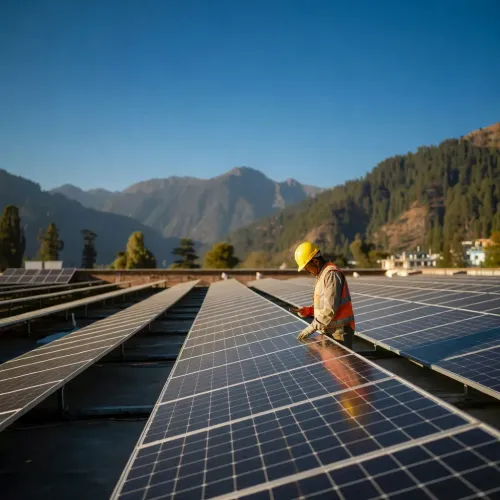
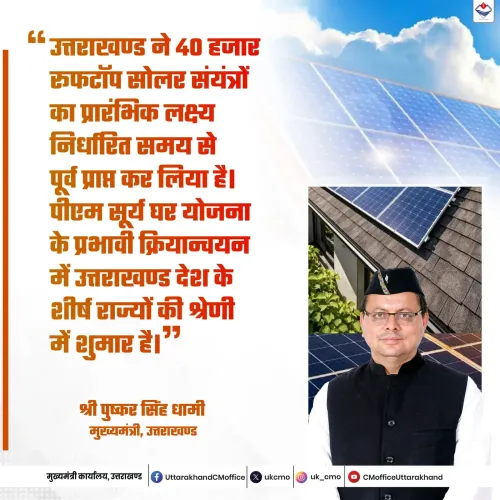
In the hills and valleys of Uttarakhand, the dark stretches between rural homes are getting a quiet makeover — powered by sunlight. The Chief Minister's Office of Uttarakhand shared on Tuesday, October 27, 2026, that solar-powered path lighting is now illuminating rural areas across the state, with Nainital district specifically highlighted as a beneficiary.
The post, shared on X, stated: 'Uttarakhand ke gramin kshetron mein saur urja se ho rahi path prakash vyavastha' — 'Solar energy is being used to provide path lighting in the rural areas of Uttarakhand.'Why Solar Makes Sense in Uttarakhand's Mountain Villages
This is not a coincidence of geography — it is a consequence of it. Uttarakhand's rugged Himalayan terrain makes extending conventional electricity grid infrastructure to remote hamlets expensive, technically difficult, and often unreliable. Decentralised solar systems sidestep those barriers entirely: no long transmission lines, no grid dependency, no outage cascades from a storm on the wrong ridge.
For hill-area residents walking narrow paths after dark — to a water source, a health post, or a neighbour's home — reliable lighting is not an amenity. It is a safety imperative. Solar path lights address that gap directly and with minimal maintenance overhead once installed.
India's Solar Push and the Himalayan Fit
The broader momentum behind this kind of initiative traces back to India's Jawaharlal Nehru National Solar Mission, launched in 2010, which prioritised off-grid and decentralised solar applications alongside utility-scale generation. States with difficult terrain — and few places in India are more topographically demanding than Uttarakhand — were natural early adopters of that off-grid philosophy.
Across India, state governments have steadily expanded solar street and path lighting in rural zones, chasing three goals simultaneously: improving personal safety after dark, cutting dependence on an often-strained grid, and ticking renewable-energy targets that come with both policy mandates and financial incentives. Uttarakhand's approach fits squarely inside that national pattern.
Nainital District in Focus
Nainital is better known internationally as a hill-station tourism destination, but the district extends well beyond its famous lake town into sparsely populated rural belts where infrastructure gaps are pronounced. Flagging Nainital in this context signals that the solar lighting effort is not confined to the state's urban or peri-urban pockets — it is reaching into areas where the need is arguably greatest.
The specifics of scale, coverage, and timelines remain to be officially documented. But the direction of travel is clear: Uttarakhand is betting on the sun to keep its mountain paths lit — and that bet gets stronger every year solar costs fall.
Point of View
Not optics. Nationally, this fits a pattern of Himalayan states using solar off-grid solutions to leapfrog conventional infrastructure, a model with implications for similar terrain in Himachal Pradesh and Arunachal Pradesh. The longer-term test will be maintenance continuity — solar installations in remote areas often shine at launch and fade without sustained upkeep budgets.
NationPress
28 Oct 2026
Frequently Asked Questions
What is the solar path lighting project in Uttarakhand rural areas?
The Uttarakhand government is installing solar-powered lights along paths in rural areas of the state, including Nainital district, to improve safety and reduce dependence on the conventional electricity grid in remote locations.
Why is solar energy used for lighting in Uttarakhand villages?
Uttarakhand's mountainous terrain makes it difficult and expensive to extend grid electricity to remote hamlets, making decentralised solar lighting systems a practical and cost-effective alternative.
Which district of Uttarakhand is highlighted in the solar lighting initiative?
Nainital district was specifically mentioned by the Chief Minister's Office of Uttarakhand in the October 2026 announcement about rural solar path lighting.
What national scheme supports solar lighting in Indian villages?
India's Jawaharlal Nehru National Solar Mission, launched in 2010, provides the policy and financial framework supporting off-grid and decentralised solar applications, including rural lighting, across Indian states.
How does solar path lighting benefit hill area residents in Uttarakhand?
It improves safety for residents walking unlit mountain paths at night, reduces dependency on an often-unreliable grid, and supports India's broader renewable energy targets in geographically challenging areas.