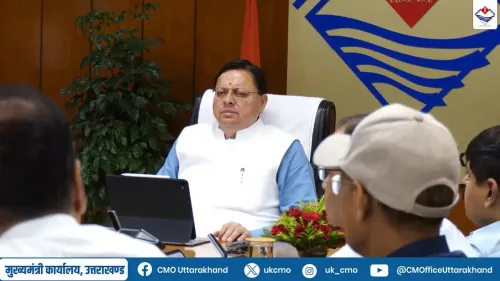
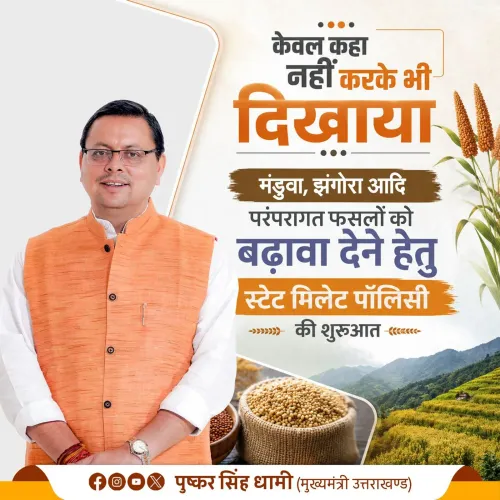
Uttarakhand CMO: Mandua farming gets a boost in Uttarkashi
Synopsis
Uttarakhand's CMO has highlighted that finger millet farming is being boosted in Uttarkashi district under the state's Millets Policy, connecting a traditional Himalayan crop to India's broader millet-promotion drive and farmer welfare goals.
Key Takeaways
The Chief Minister's Office of Uttarakhand announced on October 14, 2026 that mandua (finger millet) cultivation is being promoted in Uttarkashi district .
The push falls under Uttarakhand's formal Millets Policy , a state-level framework aligned with national and global millet-promotion goals.
Uttarkashi is a high-altitude, rainfed farming district where mandua has historically been a native, low-input crop.
India designated 2023 as the International Year of Millets , anchoring a national policy push to revive climate-resilient nutritious grains.
Mandua is high in calcium, iron, and fibre, giving the scheme both a farmer-income and a public-nutrition rationale.
Specific incentive provisions and current implementation status of the Millets Policy in Uttarkashi have not been independently verified.
In the high-altitude fields of Uttarkashi district, a centuries-old grain is making a quiet but deliberate comeback. The Chief Minister's Office of Uttarakhand announced on Wednesday, October 14, 2026, that finger millet — known locally as mandua — is receiving active promotion under the state's Millets Policy.
The CMO's post, in Hindi, stated: 'Uttarkashi janapad mein millets neeti ke tahat mandua ki kheti ko mil raha protsahan' — 'Cultivation of finger millet is receiving encouragement under the Millets Policy in Uttarkashi district.' Short, official, and pointed. Behind those few words lies a policy push with real consequences for Himalayan farming communities.
Why mandua, and why now
Mandua is a rainfed crop native to the central Himalayan belt — drought-tolerant, nutrient-rich, and well-suited to the thin soils and erratic monsoons of districts like Uttarkashi. For decades, farmers gradually abandoned it in favour of crops that appeared more commercially viable. Soil health, water tables, and dietary diversity all quietly paid the price.
The reversal gathered national momentum when India anchored its presidency of the G20 around the International Year of Millets in 2023, positioning crops like finger millet, jowar, and bajra as solutions to nutrition insecurity and climate vulnerability simultaneously. Uttarakhand's state-level Millets Policy sits within that larger arc.
Uttarkashi as a test bed for Himalayan millet revival
Uttarkashi, a district bordering China and Tibet in northern Uttarakhand, carries both ecological significance and agricultural fragility. Its terraced farms have traditionally depended on crops precisely like mandua — low-input, high-nutrition grains that ask little of the land. Several other Himalayan states have launched parallel efforts, linking millet promotion to soil conservation, reduced chemical input, and a recalibration of what 'farmer income' means across generations.
The state government's framing of this as a neeti — a formal policy — signals intent beyond symbolic gestures. A structured policy framework typically implies procurement support, seed distribution, or direct incentives for cultivating farmers, though specific provisions and current rollout status in Uttarkashi have not been independently verified.
What Uttarkashi's farmers stand to gain
For smallholder and marginal farmers in the district, the stakes are practical: a reliable market signal for a crop they can already grow without expensive inputs. If the Millets Policy delivers on procurement and pricing, mandua fields that were gradually replaced by less suitable alternatives could return — bringing with them a more resilient agricultural ecosystem for one of Uttarakhand's most geographically demanding districts.
The crop's nutritional profile — high in calcium, iron, and dietary fibre — also connects the farm-level push to national public health priorities, giving the state a dual-purpose argument for sustaining the investment.
From terraced fields to state policy frameworks, the journey of mandua in Uttarkashi is really a test of whether India's millet moment translates into lasting change on the ground — or fades as quickly as the last harvest season.
Point of View
Formalising millet support through policy is a signal to small farmers that traditional crops have a commercial future. The real test, however, lies in whether procurement mechanisms and price incentives follow the announcement — because without a reliable market, policy declarations alone rarely change what a farmer plants. Watched across the Himalayan belt, Uttarkashi's experience could inform how other mountain districts calibrate the transition from subsistence to incentivised millet farming.
NationPress
14 Oct 2026
Frequently Asked Questions
What is mandua and why is it important in Uttarakhand?
Mandua, or finger millet, is a traditional rainfed grain grown across Uttarakhand's hill districts. It is drought-tolerant, rich in calcium and iron, and well-suited to the thin soils and variable rainfall of Himalayan terrain, making it central to both farmer livelihoods and local nutrition.
What is Uttarakhand's Millets Policy?
Uttarakhand's Millets Policy is a state-level framework designed to encourage the cultivation and consumption of millets such as mandua. It aligns with the national push that followed India's celebration of the International Year of Millets in 2023, aiming to support farmer incomes and nutrition security.
Which district is the current focus of Uttarakhand's millet promotion?
Uttarkashi district in northern Uttarakhand is the district highlighted by the Chief Minister's Office for active promotion of mandua farming under the Millets Policy as of October 2026.
What was India's International Year of Millets?
India led the global push to designate 2023 as the International Year of Millets at the United Nations. The initiative promoted millets as climate-resilient, nutritious crops and helped anchor domestic policies — including state-level schemes like Uttarakhand's — around reviving their cultivation and consumption.
How does millet farming help Himalayan farmers?
Millet crops like mandua require fewer external inputs such as fertilisers and irrigation compared to many commercial crops, reducing costs for smallholder farmers. If backed by government procurement and pricing support, they offer a viable income source while also restoring soil health in ecologically sensitive mountain regions.