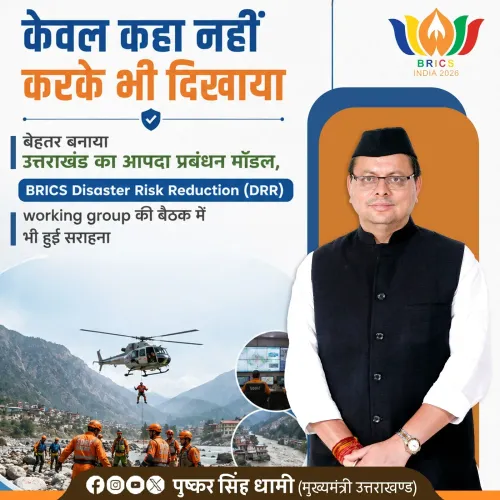
Uttarakhand's Disaster Model Shines at BRICS Forum
Synopsis
Uttarakhand's disaster management model has been presented at the BRICS platform, with the state's November 2023 Silkyara tunnel rescue — which saved 41 trapped workers after 17 days — cited as a global benchmark for specialised mountain rescue and inter-agency coordination.
Key Takeaways
The Chief Minister's Office of Uttarakhand announced on June 8, 2026 that the state's disaster management model has been showcased at the BRICS forum.
The Silkyara tunnel rescue of November 2023 — which freed 41 workers trapped for 17 days — is the centrepiece of the model being highlighted internationally.
The rescue took place in Uttarkashi district during construction under the Char Dham Pariyojana , a national highway project launched in 2016 .
BRICS platforms allow emerging economies to exchange disaster-management models outside Western multilateral frameworks, giving Indian states a direct channel for technical diplomacy.
Uttarakhand's recognition could prompt replication of its inter-agency rescue protocols in other Himalayan and landslide-prone Indian states.
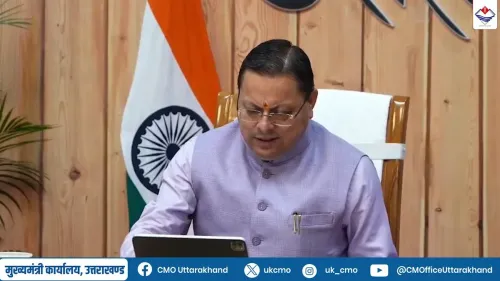
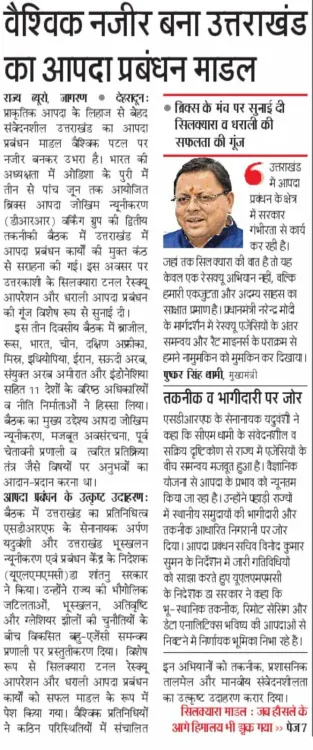
The Chief Minister's Office of Uttarakhand announced on Monday, June 8, 2026, that the state's disaster management model has received international recognition at the BRICS platform, with the landmark Silkyara tunnel rescue of November 2023 resonating at the global level.
The official post stated: 'ब्रिक्स मंच पर चमका उत्तराखण्ड का आपदा प्रबंधन मॉडल, सिल्क्यारा रेस्क्यू की गूंज अंतरराष्ट्रीय स्तर तक' — translated as: 'Uttarakhand's disaster management model shines on the BRICS platform; the echo of the Silkyara rescue reaches the international stage.'
Context
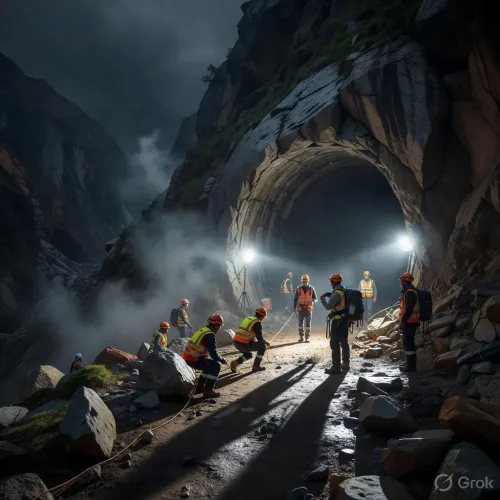
The Silkyara tunnel collapse in Uttarkashi district in November 2023 trapped 41 workers for 17 days inside a section of the Char Dham Pariyojana highway project. A multi-agency rescue operation involving specialised drilling teams, rat-hole miners, and coordinated state and national machinery eventually extracted all workers safely. The operation drew widespread attention for its complexity, improvisation under pressure, and the zero-casualty outcome. The state's presentation of this rescue at a BRICS forum marks a significant step in Uttarakhand positioning itself as a source of practical, field-tested disaster-response expertise — not merely a recipient of central assistance.Policy Backdrop
Uttarakhand is among India's most disaster-prone states, situated in the Central Himalayas and regularly exposed to landslides, flash floods, cloudbursts, and earthquakes. The Disaster Management Act, 2005 created the National Disaster Management Authority (NDMA) and mandated state-level authorities and response forces. Uttarakhand's State Disaster Response Force (SDRF) has since developed considerable operational depth through repeated high-altitude and confined-space rescue missions. The Char Dham Pariyojana, launched in 2016, accelerated four-lane highway construction through ecologically sensitive mountain terrain, raising both connectivity and infrastructure-risk profiles simultaneously. The Silkyara tunnel incident emerged directly from this construction push, making the rescue a case study in managing the risks that accompany large-scale Himalayan infrastructure development.Stakeholders and Impact
BRICS — now an expanded grouping of emerging economies — has increasingly hosted working-level exchanges on disaster risk reduction outside Western institutional frameworks such as the UN's Sendai process. Indian states presenting operational case studies at such forums signals a broader national strategy: leveraging domestic incident-response successes to build soft power and technical credibility among the Global South. For hill residents, tunnel workers, and road construction labourers across Himalayan states, the international visibility of the Silkyara model carries practical stakes. Replication of Uttarakhand's inter-agency coordination protocols in other landslide-prone or infrastructure-heavy regions could directly reduce casualty risk. Uttarakhand's SDRF and disaster management officials may also benefit from bilateral technical exchanges unlocked through BRICS-level recognition.What's Next
With India holding influence within the expanded BRICS architecture, the spotlight on Uttarakhand's model could feed into technical working-group discussions on specialised rescue, early warning systems, and inter-agency coordination frameworks. Other Himalayan states — including Himachal Pradesh, Sikkim, and Arunachal Pradesh — face structurally similar risks and could look to adapt elements of the Uttarakhand approach. The state government is expected to build on this international recognition to strengthen domestic disaster preparedness infrastructure and attract capacity-building partnerships.Point of View
BRICS-level visibility serves a dual purpose — burnishing administrative credibility ahead of electoral cycles while potentially unlocking technical and financial cooperation from fellow emerging economies. The broader implication is that India's federal units are increasingly active agents, not just passive beneficiaries, in the country's multilateral disaster-diplomacy strategy.
NationPress
24 Oct 2026
Frequently Asked Questions
What is the Silkyara tunnel rescue?
The Silkyara tunnel rescue was a November 2023 operation in Uttarkashi district, Uttarakhand, in which 41 workers trapped for 17 days inside a collapsed tunnel section of the Char Dham highway project were successfully extracted without casualties.
Why is Uttarakhand's disaster model being presented at BRICS?
Uttarakhand's multi-agency response to the Silkyara collapse is being cited as a practical, field-tested model for specialised mountain rescue and inter-agency coordination, which BRICS nations are exchanging as part of disaster risk reduction discussions.
What is BRICS and why does it matter for disaster management?
BRICS is a grouping of major emerging economies that hosts expert and ministerial meetings on topics including disaster risk reduction, offering a platform for countries to share operational models outside traditional Western-led frameworks.
What is the Char Dham Pariyojana?
The Char Dham Pariyojana is a central government infrastructure project launched in 2016 to build four-lane highways connecting four major pilgrimage sites in Uttarakhand; the Silkyara tunnel was part of this project.
What could follow from Uttarakhand's BRICS recognition?
Possible outcomes include technical working-group meetings under India's BRICS engagement, bilateral capacity-building partnerships, and adaptation of Uttarakhand's rescue protocols by other Himalayan states such as Himachal Pradesh and Sikkim.