Uttarakhand CM Office: Women's SHG Turns Gerbera Farming Into Livelihood
Synopsis
The Uttarakhand CMO spotlighted Neetu and the Pooja Self Help Group of Khatola, Udham Singh Nagar, who used government grants and bank credit under central livelihood schemes to convert Gerbera flower cultivation into a viable self-employment model for rural women.
Key Takeaways
Neetu , president of the Pooja Self Help Group in Gram Panchayat Khatola , led the Gerbera floriculture initiative.
The enterprise was financed through a combination of government grants and formal bank loans — the standard dual-channel model under NRLM.
Udham Singh Nagar's terai geography makes it well-suited for commercial floriculture, unlike Uttarakhand's mountainous districts.
The initiative aligns with the National Rural Livelihood Mission (2011) and the Mission for Integrated Development of Horticulture .
The Khatola model is viewed as replicable across other panchayats in Udham Singh Nagar district.
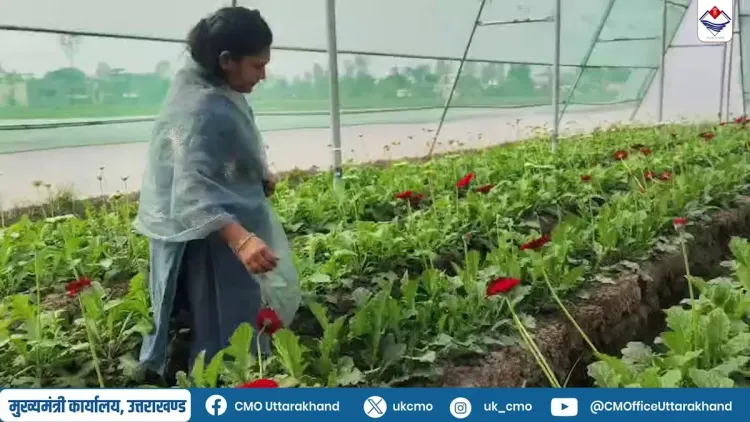
In a quiet corner of Udham Singh Nagar's terai plains, a group of women rewrote their own economic story — one Gerbera bloom at a time. The Chief Minister's Office of Uttarakhand on Tuesday, November 17, 2026 highlighted how Neetu, president of the Pooja Self Help Group in Gram Panchayat Khatola, and her fellow members leveraged government grants and bank loans to build a self-sustaining floriculture enterprise.
The post, shared by the official CMO account, noted in Hindi: 'sarkari anudan aur bank rin ki madad se Gerbera phoolon ki kheti ko banaya swarozgar ka madhyam' — 'using government grants and bank loans, Gerbera flower cultivation has been made a means of self-employment.' It is a crisp encapsulation of what rural livelihood policy can look like when it moves from paper to field.
Why Gerbera, and Why Khatola
Udham Singh Nagar occupies Uttarakhand's flat, fertile terai belt — a geography that sets it apart from the state's mountainous districts and makes it genuinely competitive for commercial floriculture. Gerbera, a high-value cut flower with strong urban market demand, suits protected cultivation and can generate returns within months of planting. For a women's self-help group looking for a bankable enterprise, it is an unusually good fit.
The Pooja Self Help Group, led by Neetu, tapped into a financing model that has become the standard template for such micro-enterprises: a government subsidy to reduce upfront capital risk, paired with a formal bank credit line to cover operating costs. This dual-channel funding — blending grant and loan — is precisely what schemes like the National Rural Livelihood Mission (NRLM), launched in 2011, and the Mission for Integrated Development of Horticulture are designed to enable.
The Policy Architecture Behind One Panchayat's Success
The NRLM created a nationwide infrastructure for linking SHGs to formal credit — moving women's groups out of informal moneylenders and into scheduled banks with subsidised interest. For horticulture specifically, the central government's floriculture promotion programmes complement state-level schemes in Uttarakhand that have consistently identified the terai plains as a priority zone for high-value crop diversification.
What the Khatola initiative represents is not an isolated success story but a replicable model: a gram panchayat-level women's group, formal financing, and a commercially viable crop. The question the state's planners will now be watching is whether similar SHG floriculture clusters can be seeded across other Udham Singh Nagar panchayats — and whether a district-level assessment of returns will follow to sharpen the template further.
For the women of Khatola, the Gerbera fields are already answering that question. The bloom is the proof.
Point of View
Not just scheme announcements. For Uttarakhand's ruling establishment, Udham Singh Nagar's terai districts — traditionally a competitive electoral zone — are a priority canvas for visible rural livelihoods work. The Gerbera SHG story threads together women's empowerment, agricultural diversification, and financial inclusion into a single frame that speaks directly to the government's core welfare narrative. If the state follows through with district-wide replication data, it could strengthen the evidence base for Uttarakhand's floriculture-as-livelihood push under central horticulture missions.
NationPress
17 Nov 2026
Frequently Asked Questions
Who is Neetu of the Pooja Self Help Group in Uttarakhand?
Neetu is the president of the Pooja Self Help Group in Gram Panchayat Khatola , Udham Singh Nagar district, Uttarakhand. She led a group of women in adopting Gerbera flower cultivation as a self-employment enterprise using government grants and bank loans.
How did the Pooja SHG fund its Gerbera farming project?
The Pooja Self Help Group used a combination of government grants (subsidies) and bank loans to finance their Gerbera floriculture enterprise — the standard dual-channel financing model promoted under the National Rural Livelihood Mission .
What is the National Rural Livelihood Mission and how does it help SHGs?
The National Rural Livelihood Mission (NRLM) , launched in 2011 , links women's self-help groups to formal bank credit, provides subsidies, and supports livelihood activities including horticulture and floriculture, helping groups like Pooja SHG access capital for commercial farming.
Why is Udham Singh Nagar suitable for Gerbera flower farming?
Udham Singh Nagar lies in Uttarakhand's flat, fertile terai belt. Unlike the state's mountainous regions, this geography supports protected cultivation of high-value commercial flowers like Gerbera, making it a priority zone for floriculture development under state and central schemes.
Can other self-help groups in Uttarakhand replicate the Khatola Gerbera model?
Policy planners and the state government are watching the Khatola initiative as a replicable model for other panchayats in Udham Singh Nagar district. A wider rollout would depend on a formal assessment of returns and continued access to government grants and bank linkages.