Vadnagar's ICSTI places 201 trainees on bullet train, Dholera chip projects
Synopsis
A skills institute in Modi's hometown of Vadnagar has quietly placed 201 trainees on India's most ambitious infrastructure sites — from the Dholera semiconductor fab to the bullet train corridor — within months of opening, using a UK-benchmarked curriculum and a 33-month stipend pathway that costs trainees nothing.
Key Takeaways
ICSTI Vadnagar has trained and deployed 201 candidates from its first two pilot batches across major national infrastructure projects.
Trainees are working at the Dholera semiconductor fab , Ahmedabad-Mumbai high-speed rail corridor , Ahmedabad Metro , Khambhalia solar project , and Panipat refinery .
Stipends range from ₹18,000 to ₹20,000 per month ; training, accommodation, and meals are provided free of charge .
The curriculum is benchmarked to UK Construction Industry Training Board standards, with trainees classified at Level-2, Level-3, or Level-4 .
Post-training engagement spans 33 months — combining the National Apprenticeship Promotion Scheme (24 months) and the PM's Internship Scheme (9 months).
The institute covers more than 20 trades on a 9.3-acre campus ; candidates aged 18–35 are eligible.
The Industrial Construction Skills Training Institute (ICSTI) in Vadnagar, Mehsana district, Gujarat, has completed its first two pilot batches — training 201 candidates — and deployed them across some of India's most consequential infrastructure projects. The institute, set up by a private engineering and construction firm under a memorandum of understanding with the Gujarat government's skill development authorities, became operational in September 2024 and has moved swiftly from pilot to full-scale operations.
Where the Trainees Are Working
Graduates of 45-day, 60-day, and 90-day industry-linked courses are now on the ground at the semiconductor fabrication facility in Dholera, the Ahmedabad-Mumbai high-speed rail corridor, Ahmedabad Metro, a solar power project in Khambhalia, and the Panipat refinery project in Haryana. Placed trainees are drawing stipends of ₹18,000 to ₹20,000 per month. All 201 trainees from the pilot batches have either been placed or are in active deployment, according to officials.
Curriculum and Training Standards
Niranjan Mishra, head of ICSTI-Vadnagar, said the curriculum was built to meet international benchmarks. 'The skill training framework is based on the standards of the UK Construction Industry Training Board. The curriculum has been developed under its guidance to ensure globally benchmarked training standards,' he said. Trainees are assessed and sorted into Level-2, Level-3, and Level-4 skill classifications based on trade performance.
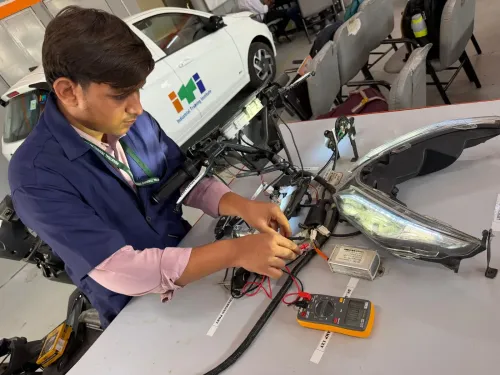
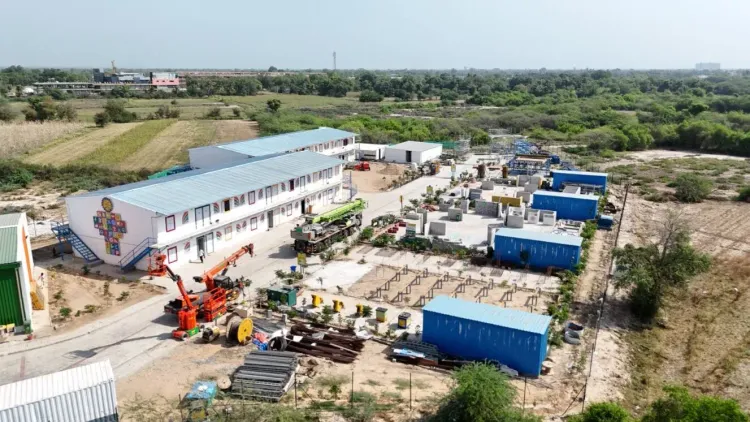
The 9.3-acre campus features open-yard workshops, simulated construction environments, and full-scale physical models — including transmission tower structures used to practise erection and dismantling — so trainees gain field-level exposure before deployment to live project sites. The institute currently offers training in more than 20 trades spanning construction, manufacturing, and emerging industrial sectors, including formwork carpentry, bar bending, scaffolding, welding, pipe fitting, HVAC, solar installation, surveying, and health, safety and environment (HSE) practices.
Post-Training Employment Pathway
The structured post-training pathway combines the National Apprenticeship Promotion Scheme (24 months) and the Prime Minister's Internship Scheme (9 months), providing a total of 33 months of stipend-based engagement. After successfully completing two years, trainees become eligible for Front Line Supervisor roles, with officials also citing opportunities for international placement thereafter.
Access and Campus Facilities
The programme is open to candidates aged 18 to 35 years, with educational requirements varying by trade — some courses accept basic schooling, while others require an ITI certificate. Entry is free: no fees are charged, and accommodation and meals are provided at no cost. The campus includes hostel facilities, a dining hall, sports grounds, a gymnasium, healthcare services, indoor games, and yoga and meditation spaces. The programme is open to both men and women, with separate residential facilities on campus.
A Trainee's Account
Ronak Kadiya, a commerce graduate from Vadnagar who enrolled in the formwork carpentry trade, is now working at the Ahmedabad-Mumbai bullet train project site. 'I learned a lot during my training at ICSTI-Vadnagar. My skills improved, and I am currently working at the bullet train project site. Based on my experience, I have also encouraged others to join as the training is practical and job opportunities are strong,' he said. His trajectory — from a commerce background to a high-profile infrastructure project in under three months — illustrates the model's core pitch: compress the gap between classroom and construction site.
The MoU underpinning the institute was signed in March 2024 between the private firm and the state government. With pilot batches fully placed, the institute's next challenge is scaling capacity to meet demand from India's accelerating infrastructure pipeline.
Point of View
But the real test will come at scale — when the institute must fill hundreds of slots rather than 201. The UK Construction Industry Training Board benchmark is a credible quality signal, yet India's vocational training landscape is littered with internationally certified programmes that failed at the last mile: employer absorption. What distinguishes this model, at least on paper, is the 33-month stipend bridge that prevents the typical post-training dropout. Whether the private firm operating the institute can sustain that pipeline as it competes for the same workers it is training — and whether the Gujarat government's MoU translates into enforceable placement commitments — will determine if Vadnagar becomes a replicable template or a well-publicised pilot.
NationPress
21 Sept 2026
Frequently Asked Questions
What is the ICSTI Vadnagar skills training institute?
The Industrial Construction Skills Training Institute (ICSTI) in Vadnagar, Mehsana district, Gujarat, is a private-sector-led skills training centre established under an MoU signed in March 2024 between a private engineering and construction firm and the Gujarat government's skill development authorities. It offers free, job-linked training in more than 20 construction and industrial trades on a 9.3-acre campus, and became operational in September 2024.
Where are ICSTI Vadnagar trainees being deployed?
Trainees from the first two pilot batches are working on the semiconductor fabrication facility in Dholera, the Ahmedabad-Mumbai high-speed rail corridor, Ahmedabad Metro, a solar power project in Khambhalia, and the Panipat refinery project in Haryana. All 201 trainees from the pilot batches have been placed or are in the process of deployment, according to officials.
How much do ICSTI trainees earn after placement?
Placed trainees receive stipends ranging from ₹18,000 to ₹20,000 per month. Post-training, they are engaged for up to 33 months through the National Apprenticeship Promotion Scheme (24 months) and the Prime Minister's Internship Scheme (9 months), both of which are stipend-based.
Who is eligible to apply to ICSTI Vadnagar?
The programme is open to candidates aged 18 to 35 years. Educational requirements vary by trade — some courses accept candidates with basic schooling, while others require ITI certification. The programme is open to both men and women, with separate residential facilities provided. No fees, accommodation costs, or meal charges apply.
What career progression do ICSTI trainees have after training?
After completing two years under the National Apprenticeship Promotion Scheme, trainees become eligible for Front Line Supervisor positions. Officials also cited opportunities for international placement after the two-year apprenticeship period. Trainees are classified at Level-2, Level-3, or Level-4 based on trade performance assessments.