Vaishnaw Highlights GOBARdhan Push for CBG Energy Future
Synopsis
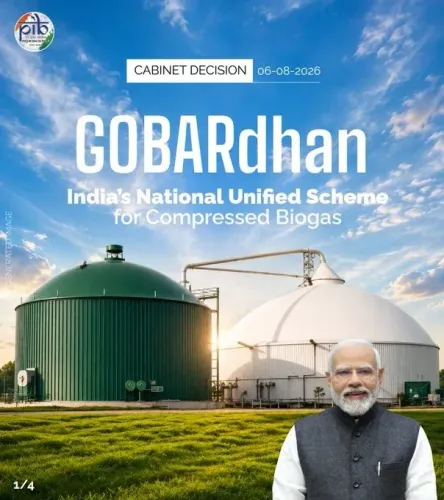
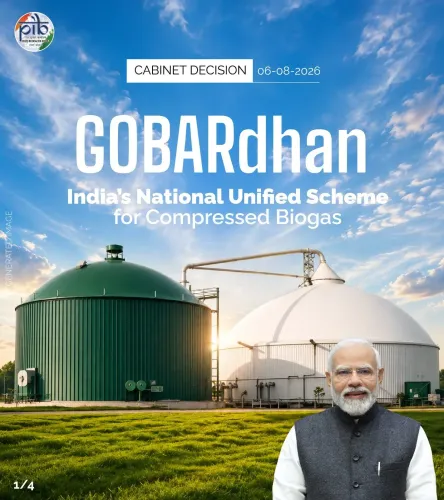
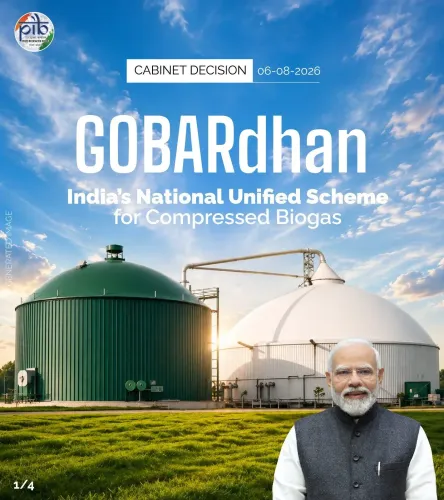
Union Minister Ashwini Vaishnaw spotlighted the GOBARdhan Scheme on 8 August 2026, framing its conversion of organic waste into Compressed Bio-Gas as central to India's Atmanirbhar energy agenda and fossil fuel reduction targets.
Key Takeaways
GOBARdhan Scheme was launched in April 2018 under the Swachh Bharat Mission-Gramin to convert cattle dung and organic waste into biogas and organic manure.
Compressed Bio-Gas (CBG) is a renewable, drop-in substitute for CNG used in transport and industry.
The SATAT initiative (October 2018) targets 5,000 CBG plants with oil marketing companies committed to offtake.
The scheme is embedded within the Atmanirbhar Bharat self-reliance framework, aiming to cut India's fossil fuel import dependence.
Key beneficiaries include farmers, rural households, and CBG plant operators who gain a monetisable output from agricultural waste.
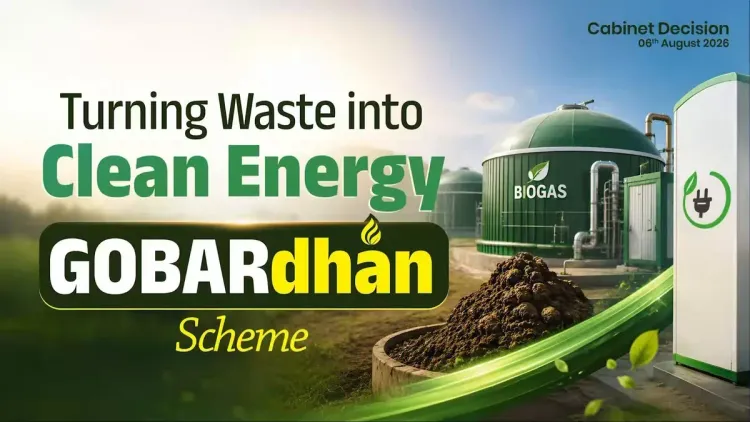
Cow dung and crop waste are not refuse — they are fuel. Union Minister Ashwini Vaishnaw underscored this on Saturday, 8 August 2026, spotlighting the GOBARdhan Scheme as a cornerstone of India's drive toward cleaner, self-reliant energy by converting organic waste into Compressed Bio-Gas (CBG) and cutting the country's dependence on fossil fuels.
From Cattle Dung to Clean Fuel: What GOBARdhan Does
Launched in April 2018 under the Swachh Bharat Mission-Gramin, the GOBARdhan (Galvanising Organic Bio-Agro Resources Dhan) scheme was designed to do two things at once: clean up rural India and generate energy from what was being discarded. Agricultural residue, animal dung, and organic waste feed anaerobic digesters that produce biogas — refined further into CBG, a drop-in substitute for Compressed Natural Gas (CNG) in transport and industry.
The scheme directly links sanitation goals with energy economics, giving farmers and rural households a monetisable output from waste streams that previously had no formal value chain.
SATAT, Atmanirbhar, and the Bioenergy Architecture Behind the Push
GOBARdhan does not stand alone. The SATAT initiative, launched in October 2018 by the Ministry of Petroleum and Natural Gas, set a target of 5,000 CBG plants across the country, with oil marketing companies committed to offtake — giving plant operators a guaranteed buyer. Together, the two programmes form the operational spine of India's waste-to-energy ambition.
That ambition sits squarely inside the Atmanirbhar Bharat framework — the self-reliance drive launched in 2020 — which includes hard targets for reducing fossil fuel imports through domestic bioenergy. Every cubic metre of CBG produced domestically is one less unit of imported natural gas on the ledger. In a country that remains heavily dependent on hydrocarbon imports, the arithmetic matters.
Where the Programme Goes From Here
The immediate signals to watch are the rollout of additional CBG plants under revised viability gap funding and any updates to bioenergy blending and production targets in upcoming budget or parliamentary cycles. India's national biofuel policy has already undergone revisions that set progressive targets for both CBG and ethanol — the question is execution speed on the ground.
Organic waste is not running out. The infrastructure to capture its energy potential is the variable — and that is precisely what Vaishnaw's post is pressing the public to notice.
Point of View
Rural income, and fossil fuel reduction into a single narrative. By invoking Atmanirbhar Bharat, the framing elevates GOBARdhan from a rural welfare scheme to a strategic industrial policy. The real test, however, is whether viability gap funding and guaranteed offtake under SATAT translate into plant commissioning at scale. Political messaging and ground-level execution have historically diverged on bioenergy targets in India.
NationPress
22 Sept 2026
Frequently Asked Questions
What is the GOBARdhan Scheme in India?
GOBARdhan (Galvanising Organic Bio-Agro Resources Dhan) is a central government scheme launched in April 2018 under the Swachh Bharat Mission-Gramin. It converts cattle dung and agricultural organic waste into biogas, Compressed Bio-Gas (CBG), and organic manure to generate rural energy and income.
What is Compressed Bio-Gas (CBG) and how is it used?
CBG is a renewable gaseous fuel produced through anaerobic digestion of organic waste. It is chemically similar to CNG and can be used as a drop-in substitute in transport vehicles and industrial applications, reducing dependence on imported natural gas.
What is the SATAT initiative and how does it relate to GOBARdhan?
The SATAT initiative, launched in October 2018 by the Ministry of Petroleum and Natural Gas, aims to establish 5,000 CBG plants across India with oil marketing companies committed to purchasing the output. It works alongside GOBARdhan to build a commercial market for bio-gas produced from organic waste.
How does GOBARdhan support Atmanirbhar Bharat?
By producing CBG domestically from agricultural and animal waste, GOBARdhan reduces India's reliance on imported fossil fuels. This directly supports the Atmanirbhar Bharat self-reliance framework, which includes targets for expanding domestic bioenergy production.
Who benefits from the GOBARdhan Scheme?
The primary beneficiaries are farmers and rural households, who can monetise organic waste that previously had no formal value. CBG plant operators also benefit from guaranteed offtake arrangements under the SATAT initiative.