Vaishnaw Hails Pradhan's Resignation as Act of Accountability
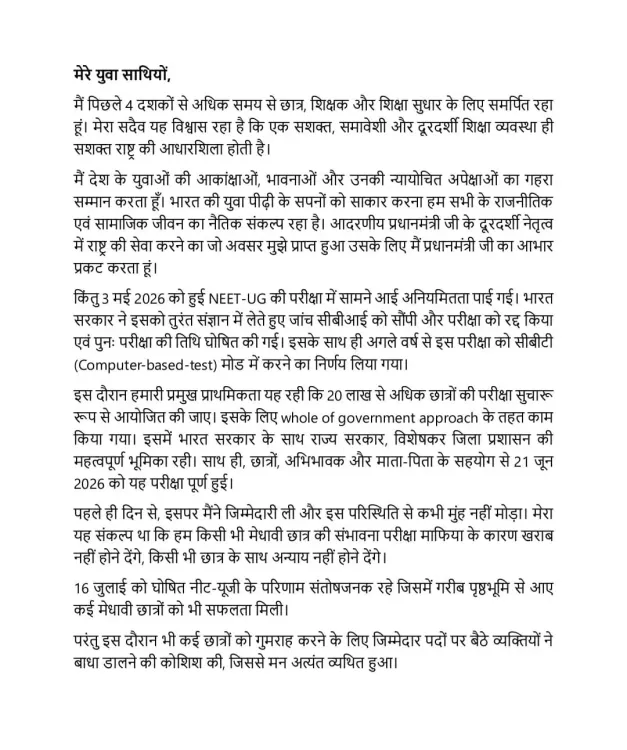
Synopsis
Union Minister Ashwini Vaishnaw on July 25, 2026 praised Dharmendra Pradhan's decision to resign as Education Minister, calling it an act of national interest and accountability, while reaffirming that NEP 2020 reforms centred on youth aspirations and transparency will continue under new leadership.
Key Takeaways
Ashwini Vaishnaw publicly praised Dharmendra Pradhan's resignation as Education Minister on July 25, 2026 .
Vaishnaw credited Pradhan with transforming India's education landscape through the National Education Policy 2020 .
NEP 2020 was approved by the Union Cabinet in July 2020 , replacing the 1986 education policy framework.
The policy emphasises critical thinking, flexibility, vocational skills, and multidisciplinary learning for students.
Vaishnaw affirmed the education reform agenda will continue, stating 'The work continues.' A Cabinet reshuffle and appointment of a new Education Minister are now anticipated.
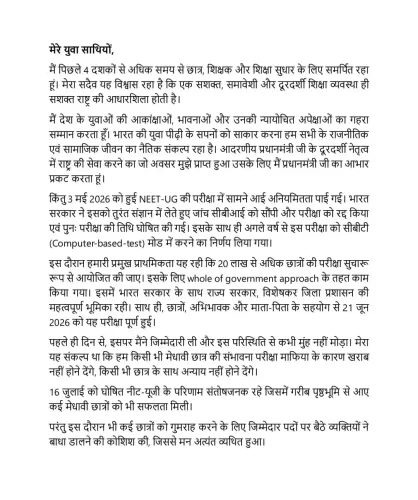
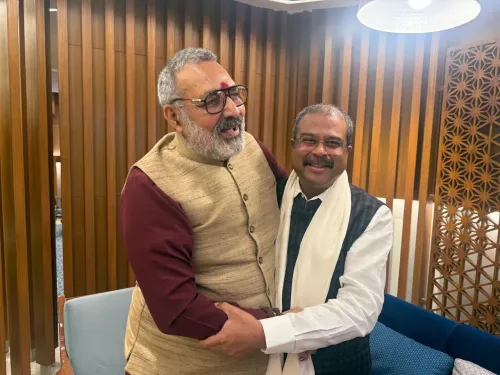
Union Minister Ashwini Vaishnaw on Saturday, July 25, 2026, publicly praised former Education Minister Dharmendra Pradhan for stepping down from his post, calling the decision an act of placing 'larger national interest above his professional position' and a demonstration of high standards of accountability in public life.
Context
In his post, Vaishnaw credited Pradhan with having 'transformed India's education landscape' through the National Education Policy (NEP) 2020, describing it as historic. He underlined that the policy promotes 'critical thinking, flexibility, and real-world skills among students.' The tribute came alongside an acknowledgement of Pradhan's voluntary exit from office.
Vaishnaw closed with a pointed line — 'The work continues' — signalling that the education reform agenda will not be disrupted by the leadership change.
Policy Backdrop
The National Education Policy 2020 was approved by the Union Cabinet in July 2020, replacing a framework that had been in place since 1986. It represents the most sweeping overhaul of India's school and higher education system in over three decades, emphasising multidisciplinary learning, mother-tongue instruction in early years, and integration of vocational skills into mainstream curricula.
Dharmendra Pradhan, a senior BJP leader, served as Education Minister during the critical rollout phase of NEP 2020, steering its implementation across states and overseeing regulatory changes in higher education governance. His tenure was closely identified with the policy's ground-level execution.
Stakeholders and Impact
The NEP 2020 directly affects millions of students, teachers, and educational institutions across India. Vaishnaw's post explicitly anchors Pradhan's legacy to the 'aspirations of our youth' and the promise of a 'transparent system,' framing the resignation not as a setback but as consistent with the reform's foundational values.
For the broader student community and education sector, the ministerial transition raises immediate questions about continuity of NEP-linked funding, regulatory decisions, and ongoing curriculum reforms at both school and university levels.
What's Next
Attention now turns to a potential Cabinet reshuffle and the appointment of a new Education Minister who will inherit the NEP 2020 implementation mandate. Parliament and state governments will be closely watched for any new NEP-related legislative or budgetary moves.
Successive BJP-led governments have framed education reforms as central to a larger push for transparency and accountability in public institutions — a narrative Vaishnaw's post reinforces even as it marks a significant personnel change at the top of the ministry.
Point of View
The party signals that the reform architecture is larger than any individual officeholder. The phrase 'The work continues' is as much a reassurance to education stakeholders as it is a political signal that no policy reversal is imminent. This pattern of framing ministerial exits as acts of principle, rather than political compulsion, has become a recurring feature of BJP crisis communication.
NationPress
25 Jul 2026
Frequently Asked Questions
Why did Dharmendra Pradhan resign as Education Minister?
According to Union Minister Ashwini Vaishnaw's post on July 25, 2026, Pradhan chose to place 'larger national interest above his professional position,' though specific reasons for the resignation have not been officially detailed.
What is the National Education Policy 2020?
NEP 2020 is a Cabinet-approved framework that replaced India's 1986 education policy. It promotes multidisciplinary learning, critical thinking, vocational skills, and mother-tongue instruction in early schooling.
Who will replace Dharmendra Pradhan as Education Minister?
No replacement has been announced as of July 25, 2026. A Cabinet reshuffle is anticipated, and the new minister will inherit the NEP 2020 implementation agenda.
What did Ashwini Vaishnaw say about Dharmendra Pradhan's resignation?
Vaishnaw said Pradhan's decision 'upholds the high standards of accountability in public life' and credited him with transforming India's education landscape through NEP 2020.
Will NEP 2020 reforms continue after Pradhan's resignation?
Yes. Vaishnaw explicitly stated 'The work continues,' signalling that the NEP 2020 reform agenda centred on youth aspirations and a transparent education system will not be disrupted by the leadership change.