Vaishnaw flags India making more smartphone parts locally
Synopsis
Union Minister Ashwini Vaishnaw has signalled that India is now producing more components and materials inside smartphones, reflecting the country's deepening push from final assembly toward localised supply chains under the PLI scheme and India Semiconductor Mission.
Key Takeaways
Ashwini Vaishnaw posted on September 25, 2026 highlighting India's growing domestic production of smartphone parts and materials.
The PLI scheme notified in April 2020 drove mobile phone exports past USD 10 billion within three years of launch.
The India Semiconductor Mission , approved in December 2021 with a Rs 76,000 crore outlay, targets chip design, fabrication and packaging on Indian soil.
The National Policy on Electronics 2019 set a USD 400 billion domestic electronics manufacturing target.
India's strategy explicitly aims to reduce dependence on China for sub-components by deepening local value-chain integration.
The minister's framing — 'hundreds of parts inside' — shifts focus from finished-goods headlines to the strategically critical sub-component layer.
India is no longer just assembling smartphones — it is building them from the inside out. On Friday, September 25, 2026, Union Minister Ashwini Vaishnaw posted on X to highlight that India is now producing more of the components and materials that go inside a smartphone, underlining the country's deepening push beyond final assembly into the complex world of parts manufacturing.
From assembly line to component factory
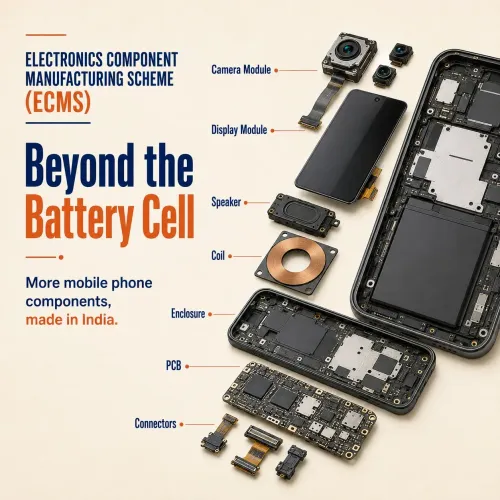
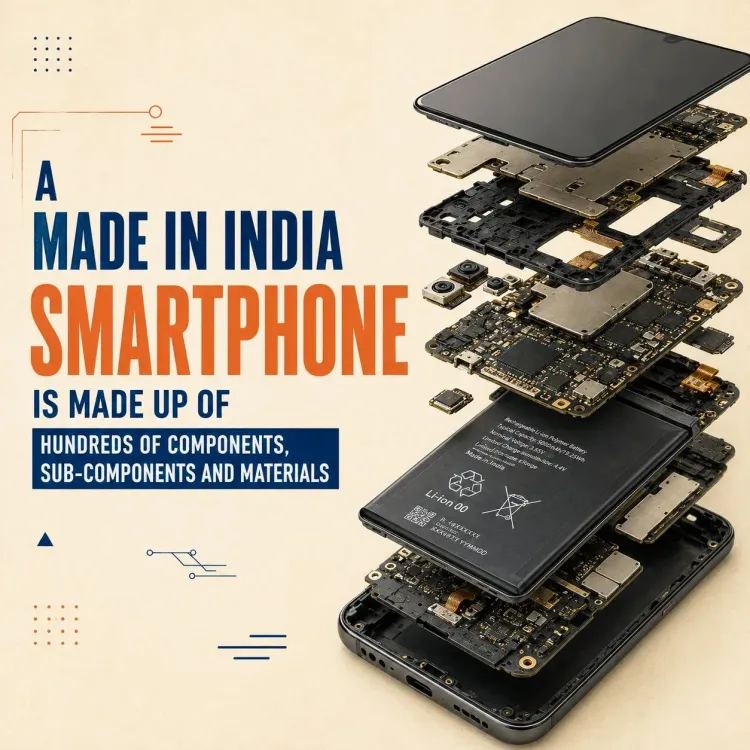
A modern smartphone contains hundreds of discrete parts — chips, displays, camera modules, connectors, batteries, and specialised materials. For years, India's electronics boom was largely a story of screwdriver assembly: imported components snapped together domestically. Vaishnaw's post signals a pivot — the supply chain is beginning to localise at deeper levels.
This is not accidental. The Production Linked Incentive (PLI) scheme, notified in April 2020 under the Ministry of Electronics and Information Technology (MeitY), was designed precisely to incentivise domestic manufacturing of mobile phones and, critically, their components. Within three years of the scheme's launch, India's mobile phone exports crossed USD 10 billion — a figure that would have seemed improbable a decade ago.
The semiconductor bet and what comes next
Components are one layer; semiconductors are another entirely. In December 2021, the government approved the India Semiconductor Mission with a budget outlay of Rs 76,000 crore — a direct attempt to build design, fabrication, and packaging capability on Indian soil. The mission sits at the apex of the 'make it here' ambition: if India can eventually produce the chips that power its smartphones, the import-dependence calculus changes fundamentally.
The broader scaffolding dates to the National Policy on Electronics 2019, which set a target of USD 400 billion in domestic electronics manufacturing. The Make in India campaign, launched in 2014, placed electronics among its priority sectors, and successive policy expansions have layered incentives, infrastructure clusters, and design-linked support on top of that foundation.
Why the 'hundreds of parts' framing matters
Vaishnaw's choice of language — 'hundreds of parts inside' — is deliberate messaging. It reframes the electronics story away from finished-goods export headlines toward the unglamorous but strategically vital world of sub-components: the resistors, the lenses, the precision connectors, the speciality glass. That is where global value-chain depth is built, and where import dependence — chiefly on China — has historically been India's soft underbelly.
The minister's post does not name specific components or cite fresh investment figures, and recent manufacturing milestones from 2026 remain unverified from available data. But the directional signal is consistent with a multi-year government strategy: move up the value chain, one part at a time.
The real test is whether approved semiconductor and component projects translate into running production lines — and whether the next Union Budget deepens the incentive stack further.
Point of View
' a distinction that carries real geopolitical and economic weight. The PLI scheme successfully seeded final assembly and export volumes, but the government knows that durable supply-chain security requires localising the upstream parts tier, especially given the China concentration risk that became visible during the pandemic-era supply crunch. The India Semiconductor Mission is the most ambitious expression of that logic, but its payoff remains years away. By consistently amplifying the 'components and materials' narrative, the ministry is building political momentum — and investor expectations — for the next, harder phase of industrial deepening.
NationPress
25 Sept 2026
Frequently Asked Questions
What did Ashwini Vaishnaw post about smartphones on September 25 2026?
Vaishnaw posted on X highlighting that India is now producing more of the components and materials that go inside smartphones, pointing to the country's shift from pure assembly toward deeper local manufacturing.
What is the PLI scheme for electronics in India?
The Production Linked Incentive scheme for Large Scale Electronics Manufacturing was notified in April 2020 to incentivise domestic production of mobile phones, IT hardware and components through financial outlays tied to incremental sales.
What is the India Semiconductor Mission?
The India Semiconductor Mission is a government initiative approved in December 2021 under MeitY with a budget outlay of Rs 76,000 crore to build semiconductor design, fabrication and packaging capability inside India.
How much has India's mobile phone export grown under PLI?
India's mobile phone exports crossed USD 10 billion within three years of the PLI scheme's launch in April 2020, a significant jump from negligible export levels before the scheme.
Why is India trying to make smartphone components locally?
India has been heavily dependent on imports, chiefly from China, for sub-components like chips, displays and connectors. Localising component production reduces that dependence, builds supply-chain resilience and moves India up the global electronics value chain.