Vaishnaw Flags 2 Semiconductor Units in Production, Teases ISM 2.0
Synopsis
Union Minister Ashwini Vaishnaw announced on June 10, 2026 that two semiconductor fabrication units have entered commercial production in under four years under India's chip mission, and teased the imminent launch of ISM 2.0 to expand the programme.
Key Takeaways
Two semiconductor fabrication units have reached commercial production in under four years , according to Union Minister Vaishnaw.
The India Semiconductor Mission (ISM) was launched in December 2021 with a ₹76,000 crore outlay to build domestic chip capabilities.
The minister signalled the imminent arrival of ISM 2.0 , a follow-on phase intended to expand incentives and infrastructure.
India's semiconductor push spans the full value chain — from chip design tools to physical fabrication plants .
The strategy aligns with similar industrial policies in the United States , European Union , and Japan to diversify global chip production.
A Production Linked Incentive (PLI) scheme for IT hardware and semiconductors has run alongside ISM since 2021-22 .
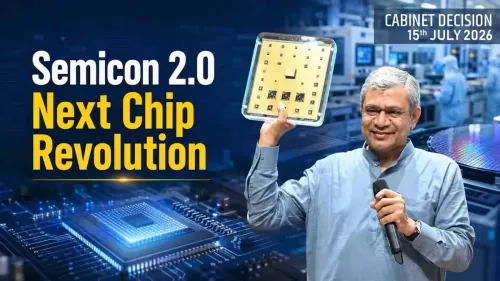
Union Minister Ashwini Vaishnaw on Wednesday, June 10, 2026 highlighted India's semiconductor push, stating that two fabrication units have entered commercial production in under four years and signalling that ISM 2.0 — the next phase of the India Semiconductor Mission — is on the horizon.
Context
The post is the tenth in what appears to be a series by Vaishnaw cataloguing milestones in India's technology and infrastructure sectors. In it, the minister writes: 'From design tools to fabs, we are building a holistic semiconductor ecosystem from scratch. 2 units under commercial production in less than 4 years.' The message also carries a teaser — 'Coming soon — ISM 2.0' — pointing to an expanded follow-on programme.
The claim of two units reaching commercial production within four years is significant given that semiconductor fabrication plants are among the most capital-intensive and technically complex industrial projects globally. The minister's framing positions India's progress as a full-stack effort, covering everything from chip design tools to physical fabrication.
Policy Backdrop
The India Semiconductor Mission (ISM) was launched in December 2021 with an outlay of ₹76,000 crore to attract investment across chip design, fabrication, and assembly and test packaging. The programme was conceived as a cornerstone of the Atmanirbhar Bharat framework — India's strategic push for self-reliance in critical technologies — and was designed to reduce the country's heavy dependence on semiconductor imports, particularly from East Asia.
A Production Linked Incentive (PLI) scheme for IT hardware and semiconductors, notified in 2021-22, complemented ISM by offering output-linked financial support to manufacturers. Together, the two instruments aimed to move India from a predominantly import-dependent position to one where it participates meaningfully in global semiconductor value chains. The approach broadly mirrors industrial strategies adopted by the United States, the European Union, and Japan to diversify chip production away from a narrow set of geographies.
Stakeholders and Impact
The primary beneficiaries of a maturing semiconductor ecosystem are domestic electronics manufacturers who currently source components from abroad, adding cost and supply-chain risk. A locally available chip supply would also benefit sectors ranging from automotive and consumer electronics to defence and telecommunications infrastructure.
For semiconductor companies — both Indian and multinational — the prospect of ISM 2.0 signals continued government commitment and potentially enhanced incentives, making India a more competitive destination against established hubs in Taiwan, South Korea, and increasingly the United States and Germany. The minister's reference to 'design tools to fabs' suggests the policy intent covers the entire value chain, not just the high-visibility fabrication layer.
What's Next
The immediate focus will be on the formal announcement of ISM 2.0 — its outlay, eligibility criteria, and the specific segments it targets beyond the first mission's scope. Industry observers will also watch for official output data and capacity utilisation figures from the two units now described as commercially operational.
If ISM 2.0 expands incentives for advanced-node fabrication or chip design infrastructure, it could accelerate India's integration into global supply chains at a moment when major economies are actively seeking to diversify sourcing. The minister's ten-point series itself suggests a broader communications push ahead of what may be a significant policy announcement.
Point of View
Suggesting a deliberate pre-announcement communications strategy rather than a standalone update — likely building public and investor anticipation for ISM 2.0. Claiming commercial production at two units within four years of a mission launch is a notable milestone for a sector where gestation periods routinely exceed a decade, and the minister is clearly seeking to anchor that narrative before a formal policy reveal. The broader arc is India's effort to position itself as a credible alternative node in global semiconductor supply chains at a moment of acute geopolitical pressure on existing hubs. Whether ISM 2.0 can attract advanced-node fabrication — the highest-value segment — will be the real test of the mission's ambition.
NationPress
26 Oct 2026
Frequently Asked Questions
What is India Semiconductor Mission ISM 2.0?
ISM 2.0 is the announced follow-on phase of the India Semiconductor Mission, expected to expand incentives and infrastructure beyond the original ₹76,000 crore programme launched in December 2021. Its specific outlay and guidelines have not yet been officially released.
How many semiconductor units are operational in India?
Union Minister Ashwini Vaishnaw stated on June 10, 2026 that two semiconductor fabrication units are under commercial production, achieved in less than four years since the India Semiconductor Mission was launched.
What is the India Semiconductor Mission?
The India Semiconductor Mission is a central government programme launched in December 2021 with a ₹76,000 crore outlay to build domestic capabilities across chip design, fabrication, and assembly, reducing India's dependence on semiconductor imports.
What did Ashwini Vaishnaw say about semiconductors?
Vaishnaw said India is building a 'holistic semiconductor ecosystem from scratch,' covering design tools to fabrication plants, with two units already in commercial production in under four years, and that ISM 2.0 is coming soon.
How is India reducing semiconductor import dependence?
India is reducing semiconductor import dependence through the India Semiconductor Mission, a Production Linked Incentive scheme for IT hardware, and targeted investments in chip design and fabrication infrastructure under the Atmanirbhar Bharat framework.