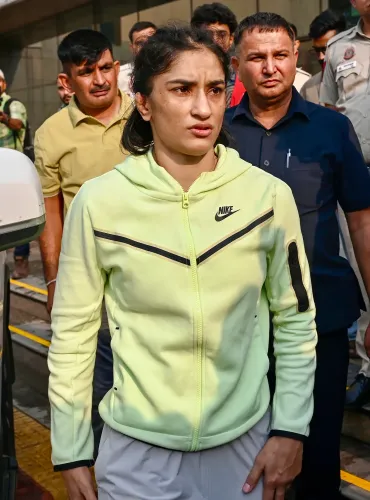
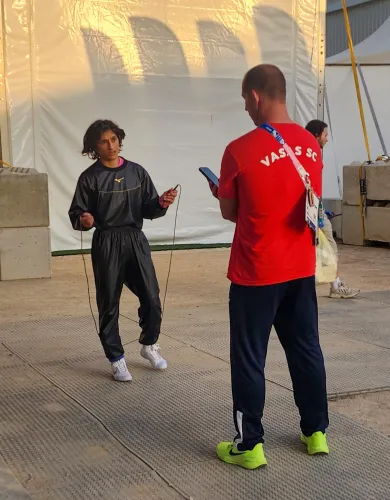
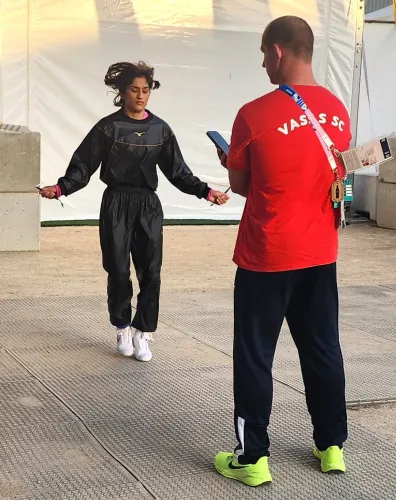
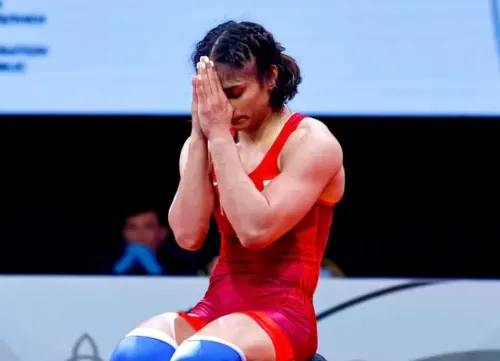
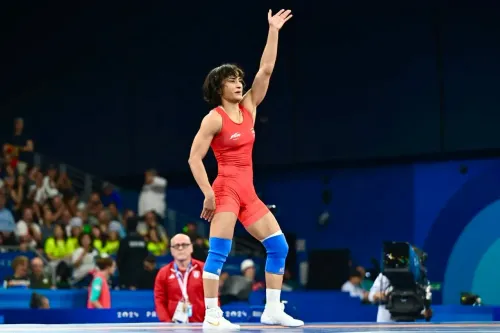
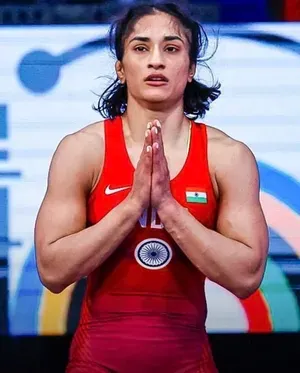
WFI moves Supreme Court against Delhi HC relief to Vinesh Phogat for Asian Games trials

Synopsis
The Wrestling Federation of India has taken its fight against Vinesh Phogat's Asian Games 2026 trial participation to the Supreme Court, days after the Delhi High Court ruled that motherhood cannot disqualify an athlete from professional opportunities. The case is now a flashpoint for maternity rights in Indian sport — and its outcome could reshape how federations write eligibility rules.
Key Takeaways
The Wrestling Federation of India (WFI) has filed a Special Leave Petition (SLP) in the Supreme Court against a Delhi High Court order.
The High Court had permitted Vinesh Phogat , a three-time Olympian, to participate in Asian Games 2026 selection trials on 30–31 May .
The bench of Chief Justice Devendra Kumar Upadhyaya and Justice Tejas Karia ruled that motherhood cannot be treated as a 'disability' under selection policy.
The High Court termed certain language in the WFI's show-cause notice 'deplorable' and 'vindictive'.
Trials must be video-recorded and supervised by independent observers from SAI and IOA , per the High Court's directions.
Phogat has filed a caveat through advocate Aman Varma to prevent any ex parte Supreme Court order.
The Wrestling Federation of India (WFI) has approached the Supreme Court challenging a Delhi High Court order that permitted three-time Olympian Vinesh Phogat to participate in the Asian Games 2026 selection trials, escalating a legal battle that cuts to the heart of maternity rights in Indian sport.
What the Supreme Court Petition Says
According to details available on the apex court's official website, the Special Leave Petition (SLP) filed by the WFI is listed for hearing before a bench of Justices P.S. Narasimha and Alok Aradhe. The petition contests the High Court's direction to allow Phogat to compete in the selection trials scheduled for 30 and 31 May, arguing she did not fulfil the eligibility criteria prescribed under the WFI's selection policy.
What the Delhi High Court Had Ruled
A Division Bench of Chief Justice Devendra Kumar Upadhyaya and Justice Tejas Karia had ruled last week that motherhood cannot be treated as a 'disability' or a ground for exclusion from professional opportunities. The bench found that the WFI's selection policy failed to account for Phogat's maternity-related sabbatical and post-partum recovery period, which had coincided with the qualifying tournaments required under the eligibility criteria.
'Motherhood must be viewed as a natural and deeply significant aspect of life that deserves accommodation and institutional sensitivity,' the Delhi High Court observed, finding a prima facie case in Phogat's favour.
Safeguards Ordered by the High Court
Beyond permitting her participation, the Delhi High Court directed that the selection trials be video-recorded and conducted under the supervision of independent observers nominated by the Sports Authority of India (SAI) and the Indian Olympic Association (IOA). It also clarified that Phogat's participation would remain subject to the outcome of a pending writ petition before a single-judge bench examining the validity of the WFI's selection policy, circular, and show-cause notice.
The court took strong exception to the language used in the WFI's show-cause notice, terming certain remarks against Phogat as 'deplorable' and indicative of a 'vindictive' approach by the federation.
Phogat's Legal Safeguard
A caveat has been filed on Phogat's behalf through advocate Aman Varma, seeking to ensure that no ex parte order is passed by the Supreme Court without first hearing her side. This is a standard legal precaution that prevents any interim stay from being granted in her absence.
Broader Context
The dispute arrives at a sensitive moment for Indian wrestling governance. The WFI has faced sustained scrutiny over its administrative conduct in recent years, and this case adds a gender-rights dimension to those institutional concerns. Notably, the High Court's observation that maternity should be accommodated within selection frameworks — rather than treated as disqualifying inactivity — could have implications for eligibility policies across multiple Indian sports federations if upheld. The Supreme Court's next hearing will determine whether Phogat competes in the 30–31 May trials or whether the WFI's challenge succeeds in staying her participation.
Point of View
Prima facie finding that maternity deserves institutional sensitivity. If the Supreme Court upholds that reasoning, Indian sports federations will need to revisit eligibility frameworks built entirely around uninterrupted competitive participation. The WFI's resistance, at this moment, looks less like principled policy defence and more like an institution struggling to accept judicial oversight of its own conduct.
NationPress
20 Sept 2026
Frequently Asked Questions
Why has the WFI moved the Supreme Court against Vinesh Phogat?
The WFI filed a Special Leave Petition challenging the Delhi High Court's order that allowed Vinesh Phogat to participate in the Asian Games 2026 selection trials. The federation argues she did not meet the eligibility criteria under its selection policy.
What did the Delhi High Court rule in Vinesh Phogat's favour?
The Delhi High Court ruled that motherhood cannot be treated as a 'disability' or a ground for exclusion from professional opportunities. It found that the WFI's policy failed to account for Phogat's maternity-related sabbatical and post-partum recovery, which overlapped with mandatory qualifying tournaments.
When are the Asian Games 2026 selection trials scheduled?
The selection trials are scheduled for 30 and 31 May. Phogat's participation in these trials is currently the subject of the Supreme Court proceedings.
What safeguards did the Delhi High Court put in place for the trials?
The court directed that the trials be video-recorded and overseen by independent observers nominated by the Sports Authority of India (SAI) and the Indian Olympic Association (IOA). It also clarified that Phogat's participation remains subject to the outcome of a pending writ petition.
What is a caveat and why has Phogat filed one?
A caveat is a legal notice that prevents a court from passing an order without first hearing the party that filed it. Phogat filed a caveat through advocate Aman Varma to ensure the Supreme Court does not grant any interim stay in her absence.