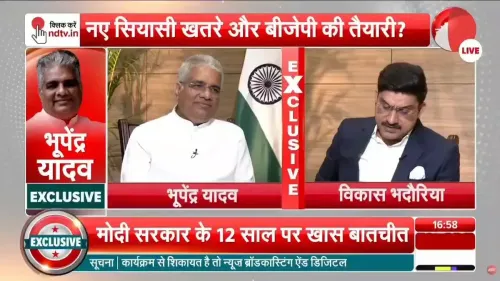
Bhupender Yadav: Ecology and Economy Can Coexist

Synopsis
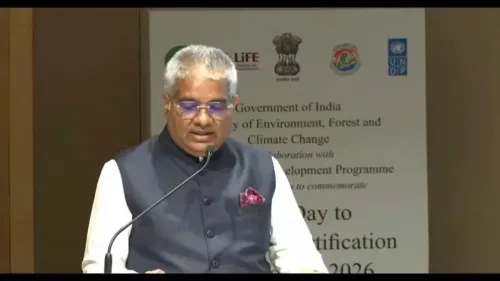
Union Environment Minister Bhupender Yadav on September 25, 2026, asserted that India's growth goals and the balance between ecology and economy require no contradiction — reaffirming a long-standing government position on sustainable development.
Key Takeaways
Bhupender Yadav , Union Minister of Environment, Forest and Climate Change, posted on September 25, 2026 , that ecology and economy need no contradiction for India's growth.
The statement, made in Hindi on X, reflects the government's consistent position that economic development and environmental protection are compatible goals.
India's National Action Plan on Climate Change (2008) established this dual-track framework through eight integrated national missions.
Yadav's ministry sits at the intersection of industrial clearance decisions and conservation mandates, making the framing both rhetorical and operational.
Analysts will watch follow-up policy signals — particularly around industrial corridors and green clearance timelines — to see whether the statement translates into procedural shifts.
Growth and green — Union Environment Minister Bhupender Yadav insists India does not have to choose between them. On Friday, September 25, 2026, the senior BJP leader posted a crisp, declarative statement on X that cuts to the heart of one of India's oldest policy debates: can a fast-growing economy afford to protect its forests, air, and water — or must it sacrifice one for the other?
Yadav's post, in Hindi, stated: 'देश की growth के लिए और ecology और economy में balance के लिए कोई contradiction की जरूरत नहीं होती है' — 'For the country's growth, and for a balance between ecology and economy, there is no need for any contradiction.'
A Claim With Deep Policy Roots
The argument Yadav is making is not new to Indian governance, but it remains fiercely contested. India's National Action Plan on Climate Change (2008) was built precisely on this premise — eight national missions designed to pursue economic expansion and ecological security simultaneously, not sequentially. Yadav's remark lands squarely in that tradition, reaffirming that the government sees sustainable development not as a concession to environmentalists but as a strategic national goal.
Successive governments have leaned on this framing whenever forest clearance policies, industrial corridor expansions, or green project approvals draw scrutiny. The logic: technology, regulatory design, and institutional will can make growth cleaner without making it slower.
Why the Tension Stays Real
For all the rhetorical consensus, the ecology-economy fault line remains one of the sharpest in Indian policy. Industrial groups push for faster environmental clearances; conservation groups push back with data on forest loss and biodiversity stress. The Ministry of Environment, Forest and Climate Change, which Yadav heads, sits directly at that intersection — approving or rejecting projects that together shape both India's growth trajectory and its ecological footprint.
A minister's public insistence that no contradiction exists is, in that context, also a signal to both camps: the ministry will not treat every clearance as a zero-sum fight, but it will frame its decisions as compatible with ecological balance. Whether the policy machinery backs that framing is what industrial corridors, green clearance timelines, and forest cover data will show in the months ahead.
Point of View
The minister signals the government's intent to hold both audiences simultaneously. The real test is not the rhetoric but the pipeline of clearance decisions, forest diversion orders, and climate target updates that will follow. If the framing is matched by measurable policy outcomes, it strengthens India's position in international climate diplomacy; if it remains declaratory, the contradiction it denies will only grow louder.
NationPress
25 Sept 2026
Frequently Asked Questions
What did Bhupender Yadav say about ecology and economy?
Yadav stated on September 25, 2026, that for India's growth and for balancing ecology with economy, there is no need for any contradiction — asserting that the two goals are compatible, not competing.
What is India's official position on environment versus development?
India's official stance, rooted in the 2008 National Action Plan on Climate Change, holds that economic growth and ecological security can be pursued simultaneously through sustainable practices and technology.
What is Bhupender Yadav's role in the Indian government?
Bhupender Yadav is India's Union Minister of Environment, Forest and Climate Change and a senior BJP leader, a position he has held since 2021.
Why does the ecology-economy debate matter in India?
India's rapid industrial expansion frequently requires forest and environmental clearances that affect biodiversity and local communities, making the trade-off between growth and conservation a live and contested policy question.
What should we watch after Yadav's ecology-economy statement?
Policy observers will track follow-up decisions on industrial corridor green clearances, forest diversion approvals, and any new schemes linking environmental compliance with growth mandates in the coming months.