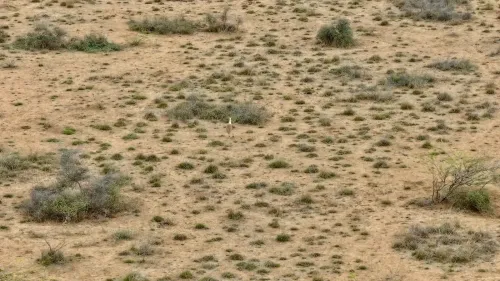
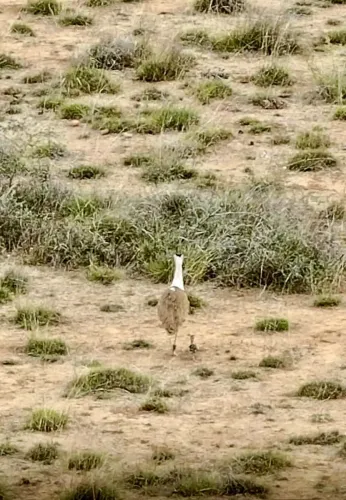
Yadav Calls Great Indian Bustard India's Most Beautiful Bird
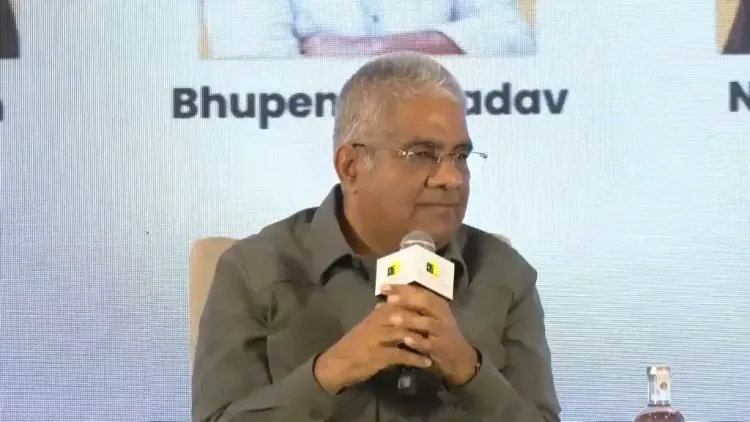
Synopsis
Union Environment Minister Bhupender Yadav called the Great Indian Bustard 'the most beautiful bird of Hindustan' on X, spotlighting a critically endangered species with fewer than 150 individuals surviving in India's wild grasslands.
Key Takeaways
Union Environment Minister Bhupender Yadav declared the Great Indian Bustard the most beautiful bird of India in a Hindi post on September 25, 2026 .
The Great Indian Bustard is critically endangered with fewer than 150 individuals surviving in the wild, primarily in Rajasthan .
The species is protected under Schedule I of the Wildlife Protection Act, 1972 and CITES Appendix I .
Power-line collisions in renewable energy corridors remain the single biggest human-made threat to the bustard's survival.
The Ministry of Environment, Forest and Climate Change runs a dedicated species recovery effort under Project Great Indian Bustard .
India's rarest grassland giant is getting a moment in the spotlight. Union Environment Minister Bhupender Yadav took to X on Friday, September 25, 2026, to celebrate the Great Indian Bustard — declaring it the most beautiful bird in the country in a post that has resonated with wildlife enthusiasts and conservationists alike.
Posting in Hindi, the Minister wrote: 'ग्रेट इंडियन बस्टर्ड हिंदुस्तान का सबसे खूबसूरत पक्षी है…' — 'The Great Indian Bustard is the most beautiful bird of Hindustan…' The ellipsis and an accompanying video signal a broader message of wonder and perhaps urgency around this critically endangered species.
Why the Great Indian Bustard Demands Attention
The Great Indian Bustard (Ardeotis nigriceps) is one of the heaviest flying birds on Earth and is found primarily in the Thar Desert of Rajasthan and isolated pockets of Gujarat, Karnataka, Andhra Pradesh, and Maharashtra. Once widespread across the Indian subcontinent's dry grasslands, its population has collapsed to fewer than 150 individuals in the wild, placing it among the world's most critically endangered birds. Habitat loss, collisions with overhead power lines, and hunting have driven this decline over decades. The species holds legal protection under Schedule I of the Wildlife Protection Act, 1972 — the highest category — and is listed on CITES Appendix I. India's Supreme Court has previously intervened to direct the undergrounding of power lines in critical bustard habitat, a measure that pits renewable energy infrastructure against species survival in one of conservation's sharpest policy dilemmas.The Ministry's Biodiversity Outreach Push
Environment ministers in India have increasingly used social media to amplify awareness of native species, weaving wildlife messaging into the broader biodiversity mandate of the Ministry of Environment, Forest and Climate Change (MoEFCC). Yadav, a senior BJP leader who has represented India at international climate forums, has positioned wildlife conservation alongside climate action as twin priorities of the ministry. The timing — late September — sits close to global biodiversity milestones and national wildlife week observances, giving the post an added layer of institutional resonance. Whether this translates into fresh announcements on the Project Great Indian Bustard recovery programme or expanded protected area notifications remains the key watch-point for conservationists who have long called for bolder state action. India cannot afford to lose a bird that exists nowhere else on Earth in such numbers. Yadav's post is a reminder — vivid, public, and pointed.Point of View
Making any ministerial attention to it politically and legally significant. If the post precedes a policy move — a new conservation reserve, a power-line undergrounding order, or a recovery programme update — it would follow the pattern of social media posts as trail-blazers for formal announcements. At minimum, it keeps the species on the national agenda at a moment when its survival window is critically narrow.
NationPress
25 Sept 2026
Frequently Asked Questions
What is the Great Indian Bustard and why is it endangered?
The Great Indian Bustard is one of the world's heaviest flying birds, found mainly in Rajasthan's Thar Desert. Its population has fallen to fewer than 150 individuals due to habitat loss, power-line collisions, and hunting, making it critically endangered.
What did Bhupender Yadav say about the Great Indian Bustard?
On September 25, 2026, Union Environment Minister Bhupender Yadav posted on X calling the Great Indian Bustard 'the most beautiful bird of Hindustan,' sharing a video of the species to raise public awareness.
Where is the Great Indian Bustard found in India?
The Great Indian Bustard is found primarily in the Thar Desert region of Rajasthan, with smaller isolated populations in Gujarat, Karnataka, Andhra Pradesh, and Maharashtra.
What legal protection does the Great Indian Bustard have in India?
The Great Indian Bustard is listed under Schedule I of the Wildlife Protection Act, 1972 — the highest level of protection — and is also on CITES Appendix I, prohibiting international commercial trade.
What is Project Great Indian Bustard?
Project Great Indian Bustard is a species recovery programme under the Ministry of Environment, Forest and Climate Change aimed at protecting the bird's grassland habitat, managing captive breeding, and addressing threats like power-line collisions.