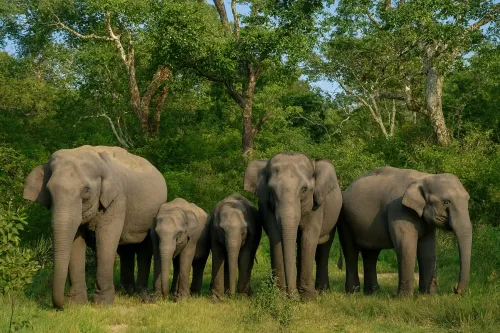
Yadav marks World Elephant Day with Project Elephant update

Synopsis
On World Elephant Day 2026, Environment Minister Bhupender Yadav detailed Project Elephant's integrated toolkit — AI alerts, solar fencing, railway safeguards, and PMFBY crop insurance — aimed at protecting India's elephants while securing livelihoods in corridor communities.
Key Takeaways
Project Elephant , launched in 1992 , now covers 16 states and combines habitat protection with technology-driven conflict mitigation.
AI-driven early warning systems and solar-powered fences are deployed to protect both communities and elephant herds in real time.
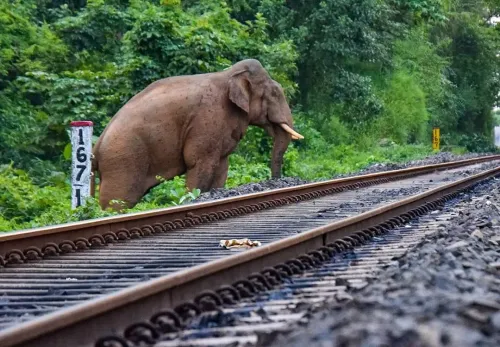
Indian Railways has introduced speed restrictions, underpasses, and AI alert systems in critical elephant corridors to prevent fatal collisions.
Farmers affected by elephant damage can claim compensation under the Pradhan Mantri Fasal Bima Yojana (PMFBY) , launched in 2016 .
India holds roughly 60 per cent of Asia's wild elephant population, giving its conservation policies significant global weight.
The approach aligns with the 2010 Gajah Task Force recommendations and India's commitments under the Convention on Biological Diversity and CITES .
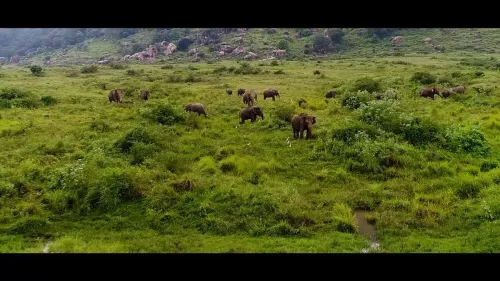
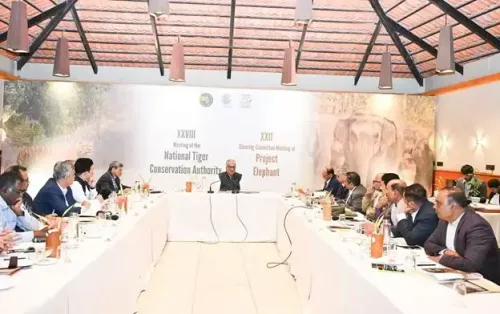
On World Elephant Day, 12 August 2026, Union Environment Minister Bhupender Yadav laid out the full toolkit India is deploying to keep elephants alive and farmers safe — a suite of interventions that stretches from AI-powered alerts in forest corridors to crop insurance payouts for families who lose harvests to a wandering herd.
Three decades of Project Elephant, now turbocharged with technology
Project Elephant, launched in 1992 as a centrally sponsored scheme, was India's first structured answer to a problem as old as settlement itself: people and elephants competing for the same land. What began as a habitat-protection drive across 16 states has since grown into a layered conflict-mitigation system. The legal spine is the Wildlife Protection Act, 1972, which lists the elephant as a Schedule I species — the highest protection tier.
The technology layer is newer and sharper. Early warning systems and AI-driven alerts now push real-time notifications to communities when elephant movement is detected near settlements. Solar-powered fences and trenches create physical buffers that protect both sides of the boundary — the village and the herd. Minister Yadav's post frames these not as separate pilots but as a coordinated suite, suggesting national-scale integration is the stated goal.
Railways, insurance, and the human side of coexistence
Indian Railways — whose tracks cut through some of the country's most critical elephant corridors — has introduced speed restrictions, AI-based detection systems, and warning signals to prevent fatal collisions, a problem that claimed dozens of elephant lives in the decade before these interventions began rolling out in the early 2010s. The railway angle matters: a single corridor crossing can mean the difference between a viable breeding population and an isolated, shrinking one.
For farmers, the safety net is the Pradhan Mantri Fasal Bima Yojana (PMFBY), the crop insurance programme launched in 2016 that covers losses caused by wild animals, including elephants. Timely compensation is the government's answer to the resentment that, left unaddressed, can turn communities from bystanders into adversaries of conservation. Education and awareness programmes complete the picture, preparing villages to read elephant behaviour and respond without escalating conflict.
Where India's elephant strategy fits globally
India holds roughly 60 per cent of Asia's wild elephant population — a fact that gives its conservation choices outsized global consequence. The multi-pronged Project Elephant approach aligns with India's commitments under the Convention on Biological Diversity and CITES, and the 2010 Gajah Task Force report had already recommended exactly this kind of landscape-level, community-integrated management. That blueprint is now, three parliamentary sessions later, the operational reality Yadav is describing.
The metric that will ultimately judge the programme is not the number of schemes listed but two hard numbers: elephant mortality figures and PMFBY crop-damage claims from corridor districts. Both are worth watching as state-level implementation reports come in.
India's bet is that technology, insurance, and community trust can do what fences alone never could — make coexistence the rational choice for everyone living on the edge of elephant country.
Point of View
Community-sensitive wildlife policy at a time when human-wildlife conflict is a live electoral grievance in forested constituencies. By threading PMFBY into the conservation narrative, the ministry explicitly links wildlife protection to rural livelihood security, broadening the political coalition for elephant conservation beyond urban environmentalists. The emphasis on AI and solar technology also feeds a wider government narrative of modernising India's public systems. Whether the on-ground implementation in corridor states matches the ministerial framing will be the test that follows.
NationPress
12 Aug 2026
Frequently Asked Questions
What is Project Elephant and when was it launched?
Project Elephant is a centrally sponsored scheme launched by the Government of India in 1992 to protect elephants, their habitats, and mitigate human-elephant conflict across 16 states .
How does India compensate farmers for crop damage caused by elephants?
Farmers can claim compensation for crop losses caused by wild animals, including elephants, under the Pradhan Mantri Fasal Bima Yojana (PMFBY) , a crop insurance programme launched in 2016 .
What measures has Indian Railways taken to protect elephants?
Indian Railways has introduced speed restrictions, AI-based detection systems, warning signals, and underpasses in identified elephant corridors to prevent fatal train-elephant collisions.
What technology is used under Project Elephant to prevent human-elephant conflict?
Project Elephant deploys AI-driven early warning systems that alert communities to elephant movement, along with solar-powered fences and trenches that create physical buffers between villages and herds.
Why is India's elephant conservation significant globally?
India holds roughly 60 per cent of Asia's wild elephant population, making its conservation policies central to the species' survival. India's approach also aligns with its commitments under the Convention on Biological Diversity and CITES .