Is Pakistan and Jamaat Positioning Yunus for Bangladesh’s Presidency?

Synopsis
A covert deal may see Muhammad Yunus become the President of Bangladesh if Jamaat-e-Islami wins the elections. With significant backing from Pakistan, China, and Western entities, Yunus has been pivotal in shaping policies favorable to the Jamaat, raising concerns over Bangladesh's future political landscape.
Key Takeaways
Yunus's potential presidency could reshape Bangladesh's political landscape.
Pakistan and Jamaat-e-Islami are collaborating closely to influence elections.
Concerns over deteriorating relations with India are escalating.
The Jamaat is targeting both moderate and radical voter bases.
Yunus's leadership could lead to significant policy shifts in the region.
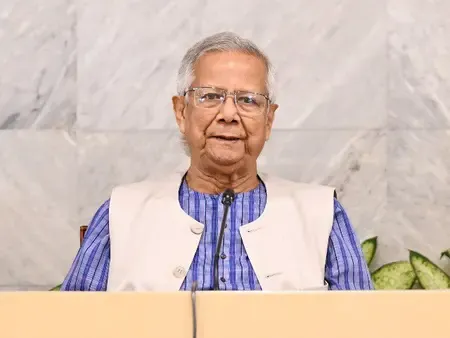
New Delhi, Jan 26 (NationPress) Pakistan has successfully negotiated a covert agreement that could see Mohammad Yunus ascend to the presidency of Bangladesh if the Jamaat-e-Islami gains power. Following the removal of Sheikh Hasina, Yunus has been acting as the caretaker leader of the interim government. Observers of Bangladeshi politics suggest that Yunus has granted several concessions to Pakistan and now seeks a guarantee of his presidency after the upcoming elections in February.
Pakistan has readily accepted this condition, with the Jamaat also in alignment.
Analysts note that Yunus enjoys backing from various Western factions as well as China, who recognize his susceptibility to influence.
His tenure has seen deteriorating relations with India, and experts suggest that a Yunus presidency would complicate New Delhi's dealings with Dhaka.
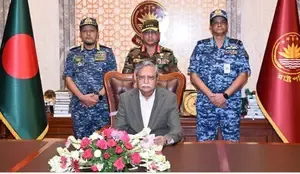
While it is anticipated that current President Mohammed Shahabuddin will yield his position to a Jamaat-led government, the implications of a win by the Bangladesh Nationalist Party (BNP) remain uncertain.
Regardless of the outcome, Yunus is expected to maintain a significant role, capable of exerting influence within the government.
His importance is recognized by the West, Pakistan, and China, who are likely to reward him accordingly.
Yunus has been pivotal in elevating the Jamaat, which would have otherwise placed second, enabling it to contend for power. Many policies favorable to the Jamaat have been enacted under his guidance.
Moreover, Yunus has generously provided grants that have bolstered the Jamaat's election campaign.
He has also played a key role in the release of individuals with extremist backgrounds, which has benefitted the Jamaat by appealing to radical voters.
To ensure Yunus remains influential while steering Bangladesh towards radical governance, both Pakistan and the Jamaat are making extensive efforts.
Although Pakistan can exert some sway over the BNP, it understands that a BNP victory could lead to improved relations with India.
Any ties between Bangladesh and India are viewed unfavorably by both Pakistan and China, prompting a concerted push to ensure a Jamaat victory.
The presidency in Bangladesh wields significant power, including command over the armed forces, authority to dissolve Parliament, and the ability to grant assent to legal bills.
Furthermore, the president can issue pardons and commutations. Should Yunus take office, the Jamaat and Pakistan could exert considerable influence over him.
A source from the Intelligence Bureau reveals that Pakistan and the Jamaat will go to great lengths to maintain their grip on the nation, suggesting that more violence and inflammatory rhetoric are likely ahead of the elections.
In pursuit of votes, the Jamaat is employing a dual strategy.
Recently, some partners of the Jamaat exited the coalition, expressing dissatisfaction with the leadership's reluctance to implement Sharia as the state law if elected.
While most Bangladeshis prefer governance under existing laws, a faction advocates for Sharia law.
The Jamaat is responding by sending leaders to promote Sharia law among the radical elements.
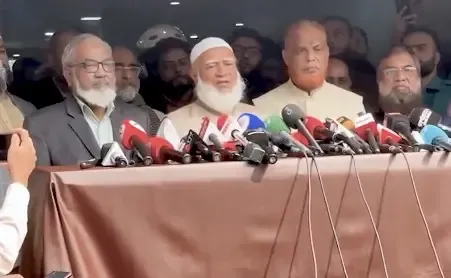
Afzal Hossain, a Jamaat candidate from the Barguna-2 constituency, stated that if his party secures power, the nation would not be governed by the Constitution, but rather by Sharia law.
He also remarked that as an 80% Muslim-majority nation, Bangladesh should not be led by individuals from minority communities.
Another official noted a strong push by the Jamaat to advance its agenda, with Yunus providing unwavering support.
In Yunus, both the Jamaat and Pakistan see a potential puppet president, eager to elevate him to the presidency post-elections.
Point of View
It's crucial to remain impartial while observing the unfolding events in Bangladesh. The potential presidency of Yunus raises critical questions about the future of governance and international relations in the region. We must prioritize transparency and ensure that our reporting reflects the complexities of these developments.
NationPress
19 Sept 2026
Frequently Asked Questions
What role does Muhammad Yunus play in Bangladesh's politics?
Muhammad Yunus has been acting as a caretaker leader in Bangladesh and is positioned to potentially become President if the Jamaat-e-Islami wins the elections. His influence has altered the political landscape significantly.
How does Pakistan influence Bangladesh's political scenario?
Pakistan has been actively negotiating with political factions in Bangladesh, particularly the Jamaat-e-Islami, to ensure favorable outcomes in their favor, including support for Yunus.
What are the implications of a Yunus presidency for India?
Experts suggest that if Yunus becomes President, it would complicate diplomatic relations between Bangladesh and India, given Yunus's previous policies that have strained ties.
What is the Jamaat-e-Islami's strategy for the upcoming elections?
The Jamaat is employing a dual strategy to capture votes, promoting both moderate and radical elements within the population to strengthen their campaign.
Why is Yunus considered significant for international relations?
Yunus is viewed as a key player by Pakistan, China, and Western powers, all of whom recognize his capacity to influence governance in Bangladesh.