Alibaba VP: RISC-V unites US, China, India as 'one ecosystem'
Synopsis
Despite escalating US-China tech tensions, Alibaba VP Xiaoning Qi says RISC-V chip development is thriving as a genuinely global collaboration — with the US, China, India, Brazil, and Europe all working inside the same open-standard ecosystem.
Key Takeaways
Alibaba vice-president Xiaoning Qi said on 7 July 2026 that companies from the US , China , India , Brazil , and Europe are collaborating on RISC-V as “one unified ecosystem.” RISC-V is a free, open-standard instruction set architecture that allows anyone to design CPUs without licensing fees.
China has rapidly increased RISC-V adoption as Washington 's export controls restrict access to foreign proprietary chip technology.
RISC-V International , the governing body, is headquartered in Zurich and maintains a multinational membership base.
Qi drew a parallel between open chip collaboration and international trade, arguing both “promote friendship between different countries.” Policy observers are watching whether Washington may eventually seek to restrict participation in open-standard bodies as part of broader tech-rivalry measures.
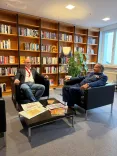
Alibaba Group Holding vice-president Xiaoning Qi declared on Tuesday, 7 July 2026 that global cooperation on the RISC-V open-standard chip architecture is alive and expanding, with companies from the United States, China, India, Brazil, and Europe actively collaborating — even as US-China tech rivalry intensifies. Speaking at a major industry conference in Hong Kong, the semiconductor veteran framed the architecture as a rare bridge across geopolitical divides.
A unified blueprint across borders
Qi described participants in the RISC-V ecosystem as working together “as one unified ecosystem” for both edge and cloud applications. “When we use a single architecture, people from different continents, different cultural backgrounds, we get together, we work together and make friends,” he told the audience. He added that the collaboration also “promote[s] friendship between different countries,” likening it to the goodwill generated by international trade.
What is RISC-V and why does it matter
RISC-V — short for fifth-generation reduced instruction set computer — is an open-standard instruction set architecture that provides a freely accessible blueprint for designing central processing units (CPUs). Unlike proprietary architectures such as those from Arm or Intel, it can be used and modified without licensing fees or geopolitical strings attached. RISC-V International, the governing body headquartered in Zurich, oversees the standard and counts members across dozens of countries.
China's strategic embrace of RISC-V
The architecture has seen a sharp surge in adoption across China, driven largely by Washington's tightening export controls on advanced semiconductors and chip-design tools. With access to foreign proprietary technology increasingly restricted, Beijing and domestic technology companies have accelerated their pivot to RISC-V as a sovereignty-friendly alternative. Alibaba itself has been among the most prominent Chinese contributors to the ecosystem through its T-Head semiconductor unit.
Why it matters
Qi's remarks carry weight precisely because they come from a major Chinese technology conglomerate operating under significant export restrictions. The fact that US and Chinese engineers continue to co-develop under a shared open standard — even as governments restrict chip hardware and software flows — signals that open-source architectures may be carving out a durable, politically neutral space in the global semiconductor landscape. “Collaboration [in RISC-V] is already the reality; it's happening,” Qi said plainly.
What's next
The durability of this cooperation will be tested as Washington considers whether open-standard bodies could become future vectors for technology transfer, a debate already surfacing in policy circles. For now, industry observers will watch whether RISC-V International's membership continues to grow and whether Alibaba and other Chinese firms deepen their contributions to the shared specification. The trajectory of the architecture could reshape how the semiconductor industry navigates the next phase of the chip war.
Point of View
But the chip war is pushing governments to scrutinise every layer of the technology stack, including specification bodies once considered untouchable. What mainstream coverage misses is that China's deep investment in RISC-V is simultaneously a hedge against sanctions and a long-term bid to shape the standard itself — giving Beijing influence it never had over Arm or x86. If Washington moves to restrict open-standard participation, it risks fracturing the very collaborative model that has kept global semiconductor progress efficient for decades.
NationPress
6 Oct 2026
Frequently Asked Questions
What did Alibaba's Xiaoning Qi say about RISC-V collaboration?
Xiaoning Qi , vice-president at Alibaba Group Holding , said on 7 July 2026 that companies from the US , China , India , Brazil , and Europe are working together on RISC-V as “one unified ecosystem.” He described the collaboration as already a reality, not a future aspiration.
What is RISC-V and why is it important?
RISC-V is an open-standard instruction set architecture — a freely available blueprint for designing CPUs — that anyone can use and modify without paying licensing fees. Its importance has grown sharply because it offers an alternative to proprietary architectures from companies like Arm and Intel , making it attractive to countries and firms seeking technological independence.
Why has China adopted RISC-V so rapidly?
China has accelerated its adoption of RISC-V primarily because Washington 's tightening export controls have restricted Chinese access to foreign proprietary chip technology. Because RISC-V is open-source and free to use, it cannot be sanctioned in the same way as commercial chip architectures or design tools.
Who governs the RISC-V standard?
RISC-V International , headquartered in Zurich , is the nonprofit body that oversees the RISC-V specification and manages its global membership. Its multinational structure is central to the argument that the standard sits outside any single government's jurisdiction.
Could US export controls eventually target RISC-V collaboration?
Policy observers note that Washington is increasingly scrutinising all layers of the technology stack, and open-standard bodies are not immune from future regulatory attention. Whether RISC-V International 's cross-border collaboration model remains untouched will be a key indicator of how far the US-China chip rivalry extends into open-source infrastructure.