Bamboo sector reforms boost innovation, create 30 million man-days yearly

Synopsis
A colonial-era law once classified bamboo as a tree, strangling its commercial potential. Since the 2017 reclassification, the sector has generated 30 million man-days of employment annually and pushed value addition from 10% to 70% — with engineered bamboo now building school rooms and disaster-relief shelters at scale.
Key Takeaways
The Centre's 2017 reclassification of bamboo removed it from restrictive British-era forestry regulations .
The reforms have generated approximately 30 million man-days of employment annually.
Value addition for bamboo commodities has risen from 10% to as high as 70% .
Over 42 lakh square feet of engineered bamboo structures have been built for disaster relief and rehabilitation.
In Chhattisgarh , 576 school rooms built from engineered bamboo house around 20,000 children .
NECTAR supports bamboo technologies across food processing, construction, renewable energy, and industrial products.
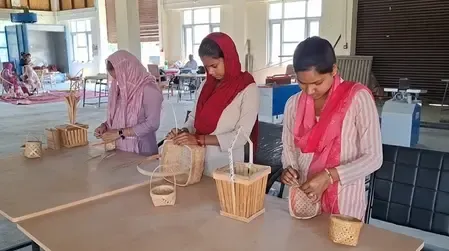
Reforms in India's bamboo sector have unlocked significant opportunities for innovation, entrepreneurship, and value addition across the country, particularly in the Northeast, where the material is reportedly driving employment and new business models, according to a government factsheet released on Saturday. The policy overhaul — rooted in a 2017 reclassification of bamboo — has generated employment of approximately 30 million man-days annually and raised value addition for bamboo commodities from 10 per cent to as high as 70 per cent.
The British-era barrier that held bamboo back
Bamboo has long been intertwined with traditional livelihoods across Indian communities, yet an outdated colonial-era regulation severely limited its economic potential. Under a British-era forestry law, bamboo was classified as a tree, making harvesting and transportation unnecessarily cumbersome for the millions who depended on it.
In 2017, the Centre took what the factsheet described as a 'landmark step' by removing bamboo from this restrictive classification, effectively freeing it from forestry regulations that had constrained its commercial use for decades. This single legislative change set the stage for an entire ecosystem of downstream reforms.
National Bamboo Mission and NECTAR's role
The National Bamboo Mission now focuses on cultivation, processing, and market access for bamboo farmers, manufacturers, and sellers. It also supports nurseries that supply quality planting material — a critical bottleneck in scaling production.
Additionally, the North East Centre for Technology Application and Reach (NECTAR) has backed bamboo technologies across several commercial verticals, including food and agro-processing, construction materials, manufacturing machinery, renewable energy, and industrial products. This comes amid a broader government push to position the Northeast as a hub for bamboo-based industry.
Engineered bamboo transforms construction
One of the most notable outcomes has been the rise of engineered bamboo — a composite material made by binding and compressing raw bamboo fibres, strips, or particles. The material is opening new possibilities in construction, an arena traditionally dominated by steel, concrete, and timber.
Furniture crafted with new designs and engineered bamboo is reportedly gaining popularity among architects, designers, and interior decorators. More than 42 lakh square feet of engineered bamboo structures have been built for disaster relief and rehabilitation, according to the factsheet.
Impact on education infrastructure
In Chhattisgarh, 576 school rooms have been constructed from engineered bamboo, housing approximately 20,000 children. The factsheet noted that this demonstrates how bamboo is moving into construction applications 'once associated only with conventional industrial materials.'
Notably, bamboo's shift from a forest product to a commercially viable industrial input mirrors similar transitions seen with jute and coir — but at a potentially larger scale, given bamboo's versatility and the Northeast's abundant supply. Whether the sector can sustain this momentum will depend on continued investment in processing infrastructure and market linkages beyond government-backed projects.
Point of View
Sustained employment versus seasonal or casual labour? The jump from 10% to 70% value addition is impressive on paper, yet most bamboo processing still happens in unorganised micro-units with limited market reach. The real test is whether engineered bamboo can compete commercially with steel and concrete without perpetual government procurement as a crutch.
NationPress
28 Oct 2026
Frequently Asked Questions
Why was bamboo reclassified in India in 2017?
Bamboo was reclassified in 2017 because a British-era forestry law had categorised it as a tree, making harvesting and transport excessively cumbersome. Removing this classification freed bamboo from restrictive regulations and opened it up for wider commercial use.
How much employment has the bamboo sector generated after reforms?
According to a government factsheet, the bamboo sector reforms have generated approximately 30 million man-days of employment annually. The Northeast has been a primary beneficiary of this employment surge.
What is engineered bamboo and how is it used?
Engineered bamboo is a composite material made by binding and compressing raw bamboo fibres, strips, or particles. It is used in construction, furniture, disaster-relief shelters, and school buildings — over 42 lakh square feet of engineered bamboo structures have been built so far.
What role does the National Bamboo Mission play?
The National Bamboo Mission focuses on cultivation, processing, and market access for bamboo farmers, manufacturers, and sellers. It also supports nurseries that supply quality planting material to address supply-chain gaps.
How many schools in Chhattisgarh use engineered bamboo?
In Chhattisgarh, 576 school rooms have been constructed from engineered bamboo, housing approximately 20,000 children. This is cited as evidence of bamboo entering mainstream construction applications.