CM Himanta flags bamboo's 800+ byproducts, Modi's grass reclassification

Synopsis
Assam CM Himanta Biswa Sarma says bamboo — native to Assam — has over 800 byproducts spanning methanol, ATF, and reinforced structures, and credits PM Modi's reclassification of bamboo as a grass for opening large-scale commercial opportunities across the Northeast.
Key Takeaways
Assam CM Himanta Biswa Sarma highlighted on 2 October 2026 that bamboo has over 800 byproducts , ranging from methanol to Aviation Turbine Fuel (ATF) to reinforced structures.
PM Modi's policy reclassifying bamboo from a 'tree' to a 'grass' under Indian law removed forest-clearance requirements, enabling large-scale commercial use.
The reclassification was achieved through an amendment to the Indian Forest Act, 1927 during the Modi government's first term.
Assam and the broader Northeast hold some of India's largest bamboo reserves, positioning the region as a key beneficiary.
The mention of bamboo-derived ATF points to a potential sustainable aviation fuel pathway with significant global and domestic demand.
CM Sarma's post frames the policy shift as a direct commercial signal to investors and entrepreneurs in the bamboo sector.
A single plant, native to the forests of Assam, may hold the key to everything from aviation fuel to reinforced structures — and a pivotal policy decision by Prime Minister Narendra Modi has unlocked that potential. Assam Chief Minister Himanta Biswa Sarma amplified the point on Friday, 2 October 2026, spotlighting how bamboo's reclassification as a grass under central policy has transformed an entire sector's commercial horizon.
From forest floor to aviation fuel: bamboo's staggering range
The post, shared in response to a comment directed at CM Sarma, lays out a striking case: bamboo — native to Assam and abundant across the Northeast — carries over 800 byproducts. The list is not modest. It stretches from methanol and Aviation Turbine Fuel (ATF) to reinforced construction materials, making bamboo one of the most versatile raw materials in India's natural inventory. 'Bamboo, native to Assam has over 800 byproducts and can be used extensively — from methanol to ATF to reinforced structures and much more,' the post states directly.
The reclassification that changed everything
The hinge of the argument is a specific legislative move: Prime Minister Modi's decision to reclassify bamboo from a 'tree' to a 'grass' under Indian law. Under the old classification, bamboo fell within the definition of a tree, meaning cutting or transporting it required forest clearances — a bureaucratic bottleneck that effectively froze large-scale commercial exploitation. Reclassifying it as a grass stripped away those restrictions for bamboo grown outside notional forest boundaries, allowing farmers, entrepreneurs, and industries to harvest and move it freely.
The reclassification was effected through an amendment to the Indian Forest Act, 1927, passed during the Modi government's first term. For states like Assam, where bamboo grows naturally across vast tracts of land, the move was particularly consequential — it converted an underutilised ecological asset into a commercially viable crop overnight.
Assam's bamboo economy and what the Northeast stands to gain
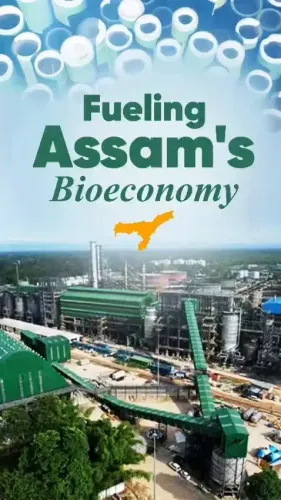
Assam and the broader Northeast are among India's most bamboo-rich regions, holding a significant share of the country's total bamboo reserves. CM Sarma, who also serves as convenor of the North-East Democratic Alliance (NEDA), has consistently framed the region's natural resources as economic leverage — and bamboo fits squarely into that narrative. From bio-energy pathways like methanol and ATF production to high-strength composite materials for construction, the downstream industries bamboo can anchor are capital-intensive and job-generating.
The post's mention of ATF is particularly pointed: sustainable aviation fuel derived from bamboo-based feedstocks is an emerging global priority as the aviation sector faces decarbonisation pressure. If India develops a domestic bamboo-to-ATF pathway, the Northeast — already rich in raw material — stands at the front of that supply chain.
Policy signal, commercial pitch
CM Sarma's amplification of this point is not incidental. It reads as a deliberate signal to investors, entrepreneurs, and central policymakers: the regulatory friction has been removed, the raw material is abundant, and the product range is enormous. The next move belongs to industry. If Assam can convert even a fraction of bamboo's 800-plus byproduct potential into functioning supply chains, the state's rural and agro-industrial economy could look very different within a decade.
Point of View
Using a reply format to amplify a policy win and reframe bamboo as a strategic industrial input rather than a forest product. The reclassification of bamboo as a grass was one of the Modi government's quieter but structurally significant agri-forest reforms — removing a colonial-era legal bottleneck. By invoking ATF alongside methanol and construction materials, Sarma is connecting Assam's raw material advantage to three distinct high-value industries simultaneously, a clear pitch to both central planners and private capital. For the Northeast, where economic marginalisation and connectivity gaps persist, this kind of resource-to-industry framing is increasingly central to the ruling alliance's regional development narrative.
NationPress
2 Oct 2026
Frequently Asked Questions
Why did PM Modi reclassify bamboo as a grass?
PM Modi's government amended the Indian Forest Act, 1927 to reclassify bamboo as a grass rather than a tree. This removed the requirement for forest clearances to harvest and transport bamboo grown outside notional forest areas, making large-scale commercial cultivation and processing legally straightforward.
How many byproducts does bamboo have?
According to Assam CM Himanta Biswa Sarma's post, bamboo has over 800 byproducts, including methanol, Aviation Turbine Fuel (ATF), and reinforced structural materials, among many others.
Can bamboo be used to make aviation fuel?
Yes. Bamboo can serve as a feedstock for producing Aviation Turbine Fuel (ATF) through bio-energy conversion pathways. CM Sarma specifically cited ATF as one of bamboo's key downstream products, pointing to its potential in sustainable aviation fuel production.
Is Assam a major bamboo-producing state in India?
Yes. Assam and the wider Northeast region together hold a significant portion of India's bamboo reserves, making the region particularly well-positioned to benefit from liberalised bamboo policies and downstream industrial investment.
What is the significance of bamboo reclassification for farmers in Assam?
The reclassification means farmers and landowners in Assam can now cultivate, harvest, and sell bamboo without navigating forest department approvals, effectively treating it like any other agricultural crop and opening direct income opportunities from one of the region's most abundant natural resources.