Biren Technology bets on optical 'supernodes' to rival Nvidia at scale

Synopsis
Biren Technology revealed at WAIC 2026 that near-packaged optics can scale Chinese AI chip clusters to 1,024 cards — eight times the copper-wire ceiling — potentially reshuffling the domestic GPU infrastructure race.
Key Takeaways
Biren Technology unveiled its optical 'supernode' architecture at the 2026 World Artificial Intelligence Conference (WAIC) in Shanghai on 18 July 2026 .
Copper-wired electrical connections currently limit server architectures to 128 GPUs per server , according to Biren Vice-President Ding Yunfan .
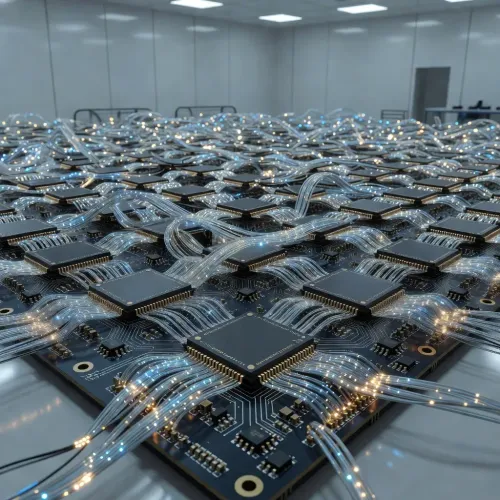
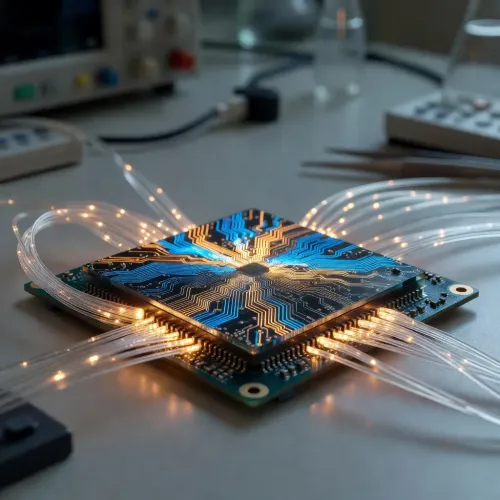
Biren 's near-packaged optics (NPO) approach integrates optical fibres closer to chips, targeting a scale-up to 1,024 accelerator cards per cluster.
Domestic competitors including Enflame , MetaX , and Huawei Technologies are also addressing AI infrastructure interconnect constraints.
ZTE 's CloudBlazer ESL-O signals that optical networking for AI is gaining traction across the broader Chinese tech industry.
US export controls on advanced chips make domestic high-density interconnect solutions a strategic priority for Chinese AI developers.
Biren Technology, the Shanghai-based semiconductor design start-up, has unveiled a next-generation 'supernode' architecture that uses optical data transmission to link up to 1,024 AI accelerator cards within a single cluster — a direct challenge to the interconnect limitations constraining today's GPU infrastructure. The announcement was made at the 2026 World Artificial Intelligence Conference (WAIC) in Shanghai on Friday, 18 July 2026.
Why it matters
The push to scale AI clusters beyond a few hundred chips has become one of the defining engineering problems of the current AI buildout cycle. As foundation models push toward trillions of parameters and AI agent workloads grow more demanding, raw single-chip performance is no longer the primary bottleneck — interconnect bandwidth is.
Ding Yunfan, Vice-President of AI Framework Architecture at Biren, made that point explicit at WAIC. 'Single-GPU performance was no longer sufficient to handle required workloads,' he said, adding that the core challenge was 'transforming massive GPU clusters into integrated, seamless systems.'
The optical interconnect bet
Traditional copper-wired electrical connections are hitting a physical ceiling, according to Ding, effectively restricting current server architectures to 128 GPUs per server. Biren's answer is a distributed, decoupled supernode architecture built around near-packaged optics (NPO) — a technique that integrates optical fibres closer to chips to dramatically increase data transfer speeds.
'Optical interconnect has become an inevitable choice to break through this bottleneck,' Ding said. The NPO-based layout, the company says, would allow Biren to scale clusters to 1,024 cards, an eightfold jump over the copper-wire ceiling.
The competitive backdrop
Biren is not alone in pursuing this direction. Several domestic Chinese players — including names such as Enflame, MetaX, and Huawei Technologies — have been announcing progress on AI infrastructure limitations in recent months. Hyperscalers like Alibaba Group Holding are also deeply invested in the outcome, as interconnect performance directly affects training and inference costs at scale.
Globally, Nvidia's NVLink and Atlas SuperPoD architectures have set the benchmark for tightly coupled GPU clusters. Products such as the CloudBlazer ESL-O from ZTE signal that optical networking for AI is gaining broader industry traction beyond pure chip designers.
What's next
The real test for Biren's supernode architecture will be commercial deployment at hyperscale — whether domestic cloud providers and AI labs will adopt the platform over established alternatives. With US export controls continuing to restrict Chinese firms' access to leading-edge Nvidia hardware, domestic interconnect solutions that can aggregate more modest chips into competitive clusters carry outsized strategic importance.
Watch for follow-on announcements from Biren on customer partnerships and benchmark disclosures, which will determine whether the optical supernode pitch translates from conference stage to data centre floor.
Point of View
Making domestic interconnect innovation the only viable path to competitive compute scale. What mainstream coverage often overlooks is that the 128-GPU copper ceiling is not a Chinese-specific problem — it is an industry-wide constraint that Nvidia itself has addressed through proprietary solutions unavailable to sanctioned buyers. By commoditising the optical interconnect layer, Biren and peers like Huawei are effectively trying to replicate the cluster-level performance that export controls were designed to deny. If NPO-based supernodes prove commercially viable, the strategic calculus behind chip restrictions becomes significantly more complicated.
NationPress
16 Oct 2026
Frequently Asked Questions
What is Biren Technology's supernode architecture?
Biren Technology 's supernode architecture is a distributed, decoupled system that uses near-packaged optics (NPO) to link up to 1,024 AI accelerator cards within a single cluster. It is designed to overcome the physical limits of copper-wired connections, which cap current servers at 128 GPUs .
Why is optical interconnect important for AI chips?
Optical interconnect allows far greater data transfer speeds between chips than copper wiring, enabling larger and more powerful AI clusters. As Biren 's Ding Yunfan noted at WAIC 2026 , 'Optical interconnect has become an inevitable choice to break through this bottleneck' as AI models scale to trillions of parameters.
How does Biren compare to Nvidia on cluster scaling?
Nvidia 's proprietary NVLink and Atlas SuperPoD systems currently set the global benchmark for tightly coupled GPU clusters. Biren 's optical supernode targets 1,024 cards per cluster, positioning it as a domestic Chinese alternative, though commercial validation is still pending.
Which other Chinese companies are working on AI interconnect?
Several Chinese firms are addressing AI infrastructure interconnect constraints, including Enflame , MetaX , Huawei Technologies , and ZTE , whose CloudBlazer ESL-O product targets optical networking for AI workloads. Hyperscaler Alibaba Group Holding is also closely invested in interconnect performance.
Why does this matter given US chip export controls?
US export restrictions have blocked Chinese AI developers from accessing Nvidia 's most advanced cluster hardware, making domestic high-density interconnect solutions strategically critical. A viable optical supernode platform could allow Chinese firms to aggregate domestically produced chips into clusters competitive with restricted hardware.