China opens photonic computing lab in Shanghai to bypass US chip curbs

Synopsis
China has opened its first dedicated photonic computing research lab in Shanghai, positioning light-based chips as a strategic workaround to US export controls that are throttling its AI ambitions — a move that could redefine the global semiconductor race.
Key Takeaways
China launched the Shanghai Key Laboratory of Integrated Photonic Computing Chips and Systems on Wednesday, 11 June 2026 — the country's first industry-academia platform of its kind.
The lab is hosted at Shanghai Jiao Tong University and directed by photonics professor Zou Weiwen .
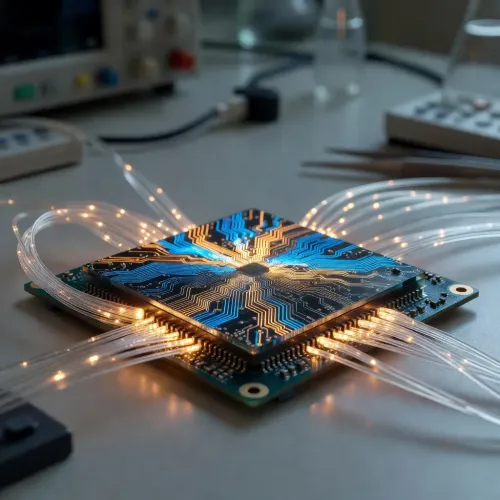
Photonic chips use light particles (photons) instead of electrons, offering faster speeds, lower latency, and significantly reduced energy consumption compared with conventional silicon semiconductors.
Research focus areas include photonic chip architectures, silicon-photonics integration, optical components, and commercial algorithms.
The initiative is a direct response to US export controls restricting China 's access to advanced AI chips, as well as the surging power demands of large AI models.
Lightelligence is among the existing players in Shanghai 's photonics startup ecosystem that could benefit from the new platform.
China has launched its first industry-academia photonic computing research platform in Shanghai, signalling a strategic push to develop light-based chip technology as an alternative to the US-restricted semiconductors constraining its artificial intelligence ambitions. The Shanghai Key Laboratory of Integrated Photonic Computing Chips and Systems was inaugurated on Wednesday, 11 June 2026, and is hosted at Shanghai Jiao Tong University.
What photonic computing is and why it matters
Unlike conventional semiconductors, which rely on electrons moving through silicon circuits, photonic chips use light particles — photons — for data transmission and computation. Because photons travel significantly faster than electrons and generate far less heat, photonic chips can theoretically deliver higher performance at a fraction of the power consumption. That makes them a compelling candidate for the energy-hungry data centres underpinning the global AI boom.The lab's research mandate
Zou Weiwen, director of the new laboratory and a photonics professor at Shanghai Jiao Tong University, described photonic — or optical — computing as 'an important pathway for achieving breakthroughs in computing power, offering advantages in bandwidth, latency, and energy efficiency.' According to reports, the lab will concentrate on photonic chip architectures, silicon-photonics integration, optical components, and the algorithms and commercial applications required to make the technology industrially viable.The competitive backdrop
The launch arrives as technology companies worldwide scramble to secure the massive computing resources needed to train and operate increasingly sophisticated AI models. Surging energy demands and performance requirements are pushing conventional silicon semiconductors toward their physical limits. For China specifically, the pressure is compounded by successive rounds of US export controls that have restricted access to leading-edge chips — including Nvidia's most powerful AI accelerators — forcing domestic researchers and companies to explore alternative computing paradigms.Why it matters for China's AI strategy
Establishing a dedicated national-level laboratory signals that Beijing views photonic computing not as a fringe research area but as a near-term strategic priority. By anchoring the effort at Shanghai Jiao Tong University — one of China's leading engineering institutions — the government is betting on an industry-academia pipeline that can accelerate commercialisation. The platform is reportedly China's first of its kind dedicated exclusively to integrated photonic computing chips and systems.What's next
The lab's success will hinge on bridging the gap between laboratory-scale photonic demonstrations and manufacturable, cost-competitive chips. Observers will be watching whether Shanghai's photonics ecosystem — which includes startups such as Lightelligence — can coalesce around the new platform to accelerate that transition. If photonic computing matures at scale, it could reshape global semiconductor competition well beyond the current chip-war dynamic.Point of View
Cost-competitive chips — most photonic AI accelerator demonstrations remain lab-scale and integration with existing software stacks is immature. The strategic logic is sound, but the timeline is measured in years, not quarters, meaning China's near-term AI compute gap with the West is unlikely to close through photonics alone. The more immediate question is whether this platform accelerates talent consolidation around Shanghai Jiao Tong University in the way that US university-industry clusters have historically done for semiconductor generations.
NationPress
26 Oct 2026
Frequently Asked Questions
What is the Shanghai photonic computing lab and what will it do?
The Shanghai Key Laboratory of Integrated Photonic Computing Chips and Systems is China 's first dedicated industry-academia platform for photonic computing, launched on 11 June 2026 at Shanghai Jiao Tong University . It will research photonic chip architectures, silicon-photonics integration, optical components, and the algorithms needed to make light-based computing commercially viable.
How does photonic computing differ from conventional semiconductor chips?
Photonic chips use light particles (photons) to transmit and process data, whereas traditional semiconductors use electrons moving through silicon. Photons travel faster, generate less heat, and consume far less power, making photonic chips a potentially transformative technology for energy-intensive AI data centres.
Why is China investing in photonic computing now?
China faces two converging pressures: US export controls that restrict access to leading-edge AI chips, and the soaring energy and performance demands of modern AI models that are pushing silicon semiconductors to their physical limits. Photonic computing offers a path that sidesteps both constraints.
Who is leading the new photonic computing laboratory?
Zou Weiwen , a photonics professor at Shanghai Jiao Tong University , has been named director of the new laboratory. He has described photonic computing as 'an important pathway for achieving breakthroughs in computing power, offering advantages in bandwidth, latency, and energy efficiency.'
Which companies are part of China's photonics ecosystem?
Lightelligence is among the Shanghai -based startups operating in the photonic computing space that could align with the new laboratory platform. The broader ecosystem is expected to grow as the government-backed research hub attracts industry partners and accelerates commercialisation efforts.