Nvidia Marks Photonics Expansion in Sherman, Texas

Synopsis
Nvidia CEO Jensen Huang joined Coherent Corp CEO Jim Anderson in Sherman, Texas, to mark expanded US production of photonics components — the lasers and optical links that power modern AI infrastructure — reinforcing the American manufacturing push behind the AI era.
Key Takeaways
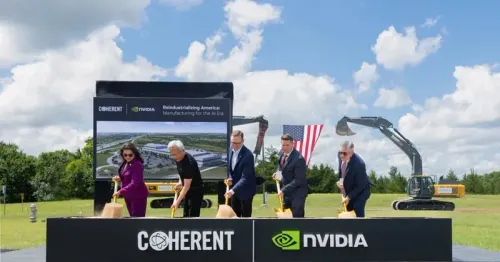
Jensen Huang attended a ceremony in Sherman, Texas , alongside Coherent Corp CEO Jim Anderson to mark expanded photonics manufacturing capacity.
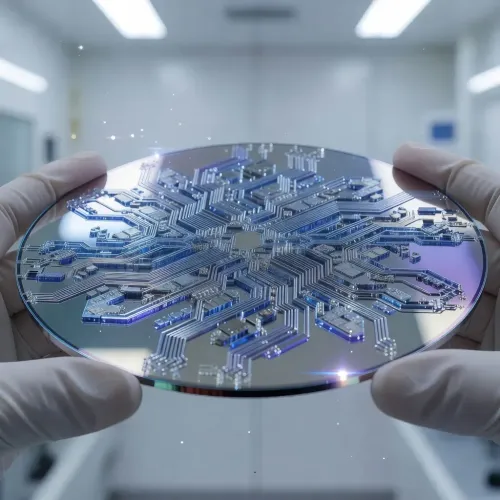
The expansion covers advanced photonics — lasers and optical links — that carry data across large-scale AI systems.
Coherent Corp is a global supplier of photonics and optical materials critical to high-bandwidth data communications.
The investment aligns with the CHIPS and Science Act of 2022 , which incentivises domestic production of advanced manufacturing technologies in the United States .
Nvidia 's participation signals that optical interconnects are now viewed as a strategic component of the AI hardware supply chain, not just GPUs.
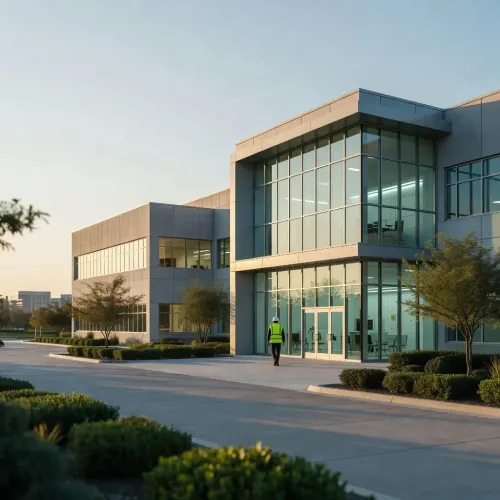
The Sherman, Texas facility strengthens the domestic supply chain for AI infrastructure, reducing reliance on overseas photonics suppliers.
Chip giant Nvidia joined Coherent Corp on Wednesday, 18 June 2026, to mark the expansion of advanced photonics manufacturing capacity in Sherman, Texas, with Nvidia chief executive Jensen Huang and Coherent Corp CEO Jim Anderson appearing alongside local leaders at the event.
Context
The event in Sherman, Texas centred on the scaling up of domestic production of photonics components — the lasers and optical links that carry data at high speed across modern AI infrastructure. Nvidia's post stated plainly: 'AI infrastructure runs on more than compute. It runs on light.' The remark underscores how optical interconnects, not just silicon chips, are now considered critical to the performance of large-scale AI systems.
Coherent Corp is a global supplier of photonics, lasers, and optical materials used in data communications. Its CEO, Jim Anderson, co-hosted the ceremony alongside Jensen Huang, signalling a deepening alignment between the two companies on AI hardware supply chains.
Policy Backdrop
The Sherman expansion fits squarely within the industrial policy push set in motion by the CHIPS and Science Act of 2022, which created federal incentives for domestic production of semiconductors and advanced manufacturing technologies. Photonics components, which enable the high-bandwidth optical interconnects required by large GPU clusters, fall within the broader category of critical hardware that US policymakers have sought to reshore.
The legislation has catalysed a wave of private-sector investments across the United States, with companies in chips, packaging, and now optical components announcing or expanding domestic facilities. Sherman, Texas has emerged as one of the beneficiaries of this trend, having previously attracted semiconductor-adjacent investments to its industrial base in North Texas.
Stakeholders and Impact
For US data-centre operators and AI infrastructure builders, domestic photonics capacity reduces dependence on overseas suppliers for components that are as essential to system performance as the GPUs themselves. High-bandwidth optical links are the arteries of any large-scale AI cluster, and supply-chain disruptions in this segment can bottleneck entire deployments.
Nvidia, whose accelerators power the majority of commercial AI training and inference workloads globally, has a direct interest in ensuring that the full stack of AI infrastructure — from compute to connectivity — is reliably sourced. The company's visible presence at the Coherent Corp event signals that it views photonics supply as strategically important, not merely incidental.
For Sherman and the broader North Texas region, the expansion represents manufacturing jobs and investment in a specialised, high-value industrial segment. Local leaders joining Huang and Anderson at the event reflects the economic significance the city attaches to the facility.
What's Next
Analysts and industry observers will watch for further site expansions by Coherent Corp, additional supplier announcements from Nvidia's hardware ecosystem, and any federal funding awards under CHIPS Act provisions that could extend to photonics or optical-component facilities. The Sherman event may also accelerate similar moves by competing optical-component suppliers seeking to position themselves as preferred domestic vendors for AI infrastructure projects.
Point of View
Nvidia is positioning optical interconnects as a co-equal pillar of AI infrastructure — a framing that has direct implications for how policymakers and investors assess the full hardware stack. This move also reinforces the CHIPS Act's broader logic: that US competitiveness in AI is inseparable from domestic control over every critical component layer, from chips to the light that connects them. For India, which is building its own AI infrastructure ambitions, the episode is a reminder that photonics and optical supply chains are fast becoming a new frontier in the global technology competition.
NationPress
15 Sept 2026
Frequently Asked Questions
What did Nvidia announce in Sherman, Texas?
Nvidia CEO Jensen Huang joined Coherent Corp CEO Jim Anderson in Sherman, Texas, to mark the expansion of US manufacturing capacity for advanced photonics — the lasers and optical components that carry data across AI infrastructure systems.
What is Coherent Corp and why does it matter for AI?
Coherent Corp is a global supplier of photonics, lasers, and optical materials used in data communications. Its components form the optical interconnects that link GPUs in large AI clusters, making it a critical supplier in the AI hardware supply chain.
What is the role of photonics in AI infrastructure?
Photonics components — including lasers and optical links — move data at high speed between processors in AI data centres. As GPU clusters grow larger, optical interconnects become essential for maintaining the bandwidth needed for training and inference workloads.
How does the CHIPS Act relate to this photonics expansion?
The CHIPS and Science Act of 2022 created federal incentives to expand domestic US production of semiconductors and advanced manufacturing technologies. The Sherman photonics expansion aligns with this policy push to reshore critical AI hardware supply chains.
Why is Sherman, Texas becoming a hub for advanced manufacturing?
Sherman, Texas, in North Texas, has attracted semiconductor-adjacent and advanced manufacturing investments in recent years, partly driven by federal incentives under the CHIPS Act and its lower-cost industrial land compared to coastal technology hubs.