China-Nepal glacier warning system tested by deadly Himalayan flood
Synopsis
A cross-border China-Nepal early warning system celebrated seven successful glacial flood alerts in a paper published the same day a deadly ice-rock avalanche killed nearly 300 people — exposing a critical gap between monitored outburst floods and sudden high-energy geophysical collapses.
Key Takeaways
A high-altitude ice-rock avalanche struck the China-Nepal border on Wednesday, 27 August 2026 , triggering a flash flood that reached Gyirong county, Tibet .
Nearly 300 people were confirmed dead and more than 1,000 reported missing as of Thursday afternoon .
A paper published in the Journal of Glaciology and Geocryology on the same day reported the monitoring system had issued seven successful early warnings , including one at the China-Nepal border the previous year.
It remains unclear whether the system detected any anomaly before Wednesday's disaster; Wang Weicai of CAS had not responded to requests for comment.
A glaciologist in Chengdu, Sichuan , noted that ice-rock avalanches 'release enormous energy and are far more destructive than typical glacial lake outburst floods,' suggesting current systems may not cover this hazard type.
Chinese and Nepali scientists built a cross-border early warning system to detect Himalayan glacial lake outburst floods, and it has issued timely alerts over several years — but a catastrophic ice-rock avalanche on Wednesday, 27 August 2026 exposed the limits of existing technology, killing nearly 300 people and leaving more than 1,000 missing across both countries.
What happened
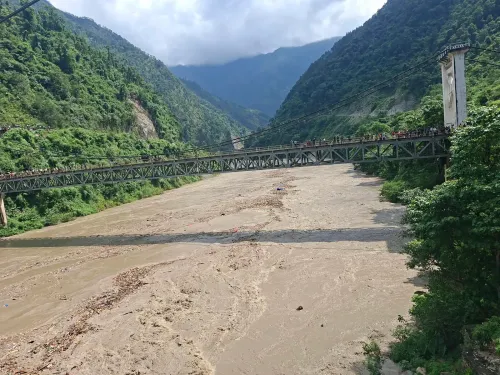
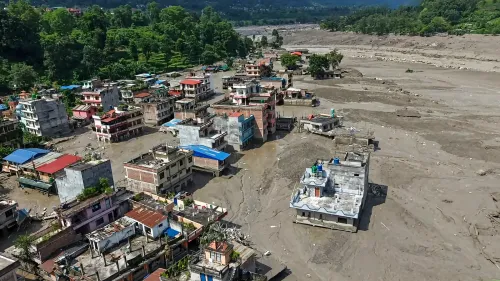
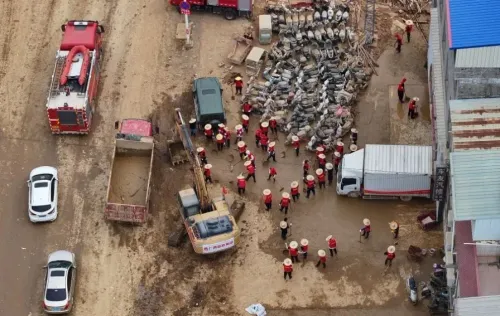
A high-altitude ice-rock avalanche struck without warning, sending a massive debris flow into a river in Nepal. The resulting flash flood surged downstream into Gyirong county in China's Tibet region, overwhelming communities along the Boqu River corridor. By Thursday afternoon, the confirmed death toll stood at nearly 300, with over 1,000 people still unaccounted for. Some experts believe the disaster was triggered by glacial rock collapse rather than a conventional glacial lake outburst.
The early warning system
The monitoring network — developed under China's second Qinghai-Tibet scientific expedition — covers glacial lakes and ice avalanche zones along the China-Nepal border. According to a paper published on the same day as the disaster in the peer-reviewed Journal of Glaciology and Geocryology, the system had 'successfully issued seven early warnings, including one at the China-Nepal border last year.' The project team cited coverage of the Yarlung Tsangpo River's Sedongpu area and the Cirenma Co glacial lake as specific successes.
It remains unclear whether the system detected any anomaly or issued an alert before Wednesday's disaster. Lead author Wang Weicai of the Chinese Academy of Sciences (CAS) had not commented as of the time of reporting.
Why it matters
Ice-rock avalanches are fundamentally different — and more dangerous — than the glacial lake outburst floods the monitoring network was primarily designed to detect. 'High-altitude ice-rock avalanches release enormous energy and are far more destructive than typical glacial lake outburst floods,' a glaciologist from a research institute in Chengdu, Sichuan province, said on Thursday. This distinction matters because it suggests current sensor arrays and alert thresholds may not be calibrated for the fastest-moving and highest-energy failure modes.
The competitive backdrop
The Himalayan region hosts the largest concentration of glaciers outside the polar zones, and accelerating melt driven by climate change is increasing the frequency and unpredictability of glacial hazards. The Institute of Tibetan Plateau Research under CAS, led by researchers including Kang Shichang, has been at the forefront of high-altitude monitoring globally. Wednesday's disaster, occurring on the same day the team published evidence of the system's successes, throws into sharp relief the gap between monitored flood events and sudden geophysical collapses.
What's next
Investigators will need to determine whether the China-Nepal early warning infrastructure registered any precursor signals before the avalanche and, if so, why no alert reached downstream communities in time. The answer will shape the next generation of cross-border disaster monitoring architecture across the Himalayas — and determine how much further investment is needed to cover ice-rock failure scenarios that current systems were not built to anticipate.
Point of View
Which move faster and carry more destructive energy. This is not merely a technical gap; it reflects a broader pattern in climate-adaptation investment where systems are designed for the hazards scientists can already model, not the ones accelerating climate change is making more frequent. With the Himalayas warming at roughly twice the global average rate, the mismatch between sensor capability and hazard evolution will only widen. The real policy question is whether cross-border monitoring programmes — which depend on diplomatic continuity between China and Nepal — can be upgraded fast enough to cover the full spectrum of glacial failure modes before the next catastrophe.
NationPress
27 Aug 2026
Frequently Asked Questions
What caused the deadly flood on the China-Nepal border on 27 August 2026?
A high-altitude ice-rock avalanche triggered a massive debris flow into a river in Nepal, generating a flash flood that swept into Gyirong county in China's Tibet region. Some experts believe the disaster was caused by glacial rock collapse rather than a standard glacial lake outburst flood.
Did the China-Nepal early warning system issue an alert before the disaster?
It remains unclear whether the system detected any anomaly or issued an alert before Wednesday's avalanche. Lead author Wang Weicai of the Chinese Academy of Sciences had not commented as of the time of reporting.
How many people were killed or missing in the Gyirong county flood?
As of Thursday afternoon, nearly 300 people were confirmed dead and more than 1,000 reported missing across Nepal and China's Tibet region combined.
What is the China-Nepal Himalayan glacial lake early warning system?
It is a cross-border monitoring network developed under China's second Qinghai-Tibet scientific expedition, designed to detect glacial lake outburst floods along the Himalayan border. According to a paper in the Journal of Glaciology and Geocryology, it had successfully issued seven early warnings before the August 2026 disaster.
Why are ice-rock avalanches more dangerous than glacial lake outburst floods?
Ice-rock avalanches release far greater energy than glacial lake outburst floods, making them more destructive and harder to predict with existing sensor networks. A glaciologist based in Chengdu, Sichuan province, explained that this energy difference means current early warning thresholds may not be adequate for this hazard type.