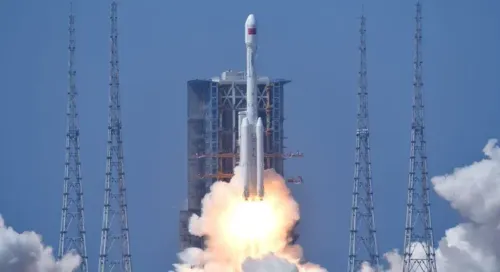
China recovers Long March 10B rocket after maiden launch

Synopsis
China recovered the reusable first stage of the Long March 10B rocket after its maiden launch on 10 July 2026, catching the booster on a sea-based net platform — a SpaceX-style milestone that signals China's commercial launch industry is operationally closing the gap with Western rivals.
Key Takeaways
The Long March 10B completed its maiden launch from Wenchang Space Launch Site , southern China, on 10 July 2026 at 12:15 pm local time .
The rocket stands 70 metres tall and 5 metres wide, classifying it as a medium-lift vehicle.
The first stage returned vertically and was recovered on a sea-based net platform , according to state news agency Xinhua .
The recovery method mirrors SpaceX Falcon 9 -style booster landing, enabling potential booster reuse to cut launch costs.
The successful recovery positions China's launch sector as a credible competitor in the global reusable rocket market.
China has successfully recovered the reusable first stage of the Long March 10B rocket following its maiden launch on 10 July 2026, marking a significant milestone in the country's push toward reusable space launch technology. The rocket lifted off from the Wenchang Space Launch Site in southern China at 12:15 pm local time, with the first-stage booster returning vertically and being caught by a sea-based net platform, according to state news agency Xinhua.
The rocket at a glance
The Long March 10B is a medium-lift vehicle standing 70 metres (230 feet) tall and 5 metres wide. The rocket's dimensions and payload class position it as a workhorse-tier launcher, designed to serve a broad range of commercial and government satellite missions.Why it matters
The vertical landing and sea-platform recovery of the first stage mirrors the approach pioneered by SpaceX with its Falcon 9 booster, a technique that dramatically reduces per-launch costs by enabling booster reuse. China's successful demonstration of this capability signals that its domestic launch industry is closing the operational gap with commercial Western counterparts. Reusable rockets are widely seen as the defining competitive advantage in the global launch market.The competitive backdrop
China has been accelerating investment in next-generation launch vehicles as domestic commercial space companies — alongside state-backed programmes — race to capture a share of the rapidly growing satellite deployment market. The Long March 10B's debut adds a proven reusable option to China's launch manifest. The sea-based recovery method, rather than a land pad, also suggests the programme is designed to support launches from Wenchang's coastal location with flexible downrange recovery logistics.What's next
The recovery of the first stage opens the door to reflights, which will be the true test of the booster's reusability credentials. Analysts will be watching for how quickly the recovered stage is inspected, refurbished, and cleared for a second mission — the timeline for that turnaround will determine whether the Long March 10B can genuinely compete on cost with established reusable launchers. Further details on the payload carried during the maiden flight are expected to follow from official channels.Point of View
China is demonstrating it can replicate and operationalise reusable launch capabilities indigenously. What mainstream coverage often misses is that the sea-platform recovery approach also sidesteps the logistical constraints of inland landing zones, giving the Long March 10B operational flexibility that could appeal to commercial customers launching into low-inclination orbits. The real metric to watch is reflght cadence — if China can turn this booster around in weeks rather than months, the cost economics of the global launch market shift materially.
NationPress
8 Oct 2026
Frequently Asked Questions
What is the Long March 10B rocket?
The Long March 10B is a Chinese medium-lift reusable rocket standing 70 metres tall and 5 metres wide. It conducted its maiden launch from the Wenchang Space Launch Site in southern China on 10 July 2026.
Did China successfully recover the Long March 10B rocket?
Yes. The first stage of the Long March 10B was successfully recovered after the maiden launch on 10 July 2026. According to state news agency Xinhua, the booster returned vertically and was caught by a sea-based net platform shortly after liftoff.
Where did the Long March 10B launch from?
The Long March 10B lifted off from the Wenchang Space Launch Site, located in southern China, at 12:15 pm local time on 10 July 2026.
Why is a reusable rocket recovery significant for China?
Recovering and reusing rocket boosters dramatically reduces the cost of reaching orbit, a capability that SpaceX demonstrated commercially with the Falcon 9. China's successful recovery of the Long March 10B first stage signals that its launch industry can now compete on cost and technology with leading Western providers.
What happens next with the Long March 10B?
The recovered first stage will undergo inspection and refurbishment before being cleared for a second flight. The speed of that turnaround will be the key indicator of whether the Long March 10B can match the operational tempo of established reusable launchers in the global market.