China, Russia complete first joint Arctic sea ice survey on Xuelong 2
Synopsis
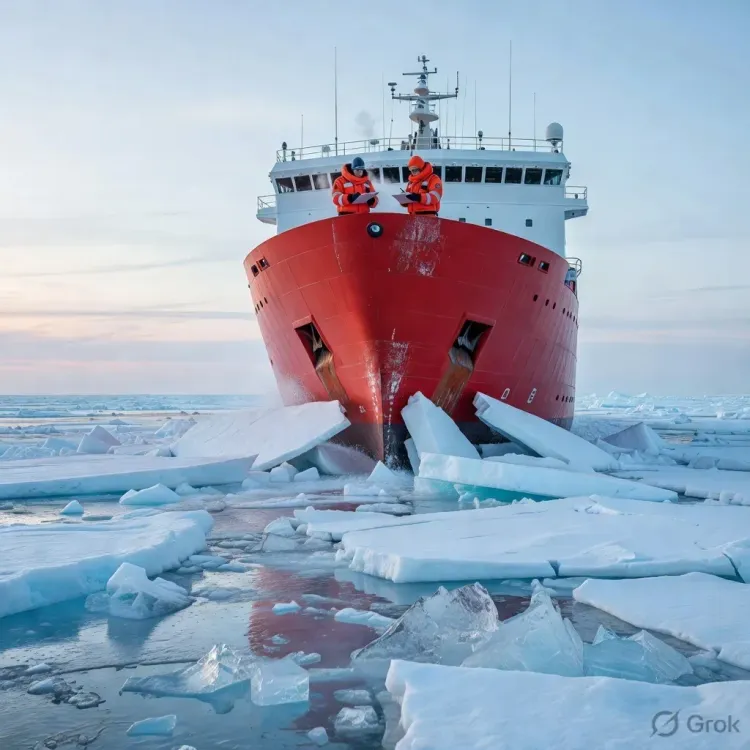
For the first time, Chinese and Russian scientists conducted a joint on-site sea ice survey aboard the icebreaker Xuelong 2, a concrete step toward coordinated control of the Polar Silk Road as Arctic ice retreats faster than any climate model predicted.
Key Takeaways
China and Russia completed their first joint on-site Arctic sea ice survey aboard the research icebreaker Xuelong 2 during China's 16th Arctic Ocean Expedition .
Two researchers from Russia's Arctic and Antarctic Research Institute boarded Xuelong 2 to conduct coordinated field observations.
Lin Long , captain of the Xuelong 2 sea ice team, called the joint observation more 'practical' than previous Chinese Arctic voyages.
Lead engineer Evgeniy Kozlovskiy said the collaboration allowed the Russian team to learn from Chinese sea ice observation methods.
The survey data covers ice concentration, thickness, type, snow cover, atmospheric factors, and large animal sightings, intended to complement satellite remote sensing.
The exercise is expected to lay the foundation for broader international Arctic scientific cooperation, according to state broadcaster CCTV .
China and Russia have conducted their first joint on-site sea ice survey in the Arctic Ocean, with two Russian scientists boarding the Chinese research icebreaker Xuelong 2 as part of China's 16th Arctic Ocean Expedition. The milestone collaboration, reported by state broadcaster CCTV on Saturday, September 7, 2026, comes as geopolitical and economic competition over the rapidly warming northern region intensifies.
What the joint survey involved
Two researchers from Russia's Arctic and Antarctic Research Institute joined the Xuelong 2 crew to carry out coordinated field observations along the vessel's route. The team recorded data on sea ice concentration, thickness and type, snow cover, atmospheric conditions, and large animal sightings — information that complements satellite remote sensing and deepens scientific understanding of climate change, according to the report.
Lin Long, captain of the Xuelong 2 sea ice team, described the joint observation as more 'practical' than previous Chinese Arctic voyages, signalling a qualitative step up from earlier expeditions.
Russian perspective on the collaboration
Evgeniy Kozlovskiy, a lead engineer at the Russian Arctic and Antarctic Research Institute, said: 'By taking part in this joint observation, we were able to learn from the Chinese team's experience in sea ice observation and draw on the valuable aspects of their observation methods.' The quote, carried by CCTV, underscores a reciprocal knowledge exchange rather than a one-sided technology transfer.
Why it matters
The Arctic is warming roughly four times faster than the global average, steadily opening the Polar Silk Road — a northern shipping corridor that could dramatically cut transit times between Asia and Europe. Both Beijing and Moscow have strategic incentives to jointly map and monitor sea ice conditions along the route, which passes through the Chukchi Sea and other contested waters near Alaska.
The survey data is also expected to lay the groundwork for broader international scientific cooperation, according to the report, potentially drawing in additional partners beyond the current bilateral framework.
The competitive backdrop
Western nations, particularly the United States and Norway, have grown increasingly wary of deepening China-Russia coordination in the Arctic, a region rich in untapped hydrocarbons and rare minerals. China formally designated itself a 'near-Arctic state' in 2018 and has since expanded its icebreaker fleet, with Xuelong 2 — built at Dalian — representing its most advanced polar research vessel to date.
What's next
The findings from China's 16th Arctic Ocean Expedition are expected to feed into both nations' climate modelling and navigation planning for the Polar Silk Road. As melting accelerates and economic stakes rise, watch for additional joint expeditions, potential data-sharing agreements, and growing pushback from Western Arctic Council members seeking to limit Beijing's polar footprint.
Point of View
Not just the diplomatic one. Mainstream coverage focuses on climate science, but the strategic subtext is navigation sovereignty — whoever best maps and monitors Arctic sea ice conditions holds an asymmetric advantage over the Polar Silk Road's commercial and military routing. What goes underreported is that this expedition mirrors the pattern seen in China-Russia joint military exercises: incremental, deniably civilian steps that cumulatively shift the balance of influence. Western Arctic Council members, already sidelined by the Russia-Ukraine war's diplomatic fallout, now face a coordinated Sino-Russian data ecosystem in the Arctic that they are structurally excluded from.
NationPress
24 Oct 2026
Frequently Asked Questions
What happened during China and Russia's joint Arctic survey on Xuelong 2?
Two Russian scientists from the Arctic and Antarctic Research Institute boarded China's Xuelong 2 icebreaker and jointly observed sea ice conditions alongside the Chinese crew. They recorded data on ice concentration, thickness, type, snow cover, atmospheric factors, and large animal sightings as part of China's 16th Arctic Ocean Expedition .
Why is the China-Russia Arctic sea ice survey significant?
It marks the first joint on-site sea ice survey between the two nations in the Arctic Ocean , representing a concrete operational step in their polar cooperation. The Arctic is warming rapidly, opening the Polar Silk Road shipping route, and coordinated sea ice data gives both countries a strategic edge in navigating and potentially controlling that corridor.
What is the Polar Silk Road and why do China and Russia care about it?
The Polar Silk Road is a northern sea route through the Arctic Ocean that could dramatically shorten shipping distances between Asia and Europe . As sea ice retreats due to climate change, China and Russia — both with major economic interests in Arctic resources and transit fees — are investing heavily in the science and infrastructure needed to exploit the route.
Who is Evgeniy Kozlovskiy and what did he say about the expedition?
Evgeniy Kozlovskiy is a lead engineer at Russia's Arctic and Antarctic Research Institute who participated in the joint survey. He said: 'By taking part in this joint observation, we were able to learn from the Chinese team's experience in sea ice observation and draw on the valuable aspects of their observation methods.'
How does this Arctic survey affect Western nations?
Western countries, particularly the United States and Norway , are increasingly concerned about deepening China-Russia coordination in the Arctic . A joint Sino-Russian sea ice data ecosystem could give both nations an informational and navigational advantage that Western Arctic Council members — already diplomatically strained by the Russia-Ukraine war — are poorly positioned to counter.