Dongfang Suanxin unveils DF1000 AI chip to rival Nvidia
Synopsis
Shanghai start-up Dongfang Suanxin has unveiled the DF1000 — a 14nm AI chip delivering 520 teraflops — backed by Alibaba, JD.com, and Xiaomi, with mass shipments targeted for late 2026. Its architecture-first strategy is the most explicit Chinese attempt yet to build an Nvidia alternative that doesn't depend on restricted US technology.
Key Takeaways
Dongfang Suanxin (Shanghai Oriental Computing Technology) unveiled its AI chip road map on Monday, 13 July 2026 in Shanghai .
Its flagship DF1000 processor, built on a 14-nanometre node, is rated at 520 teraflops (BF16), 6.4 TB/s memory bandwidth, and 900 GB/s scale-up bandwidth.
The company's strategy relies on software-defined computing and 3D-stacked near-memory architecture to avoid dependence on restricted advanced manufacturing processes.
Backers reportedly include the National Artificial Intelligence Industry Investment Fund , Alibaba , JD.com , and Xiaomi .
Mass production is complete and commercial shipments are expected before the end of 2026 , according to the company.
Founder Wei Shaojun called for 'independent architecture, original technology, a self-sustaining ecosystem and a secure, controllable supply chain.'
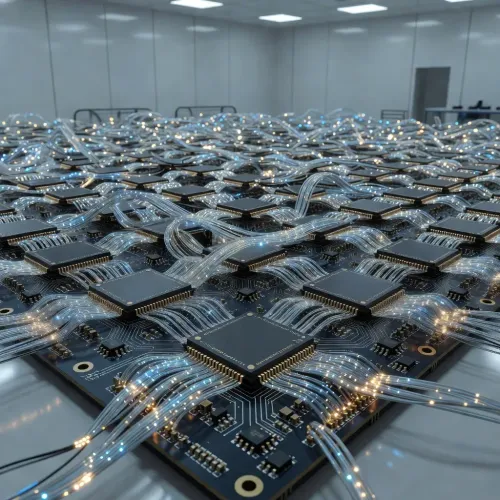
Dongfang Suanxin, a Shanghai-based semiconductor start-up backed by state funds and domestic tech giants, has unveiled an aggressive chip road map aimed squarely at displacing Nvidia as the dominant AI processor supplier — using alternative architectures designed to work around United States-led export controls. The company made the announcement on Monday, 13 July 2026, marking one of the most detailed public challenges yet to American chip supremacy in AI computing.
The architecture play: sidestepping US restrictions
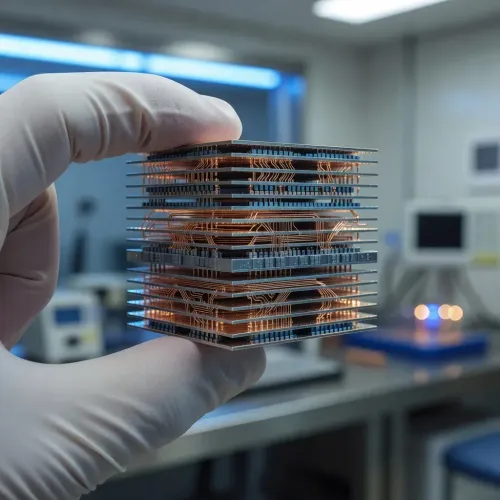
The company's strategy centres on two unconventional technologies: software-defined computing and 3D-stacked near-memory architecture. Software-defined computing dynamically reconfigures a chip's processing and data-flow resources to match different workloads, reducing dependence on the bleeding-edge fabrication nodes that Washington has restricted. 3D-stacked near-memory architecture places memory layers vertically atop computing cores rather than side by side on a circuit board, cutting data-travel distances and lowering both latency and energy consumption.
Together, the two approaches are intended to let Dongfang Suanxin — formally known as Shanghai Oriental Computing Technology — extract competitive AI performance from manufacturing processes still accessible to Chinese firms, according to the company.
The DF1000: specs and timeline
The company debuted its flagship processor, the DF1000, a chip built on a 14-nanometre process node. According to company specifications, it delivers 520 teraflops of computing performance in the BF16 numerical format — the standard precision used for training large AI models. The chip also offers 6.4 terabytes per second of memory bandwidth and 900 gigabytes per second of scale-up bandwidth for inter-chip communication.
The DF1000 is reportedly ready for mass production, with commercial shipments expected before the end of 2026, according to the company. The launch positions Dongfang Suanxin among a growing cohort of Chinese fabless designers racing to fill the AI hardware gap left by Nvidia's restricted H100 and H800 lines.
Why it matters: the founder's vision
Founder Wei Shaojun was unambiguous about the company's intent at the launch event. 'We have to forge a path of our own,' he said. 'That path cannot be about passively catching up within a framework set by others. We need independent architecture, original technology, a self-sustaining ecosystem and a secure, controllable supply chain.'
The statement signals that Dongfang Suanxin is not simply attempting to clone Nvidia's roadmap but is betting that a clean-sheet architectural approach can leapfrog incremental hardware competition. Backers reportedly include the National Artificial Intelligence Industry Investment Fund, alongside major domestic tech names including Alibaba, JD.com, and Xiaomi, as well as institutional ties to Tsinghua University through the CAAP research lineage.
Competitive backdrop
The announcement comes as China's AI hardware ecosystem faces sustained pressure from successive rounds of US export controls that have blocked access to Nvidia's most advanced data-centre GPUs. Domestic rivals such as Dianfeng and Huawei's Ascend line are already shipping products, and the China Semiconductor Industry Association has publicly called for accelerated domestic alternatives. Dongfang Suanxin's 14nm process node — accessible through domestic foundries — is a deliberate design choice that sidesteps reliance on TSMC or restricted advanced nodes.
What's next
Analysts will be watching whether the DF1000's real-world cluster performance matches its paper specifications, particularly at scale — an area where Nvidia's NVLink interconnect ecosystem has historically been difficult to replicate. The company's ability to secure software ecosystem buy-in from Chinese AI labs and cloud providers will be equally decisive. If mass production begins on schedule by late 2026, it could represent a meaningful inflection point in China's push for AI self-sufficiency.
Point of View
And China's fragmented AI framework landscape remains a structural liability. The state-fund and hyperscaler backing — Alibaba, JD.com, Xiaomi — suggests this is as much a captive-customer strategy as a technology play, mirroring how Google's TPU programme succeeded by internalising demand. The deeper signal is that Washington's export controls are accelerating architectural divergence rather than simply delaying Chinese AI progress, which may produce a bifurcated global AI hardware market faster than most forecasters expect.
NationPress
12 Oct 2026
Frequently Asked Questions
What is the Dongfang Suanxin DF1000 AI chip?
The DF1000 is a 14-nanometre AI processor developed by Shanghai -based start-up Dongfang Suanxin , rated at 520 teraflops of BF16 computing performance, 6.4 TB/s memory bandwidth, and 900 GB/s inter-chip bandwidth. It was unveiled on 13 July 2026 and is positioned as a domestic Chinese alternative to Nvidia 's restricted data-centre GPUs.
How does Dongfang Suanxin plan to compete with Nvidia?
Dongfang Suanxin is using software-defined computing and 3D-stacked near-memory architecture instead of trying to replicate Nvidia's approach on advanced nodes that are restricted by US export controls. Software-defined computing dynamically tailors chip resources to different workloads, while 3D stacking places memory closer to computing cores to cut latency and power use.
Who is backing Dongfang Suanxin?
Dongfang Suanxin is reportedly backed by the National Artificial Intelligence Industry Investment Fund — a state-linked vehicle — as well as domestic tech giants Alibaba , JD.com , and Xiaomi . The company also has institutional ties to Tsinghua University through the CAAP research lineage.
When will the DF1000 chip be available?
According to the company, the DF1000 is already ready for mass production, with commercial shipments expected to begin before the end of 2026 . The timeline has not been independently verified.
Why is the DF1000 significant for the US-China chip war?
The DF1000 represents one of the most detailed public attempts by a Chinese firm to build a competitive AI processor that deliberately avoids dependence on US-restricted advanced manufacturing nodes or memory technology. Its launch signals that successive rounds of US export controls may be accelerating architectural divergence in global AI hardware rather than simply delaying Chinese progress, with implications for cloud providers, AI labs, and policymakers on both sides.