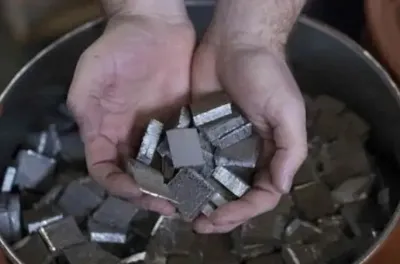
China's rare earth dominance has a patent blind spot, study warns
Synopsis
A study by Chinese state-affiliated researchers admits that Japan and the US control the patents behind more than 80% of high-value rare earth applications — exposing a structural gap in China's much-feared resource dominance that raw material export bans alone cannot fix.
Key Takeaways
Researchers from the University of Science and Technology of China concluded that key patents for advanced rare earth functional materials are largely controlled by Japan and the United States .
Downstream rare earth products — including permanent magnets, catalysts, luminescent materials, and polishing compounds — represent more than 80 per cent of rare earth-related patents globally.
The study was published in the Bulletin of the Chinese Academy of Sciences on 5 July 2026 , signalling official-level acknowledgement of the technology gap.
The researchers stated directly: 'China is not in a leading position in mastering key core technologies in certain fields.' The findings challenge the assumption that China's upstream mining and refining dominance translates into full-spectrum strategic control over rare earth supply chains.
Despite commanding the world's rare earth mining and refining supply chains, China holds a critical technological vulnerability in high-end rare earth applications — a finding that challenges the conventional narrative of Beijing's strategic supremacy in the sector. Researchers from the University of Science and Technology of China published the assessment in the latest issue of the Bulletin of the Chinese Academy of Sciences, dated 5 July 2026.
The core finding
The study shifts analytical focus away from raw material reserves and production volumes toward the patent landscape governing advanced rare earth functional materials. Its conclusion is stark: Japan and the United States retain dominant control over key patents underpinning the most commercially valuable downstream applications. 'China is not in a leading position in mastering key core technologies in certain fields,' the researchers wrote directly in the paper.
Why it matters
Downstream rare earth functional materials — including permanent magnets, catalysts, luminescent materials, and polishing compounds — account for more than 80 per cent of rare earth-related patents worldwide. These are the components embedded in electric vehicles, wind turbines, semiconductors, defence systems, and consumer electronics, making them the industry's most commercially critical tier. Controlling raw ore extraction means little if the intellectual property required to convert those materials into high-value products sits with foreign competitors.
The competitive backdrop
China processes an estimated 85–90 per cent of the world's rare earths and has periodically weaponised export restrictions as geopolitical leverage. Yet the new research, published in a flagship journal of the Chinese Academy of Sciences, represents a rare instance of Chinese state-affiliated institutions publicly acknowledging a structural gap in the country's technological stack. The candour signals that policymakers may be under pressure to accelerate domestic R&D investment in functional materials rather than rely solely on upstream resource control.
What's next
The study's publication in an official Academy journal suggests it is intended to inform industrial policy rather than remain an academic exercise. Industry analysts note that bridging the patent gap in permanent magnets and luminescent materials alone would require years of sustained R&D, licensing negotiations, or strategic acquisitions — none of which are quick fixes. The findings are likely to intensify scrutiny of rare earth value chains at a time when the United States, Japan, and the European Union are all accelerating efforts to reduce dependence on Chinese-processed rare earths.
How quickly China can close the functional-materials patent deficit will determine whether its upstream dominance translates into lasting strategic leverage or remains a commodity-level advantage in an increasingly technology-defined supply chain.
Point of View
Published inside China's own premier scientific establishment, reveals the more consequential battle is happening in intellectual property, not in mines. Japan's decades-long investment in rare earth processing chemistry and the US patent portfolio in magnet and catalyst technologies mean that even a total Chinese export embargo would not strip Western manufacturers of the know-how to rebuild supply chains over time. What mainstream coverage misses is that this admission from Chinese state-affiliated researchers is itself a policy signal: Beijing is likely to funnel significant capital into functional-materials R&D, potentially reshaping the competitive dynamics of the global critical-minerals race within a decade. The countries most exposed in the near term are those still reliant on Chinese-processed intermediates without domestic patent positions in downstream applications.
NationPress
5 Oct 2026
Frequently Asked Questions
What did the Chinese rare earth study find?
The study found that despite China's dominance in rare earth mining and refining, Japan and the United States control the key patents for advanced rare earth functional materials. These downstream products account for more than 80 per cent of rare earth-related patents worldwide.
Why does the rare earth patent gap matter for China?
Controlling raw ore is only one layer of the supply chain. The most commercially valuable rare earth applications — permanent magnets used in EVs and wind turbines, catalysts, and luminescent materials — require proprietary technologies that China currently does not lead in. This limits Beijing's ability to capture full economic value from its resource dominance.
Who published the rare earth technology study?
Researchers from the University of Science and Technology of China published the findings in the Bulletin of the Chinese Academy of Sciences on 5 July 2026 . The journal is one of China's most authoritative state-affiliated scientific publications.
Which rare earth products are most affected by the patent gap?
The study highlights permanent magnets, catalysts, luminescent materials, and polishing compounds as the key functional material categories where foreign patents dominate. These components are critical to electric vehicles, semiconductors, defence systems, and consumer electronics.
How does this affect the global rare earth supply chain?
The findings suggest that China's export restrictions on raw rare earths carry less strategic weight than previously assumed, because the intellectual property needed to manufacture high-value end products remains concentrated in Japan and the United States . Nations investing in domestic rare earth processing capacity with strong patent positions are best placed to reduce exposure.