China's rocket dome breakthrough could shift the US-China space race
Synopsis
China has simultaneously demonstrated a SpaceX-benchmarked welding method on the recovered Long March 10B and unveiled a cold-forming technique that cuts dome production from a week to hours — potentially the most consequential manufacturing edge in the US-China space race.
Key Takeaways
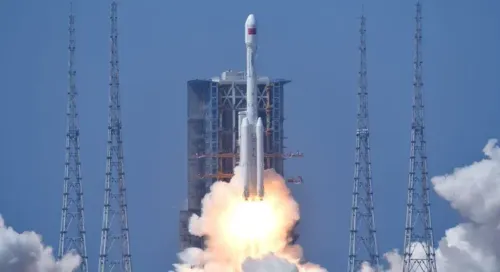
China 's Long March 10B (CZ-10B) completed the country's first reusable rocket recovery on Friday, 11 July 2026 , landing vertically into a buffer net on an offshore platform.
The CZ-10B 's propellant tank dome used a welding method benchmarked against SpaceX 's Falcon series, reportedly offering faster production throughput.
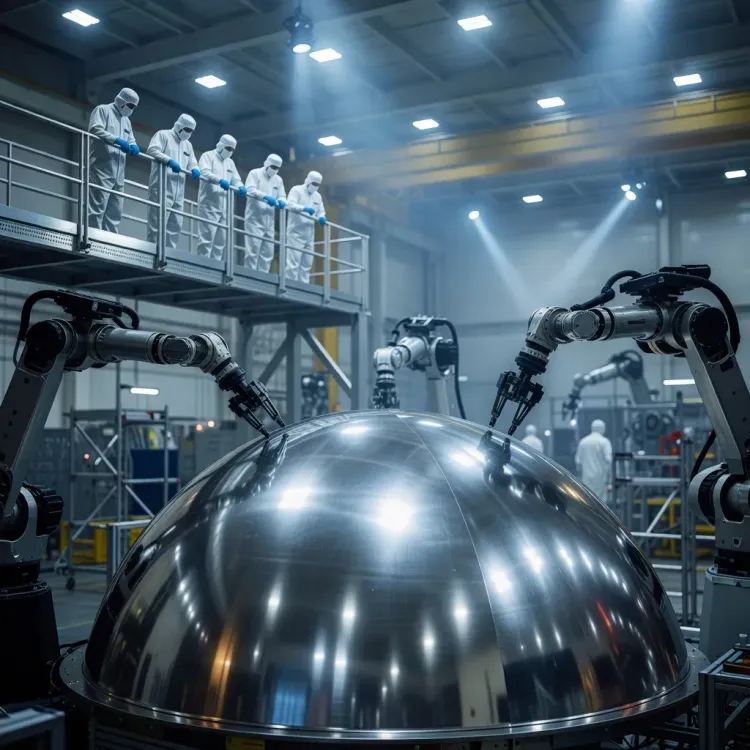
Chinese researchers separately unveiled a 'cold forming' technique that produces a seamless rocket dome in a few hours versus the conventional one week .
Key institutions involved include Dalian University of Technology , Shanghai Top Numerical Control Technology , Tianjin Harbin Gongda Yongxing Technology Co., Ltd. , and CALT .
The dome — an ellipsoidal bulkhead several metres wide and only millimetres thick — is considered a critical bottleneck in scaling reusable rocket fleets.
Western firms M.Torres and Dufieux are among the established players in advanced dome-forming technology that China is now challenging.
China has unveiled two potential manufacturing breakthroughs in rocket propellant tank domes — a component so critical that experts say whichever nation masters its mass production will hold a decisive edge in the emerging space economy. The developments, disclosed in July 2026, coincide with China's first-ever recovery of a reusable rocket, the Long March 10B (CZ-10B), which landed vertically into a buffer net aboard an offshore recovery platform on Friday, 11 July 2026.
Why the dome matters
The propellant tank dome — an ellipsoidal bulkhead several metres wide but only millimetres thick — must endure extreme internal pressures, vibration, and shock during flight. Despite its deceptively simple appearance, the rounded end cap is notoriously difficult to mass-produce at the scale and reliability that reusable rocket programmes demand. Whichever country can manufacture these components faster, cheaper, and more consistently will have a structural advantage in fielding large reusable rocket fleets, according to industry analysts.
The Long March 10B milestone
The CZ-10B's successful orbital delivery and vertical recovery marked a landmark moment for China's space programme, developed under the China Academy of Launch Vehicle Technology (CALT). The rocket's dome was produced using a welding method benchmarked against SpaceX's Falcon series, and reportedly offers faster throughput on the production line. The recovery demonstrated that China is no longer merely observing reusable rocket technology — it is operationalising it.
The cold-forming revolution
Separately, Chinese researchers have unveiled a 'cold forming' technique capable of shaping a complete, seamless dome in a few hours rather than the roughly one week required by conventional methods. The advance, reported by China Science Daily, is attributed to work involving institutions including Dalian University of Technology and companies such as Shanghai Top Numerical Control Technology and Tianjin Harbin Gongda Yongxing Technology Co., Ltd., with facilities in areas including the Jizhou Economic Development Zone in Tianjin. The technique produces a seamless dome, eliminating weld seams that are traditional points of structural vulnerability.
The competitive backdrop
The dome bottleneck has long been a quiet constraint on rocket production rates globally. Western manufacturers including M.Torres and Dufieux have their own advanced forming capabilities, and SpaceX has invested heavily in proprietary dome manufacturing for its Falcon and Starship programmes. China's parallel advances — one in welding speed, one in cold-forming — suggest a deliberate, state-backed push to eliminate this single-point vulnerability in its launch supply chain.
What's next
The cold-forming technique and the CZ-10B's welding approach now face the harder test of industrial-scale deployment. If either method can be validated at volume, China could meaningfully compress the cost and cycle time of its next-generation rocket programmes. Observers will be watching whether CALT and its commercial partners can translate laboratory and first-flight results into sustained production rates that rival — or exceed — those of SpaceX's Falcon 9 line.
Point of View
It doesn't just accelerate China's own programme — it potentially commoditises a process that Western launch firms have treated as a durable moat.
NationPress
14 Oct 2026
Frequently Asked Questions
What is a rocket propellant tank dome and why does it matter?
A rocket propellant tank dome is an ellipsoidal end cap, several metres wide but only millimetres thick, that seals the top or bottom of a rocket's fuel or oxidiser tank. It must withstand extreme internal pressures, vibration, and shock, and is notoriously difficult to mass-produce — making it a key bottleneck in scaling reusable rocket fleets.
What did China's Long March 10B rocket achieve in July 2026?
The Long March 10B (CZ-10B), developed by the China Academy of Launch Vehicle Technology, delivered satellites into orbit and then made a vertical descent into a buffer net aboard an offshore recovery platform — marking China's first recovery of a reusable rocket. The dome on the CZ-10B used a welding method benchmarked against SpaceX's Falcon series.
What is the cold-forming technique for rocket domes?
Cold forming is a manufacturing process unveiled by Chinese researchers that can shape a complete, seamless propellant tank dome in a few hours, compared to roughly one week using conventional methods. The seamless construction eliminates weld seams, which are traditional structural weak points, and the work involves institutions including Dalian University of Technology and Shanghai Top Numerical Control Technology.
How does this affect the US-China space race?
Faster, cheaper dome production directly determines how quickly either country can build large fleets of reusable rockets — the backbone of the future space economy. If China validates these techniques at industrial scale, it could close or reverse the production-rate advantage currently held by SpaceX's Falcon 9 programme.
Who are the key players competing in rocket dome manufacturing?
On the Chinese side, CALT, Shanghai Top Numerical Control Technology, Tianjin Harbin Gongda Yongxing Technology Co., Ltd., and Dalian University of Technology are central. Western competitors include SpaceX, and European equipment makers M.Torres and Dufieux, which have established advanced forming capabilities for rocket components.