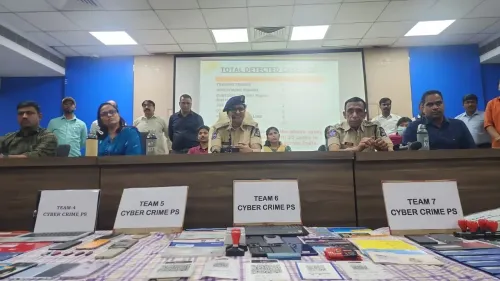
Hyderabad Police chief warns banks on AI-driven cyberattacks, demands urgent action

Synopsis
Hyderabad's top cop is sounding a rare public alarm: AI-powered criminal networks are already inside India's financial plumbing, exploiting forgotten APIs and outdated software to vanish crores in seconds. Commissioner Sajjanar's unusually detailed directive — covering everything from KYC approvals to Red Team drills — signals that voluntary compliance is no longer assumed.
Key Takeaways
Hyderabad Police Commissioner V.
Sajjanar issued a cybersecurity advisory to banks, NBFCs, quick-commerce, and mobility platforms on 9 November 2026 .
Cybercriminals are using AI agents to identify vulnerabilities such as outdated software, misconfigured systems, and loopholes in customer grievance portals.
Automated payment APIs are being exploited to divert crores of rupees into mule accounts while wiping digital records.
NBFCs using third-party modules must apply the same security standards as core banking applications, Sajjanar warned.
Institutions are directed to run frequent Red Team drills , conduct daily portal audits, enforce KYC before fund credits, and remove obsolete APIs.
Citizens can report cyber fraud at the national helpline 1930 or via cybercrime.gov.in .
Hyderabad Police Commissioner V. C. Sajjanar on Monday, 9 November 2026, issued a sharp directive to banks, financial institutions, quick-commerce platforms, and mobility service providers in Hyderabad, urging them to immediately overhaul their cybersecurity defences against a rising wave of AI-assisted cyberattacks and organised hacker syndicates. The commissioner stressed that inaction could expose citizens' finances and sensitive data to irreversible harm.
The Threat Landscape
Commissioner Sajjanar described a rapidly evolving threat environment in which international cybercriminal networks are deploying cutting-edge Artificial Intelligence tools to probe and exploit weaknesses inside financial systems. Criminals are, according to the commissioner, specifically targeting outdated software, misconfigured internet systems, and technical loopholes in customer grievance portals.
Of particular concern is the use of automated fund disbursement systems and payment APIs to redirect crores of rupees into so-called 'mule' accounts within seconds — often erasing digital records entirely to obstruct law enforcement. The speed and scale of such diversions make conventional monitoring systems inadequate, Sajjanar warned.
Third-Party Systems Under the Microscope
A significant portion of the commissioner's advisory focused on Non-Banking Financial Companies (NBFCs), which routinely depend on third-party modules and API services for customer data management and payment processing. Sajjanar stressed that these supporting systems must be subjected to the same rigorous security scrutiny as core banking applications — a standard that many institutions are reportedly not meeting.
'Entities handling citizen finances and data — including Banks, Financial Institutions, Quick Commerce, and Mobility Platforms — are requested to strengthen their cybersecurity systems, processes, and manpower against evolving AI-assisted attacks and hacker syndicates,' the commissioner said.
Key Defensive Measures Prescribed
Commissioner Sajjanar outlined a set of immediate steps financial institutions must implement. These include removing obsolete APIs — particularly those created for testing that were never decommissioned — and enforcing robust security protocols around fund-disbursement systems. Institutions are also advised to keep all software updated, conduct daily security audits of internet-facing customer portals, and set transaction thresholds to automatically flag unusually rapid or large-value movements.
He further directed that a full-scale KYC (Know Your Customer) process must be completed and senior-official approval obtained before funds are credited to any account. To stress-test preparedness, IT and cybersecurity teams should run frequent coordinated 'Red Team' mock drills simulating live attack scenarios.
Public Advisory and Helpline
The commissioner also addressed citizens directly, urging anyone who notices a suspicious transaction or falls victim to cyber fraud to immediately contact the national cybercrime helpline at 1930 or file a complaint through the portal cybercrime.gov.in. Prompt reporting, he noted, can significantly improve the chances of fund recovery before digital trails are wiped.
This advisory comes at a time when cyber fraud losses in India have surged, with government data pointing to tens of thousands of complaints filed monthly. As AI tools become cheaper and more accessible, security experts warn that attack complexity will only increase — making Sajjanar's call for proactive, not reactive, security culture all the more urgent.
Point of View
Which suggests Hyderabad authorities have specific intelligence about active exploits rather than issuing a generic caution. The focus on forgotten test APIs and third-party NBFC modules points to an ecosystem-wide compliance gap that regulators like the RBI have flagged but not yet enforced with teeth. What is missing from the advisory is any mention of accountability: institutions that fail to act face no stated consequence, which may limit its impact to the already-compliant. The real enforcement signal will come only if cybercrime FIRs begin naming institutional negligence alongside individual fraudsters.
NationPress
9 Nov 2026
Frequently Asked Questions
What did Hyderabad Police Commissioner Sajjanar warn banks about?
Commissioner V. C. Sajjanar warned banks, NBFCs, quick-commerce platforms, and mobility service providers that AI-powered cybercriminal networks are actively exploiting weaknesses in their digital systems to divert funds into mule accounts. He called for immediate strengthening of cybersecurity infrastructure, processes, and expert manpower.
How are cybercriminals using AI to attack financial institutions?
According to Commissioner Sajjanar, cybercriminals are using AI agents to automatically scan financial networks for vulnerabilities such as outdated software, misconfigured internet systems, and loopholes in customer grievance portals. They then use automated payment APIs and fund-disbursement systems to rapidly move crores of rupees into mule accounts, often erasing digital evidence in the process.
What security steps did the Hyderabad Police Commissioner prescribe?
Sajjanar directed institutions to remove obsolete APIs, enforce daily audits of internet-facing portals, keep all software updated, set transaction thresholds for large or rapid transfers, complete full KYC before crediting funds, obtain senior-official approvals, and conduct regular Red Team cybersecurity drills in coordination with IT teams.
Why are NBFCs specifically highlighted in the advisory?
The commissioner noted that many Non-Banking Financial Companies rely heavily on third-party modules and API services for customer data and payment processing, often holding them to lower security standards than core applications. Sajjanar stressed that these supporting systems are equally vulnerable and must meet the highest security norms.
How can citizens report a cyber fraud in India?
Citizens who detect a suspicious transaction or become victims of cyber fraud should immediately call the national cybercrime helpline at 1930 or file a complaint online at cybercrime.gov.in. Early reporting improves the chances of tracing and recovering diverted funds before digital records are wiped.