IIT Madras releases ANCHOR, world's most detailed 3D brainstem atlas

Synopsis
IIT Madras has built what researchers are calling the world's most detailed map of the human brainstem — a freely accessible 3D atlas covering over 200 nuclei from prenatal to adult brains. ANCHOR, developed by the Sudha Gopalakrishnan Brain Centre, could reshape clinical understanding of Parkinson's, ALS, and brainstem lesions, and marks a rare moment of Indian-led frontier science reaching global neuroscience infrastructure.
Key Takeaways
IIT Madras released ANCHOR , the world's most detailed 3D atlas of the human brainstem , on 12 June 2026 .
The atlas maps over 200 brainstem nuclei and fibre tracts using eight complementary immunostains across more than 500 sections .
Coverage spans the full human lifespan — from the prenatal period through childhood to adulthood .
ANCHOR is freely accessible online to researchers, clinicians, and patients worldwide.
The Sudha Gopalakrishnan Brain Centre has a team of over 200 researchers and 20 international collaborators .
Ajay Kumar Sood , Principal Scientific Adviser to the Government of India, described it as 'a significant accomplishment in the field of neurobiology.'
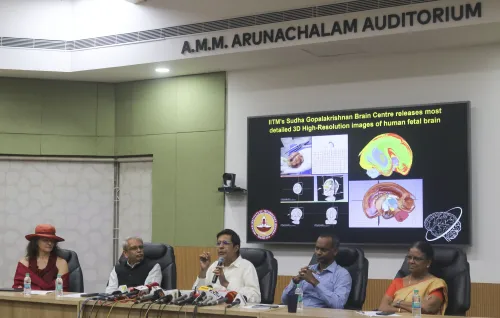
The Indian Institute of Technology Madras (IIT Madras) on Friday, 12 June 2026, unveiled ANCHOR — the Atlas of Neurochemical Characterisation of the Human Brainstem with 3D Reconstruction — described as the world's most detailed three-dimensional atlas of the human brainstem. Developed by the institute's Sudha Gopalakrishnan Brain Centre (SGBC), the atlas has been made freely accessible to researchers, clinicians, and patients globally through a dedicated public website.
What ANCHOR Is and How It Was Built
ANCHOR was produced through SGBC's high-throughput brain imaging and computing platform, which converts whole human brains into cell-resolution 3D atlases. The atlas encompasses over 200 brainstem nuclei and fibre tracts, reconstructed from hundreds of serial sections using eight complementary immunostains overlaid across more than 500 sections. It spans the human lifespan — from the prenatal period through childhood to adulthood — making it the most comprehensive multimodal 3D brainstem reference available to date.
Where It Was Unveiled
The atlas was formally released at the 3rd BRICS Neuroscience Symposium, held from 5 to 7 June 2026 at the IIT Madras campus in Chennai. The public launch ensures that the research is accessible beyond institutional boundaries, a deliberate choice by the team to maximise clinical and scientific impact.
What Experts Said
Prof. Ajay Kumar Sood, Principal Scientific Adviser to the Government of India, called the development 'a significant accomplishment in the field of neurobiology,' noting that it represents 'a multimodal framework integrating MRI, histology and detailed chemo-architecture.' He added that the maps would help identify specific cell populations affected in brainstem lesions, which could be critical for clinical applications.
Prof. Sood also highlighted the model behind the centre's success: 'The centre is a unique example of how risk taking by a public agency led to an advanced technology platform for doing big science and that was then scaled by private and philanthropic support to produce world-class results in frontier areas of human brain sciences.'
The Scale of SGBC's Ambition
The Sudha Gopalakrishnan Brain Centre has assembled a global interdisciplinary team of over 200 researchers, engineers, and technicians, collaborating with 20 partners across multiple countries. The centre's long-term goal is to image over 100 whole brains spanning the human lifespan and a range of neurological diseases — building what it describes as the most comprehensive set of cell-resolution human brain maps ever compiled.
Why This Matters for Medicine and Neuroscience
The brainstem governs critical autonomic functions — breathing, heart rate, and consciousness — yet has historically been among the least mapped regions of the brain due to its structural complexity. ANCHOR's granular, publicly available maps could accelerate research into conditions such as Parkinson's disease, ALS, and brainstem tumours, where precise knowledge of affected nuclei is essential for targeted treatment. This is a landmark contribution from an Indian research institution to global neuroscience infrastructure, and its open-access design positions it as a foundational reference for the field going forward.
Point of View
And the fact that it comes from an Indian institution is significant. The open-access decision is the right one: proprietary brain atlases have historically slowed translational research. What deserves scrutiny, however, is whether India's clinical and pharmaceutical ecosystem is equipped to act on this data. Mapping brainstem nuclei at cell resolution is only as valuable as the downstream research it enables. The SGBC model — public risk, private scale — is worth replicating, but it requires sustained funding continuity that Indian science has not always guaranteed.
NationPress
26 Oct 2026
Frequently Asked Questions
What is ANCHOR, the atlas released by IIT Madras?
ANCHOR stands for Atlas of Neurochemical Characterisation of the Human Brainstem with 3D Reconstruction. It is the world's most detailed three-dimensional atlas of the human brainstem, mapping over 200 nuclei and fibre tracts across the human lifespan, from the prenatal period to adulthood.
Who developed ANCHOR and how was it built?
ANCHOR was developed by the Sudha Gopalakrishnan Brain Centre at IIT Madras using a high-throughput brain imaging and computing platform. It uses eight complementary immunostains overlaid across more than 500 serial sections to achieve cell-resolution 3D mapping.
Is the ANCHOR brainstem atlas publicly available?
Yes. IIT Madras has made ANCHOR freely accessible through a dedicated public website, allowing researchers, clinicians, and patients worldwide to use the atlas without restriction.
Why is a detailed brainstem atlas clinically important?
The brainstem controls vital functions such as breathing, heart rate, and consciousness. A high-resolution map helps identify specific cell populations affected by brainstem lesions, which is critical for understanding and treating conditions such as Parkinson's disease, ALS, and brainstem tumours.
Where was ANCHOR officially launched?
ANCHOR was unveiled at the 3rd BRICS Neuroscience Symposium, held from 5 to 7 June 2026 at the IIT Madras campus in Chennai.