How Are India and Russia Strengthening Trade and Investment Relations?
Click to start listening

Synopsis
In a historic partnership, India and Russia are set to strengthen their trade and investment ties, with ambitious targets in sight. Explore how these two nations are working together to enhance economic cooperation and connectivity, paving the way for a brighter future. This collaboration could reshape the geopolitical landscape and benefit both economies significantly.
Key Takeaways
- Bilateral trade between India and Russia reached $68.7 billion in FY 2024-25.
- Targets of $100 billion in bilateral trade and $50 billion in mutual investments by 2030 have been set.
- Key sectors include defense, energy, and pharmaceuticals.
- Maritime cooperation is being enhanced through various initiatives.
- India and Russia are focusing on expanding cooperation beyond traditional sectors.
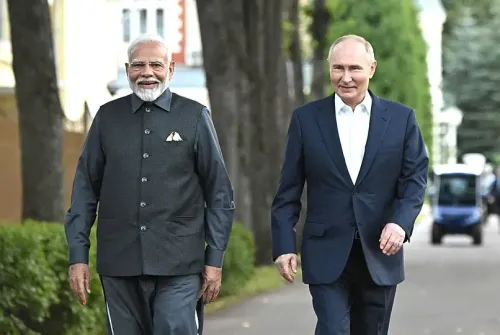
New Delhi, Dec 4 (NationPress) The bilateral relationship between India and Russia has thrived for 78 years, characterized by a mutual dedication to a multipolar world and an interest in extending collaboration beyond the realms of military, nuclear, and space sectors, according to an official announcement made on Thursday prior to Russian President Vladimir Putin’s two-day visit to India.
In the last two years, there has been a remarkable increase in bilateral trade. During this visit, discussions are slated to focus on enhancing exports from India and exploring innovative cooperation frameworks.
Both nations are eager to bolster inter-regional cooperation, particularly with the Russian Far East, and to promote connectivity initiatives, including the International North-South Transport Corridor, the Chennai-Vladivostok Eastern Maritime Corridor, and the Northern Sea Route, as per the official statement.
A synergy exists between Russia's pivot towards the East, its resources and technology, and India's flagship initiatives like 'Atmanirbhar Bharat' and 'Make in India', the statement elaborated.
During External Affairs Minister S. Jaishankar’s visit to Moscow in August this year, both countries aimed to expedite their progress towards a target of $100 billion in bilateral trade by 2030, addressing the India-EAEU FTA and establishing two new Indian consulates in Russia.
Sectoral cooperation has been advanced through numerous high-level engagements, including maritime discussions and Russia’s involvement in India Energy Week 2025.
Maritime consultations that took place in New Delhi on November 17, 2025, were led by Minister Sarbananda Sonowal and Nikolai Patrushev. They discussed shipbuilding, port development, logistics, and Arctic collaboration, reaffirming their strategic partnership and committing to enhance cooperation for a resilient and efficient maritime framework.
The primary mechanism for bolstering trade and economic relations is the India-Russia Intergovernmental Commission for Trade, Economic, Scientific & Cultural Cooperation (IRIGC-TEC), co-chaired by the EAM from India and First Deputy Prime Minister Denis Manturov from Russia.
The 26th session of the IRIGC-TEC, held on August 20, 2025, in Moscow, focused on tackling tariff and non-tariff barriers, resolving logistics bottlenecks, promoting connectivity, and ensuring the timely execution of the Programme of Economic Cooperation through to 2030.
The session also underscored the urgency of finalizing the India–Eurasian Economic Union FTA and emphasized the need for consistent interactions between businesses from both nations to achieve the revised $100 billion trade goal by 2030.
Post-session, the Protocol for the 26th Session of IRIGC-TEC was signed by the co-chairs. Both nations are targeting ambitious goals set by their leaders: $50 billion in mutual investments by 2025 and $100 billion in annual bilateral trade by 2030.
Bilateral trade has surged, reaching an impressive $68.7 billion in FY 2024-25, with Indian exports totaling $4.9 billion, primarily in pharmaceuticals, chemicals, iron, steel, and marine products. Imports from Russia reached $63.8 billion, mainly consisting of crude oil, petroleum products, sunflower oil, fertilizers, coking coal, and precious stones.
The bilateral services trade has remained steady, amounting to $1.021 billion in 2021. Investments between the countries are solid, with a mutual investment target of $50 billion by 2025. Russian investments in India are concentrated in the oil and gas, petrochemicals, banking, railways, and steel sectors, while Indian investments in Russia focus mainly on oil and gas and pharmaceuticals.
The statement also underlines that defense is a crucial component of the robust friendship and strategic partnership between India and Russia. The longstanding military-technical cooperation has evolved from a basic buyer-seller relationship to one that includes joint research, development, and production of advanced defense technologies and systems.
Russia remains a key supplier of defense equipment, engines, and spare parts. Various defense platforms, such as T-90 tanks and Su-30 MKI aircraft, are assembled or produced in India. Both nations are exploring co-development and co-production ventures, including the potential export of systems like the BrahMos missile.
Point of View
The strengthening of trade and investment ties between India and Russia reflects a strategic vision that prioritizes collaboration and mutual growth. As both nations work towards ambitious economic targets, it is critical for India to leverage its partnerships for sustained development while maintaining its sovereignty and national interests. This evolving relationship is essential to navigate the complexities of a multipolar world.
NationPress
04/12/2025
Frequently Asked Questions
What is the significance of the India-Russia relationship?
The India-Russia relationship is significant due to its historical stability and shared commitment to a multipolar world, focusing on expanding cooperation beyond traditional sectors.
What are the trade targets set by India and Russia?
India and Russia are targeting $100 billion in bilateral trade by 2030 and $50 billion in mutual investments by 2025.
What sectors are involved in the India-Russia trade?
The trade encompasses various sectors, including defense, energy, pharmaceuticals, and technology, with a focus on enhancing inter-regional cooperation.
How is maritime cooperation being strengthened?
Maritime cooperation is being strengthened through high-level consultations, focusing on shipbuilding, port development, and logistics for better connectivity.
What role does defense play in the India-Russia partnership?
Defense is a critical part of the partnership, involving joint research, development, and production of advanced defense technologies and systems.