Could Researchers at INST Have Found a New Way to Treat Alzheimer’s?
Synopsis
In a groundbreaking discovery, researchers at INST, Mohali, have developed a pioneering nanoparticle therapy for Alzheimer’s disease, promising to revolutionize treatment by addressing multiple pathological factors simultaneously.
Key Takeaways
New therapy uses nanoparticles to treat Alzheimer’s.
Targets multiple pathological factors simultaneously.
Combines green tea antioxidants , neurotransmitters, and amino acids.
May improve cognitive function and memory.
Promising results in laboratory and mouse models .
New Delhi, Dec 16 (NationPress) Researchers at the Institute of Nano Science and Technology (INST) in Mohali have discovered a novel pathway utilizing nanoparticles for the treatment of Alzheimer’s Disease (AD), as reported by the Ministry of Science & Technology on Tuesday.
Traditional therapies for Alzheimer’s mainly focus on a single pathological aspect, such as amyloid aggregation or oxidative stress, which often yield limited clinical results.
In contrast, this innovative therapy incorporates nanoparticles that blend polyphenols with antioxidant properties from green tea, along with a neurotransmitter and an amino acid.
This approach aims to alter the disease's trajectory, potentially slowing its progression, enhancing memory, and bolstering cognitive function, as explained by the researchers in their publication in the journal Small.
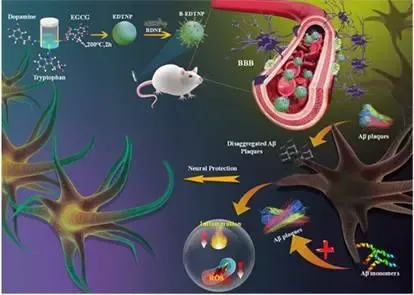
The therapy functions by combining epigallocatechin-3-gallate (EGCG), an antioxidant from green tea, dopamine, a key neurotransmitter for mood, and tryptophan, an amino acid critical for various cellular activities, into a nanoparticle termed EGCG-dopamine-tryptophan nanoparticles (EDTNPs).
This enables the therapy to concurrently address amyloid aggregation, oxidative stress, inflammation, and neuronal degeneration, which are four primary pathological features of Alzheimer’s.
“By incorporating Brain-Derived Neurotrophic Factor (BDNF)—a protein essential for neuronal survival, growth, and function—onto EDTNPs to create B-EDTNPs, we have established a dual-action nanoplatform that not only eliminates neurotoxic Amyloid Beta aggregates but also promotes neuronal regeneration,” stated the team led by Dr. Jiban Jyoti Panda from INST, which operates under the Department of Science and Technology (DST).
“This therapeutic strategy is unique in Alzheimer’s treatment, as it combines antioxidant, anti-amyloid, and neurotrophic effects,” they further noted.
The research, supported by Dr. Ashok Kumar Datusalia (NIPER Raebareli) and Dr. Nisha Singh (Gujarat Biotechnology University), encompasses the synthesis of EDTNPs through biocompatible methods like pressure-assisted hydrothermal and electrostatic-based co-incubation techniques to amalgamate antioxidant, neurotransmitter, and amino acid components.
These nanoparticles were then functionalized with BDNF, yielding B-EDTNPs that exhibit enhanced neuroprotective capabilities.
In laboratory tests and mouse models, these nanoparticles effectively dismantled toxic plaques, alleviated inflammation, restored equilibrium within brain cells, and even improved memory and learning. Computer simulations further validated that the nanoparticles bind to harmful Amyloid beta fibrils and disassemble them at the molecular level.
“This research has the potential to assist individuals with Alzheimer’s by providing a treatment that addresses multiple targets. The nanoparticles not only eliminate harmful protein plaques but also mitigate brain stress, reduce inflammation, and promote nerve cell growth via BDNF,” concluded the researchers.
Point of View
This innovative breakthrough at INST represents a significant leap in Alzheimer’s research. By addressing multiple pathological factors with a single therapy, it could reshape treatment approaches and bring hope to countless individuals affected by the disease.
NationPress
30 Sept 2026
Frequently Asked Questions
What is the new therapy developed by INST researchers?
The new therapy utilizes nanoparticles that combine polyphenols from green tea with a neurotransmitter and an amino acid to treat Alzheimer’s disease.
How does this therapy differ from traditional methods?
Unlike traditional therapies that target a single aspect of Alzheimer’s, this new approach addresses multiple pathological features simultaneously.
What are the components of the nanoparticles?
The nanoparticles consist of epigallocatechin-3-gallate (EGCG), dopamine, and tryptophan, forming a structure known as EGCG-dopamine-tryptophan nanoparticles (EDTNPs).
What potential benefits does this therapy offer?
The therapy has the potential to slow disease progression, improve memory, and enhance cognitive skills.
How were these nanoparticles tested?
The nanoparticles were tested in laboratory experiments and mouse models, showing effectiveness in dismantling toxic plaques and restoring brain cell balance.