Nvidia Expands Open Source Alliance With 18 New Members

Synopsis
Nvidia has welcomed 18 major technology companies — including Amazon, Microsoft, Cisco, Visa, and Perplexity AI — as new members of its Alliance, spotlighting their open-source contributions to the AI and infrastructure ecosystem as of August 2026.
Key Takeaways
18 companies named as new members of Nvidia's Alliance, announced on 4 August 2026 .
Members span cloud, cybersecurity, fintech, AI tooling, and enterprise software — covering virtually every layer of the modern tech stack.
Named members include Amazon, Microsoft, Cisco, Cloudflare, CrowdStrike, Palo Alto Networks, Red Hat, Visa, Uber, Perplexity AI , and others.
The Alliance focuses on open-source contributions, potentially accelerating adoption of Nvidia's AI and GPU platforms.
Several members — including Microsoft, Amazon, Cisco , and Red Hat — have major engineering centres in India , making this directly relevant to Indian developers.
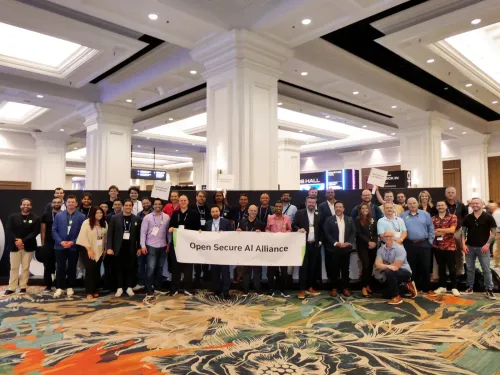
Chip giant Nvidia is widening its open-source ecosystem in a significant way — pulling in 18 major technology companies as the newest members of what it calls its Alliance, and spotlighting their latest open-source contributions to the broader AI and infrastructure community.
The post, shared on Tuesday, 4 August 2026, names a sweeping cross-section of the technology industry: cloud providers Akamai and Amazon, financial giant Capital One, networking leaders Cisco and Cloudflare, AI coding startup Cognition, cybersecurity firms CrowdStrike, Palo Alto Networks, Okta, and Wiz, developer tooling platform LangChain, enterprise software titan Microsoft, AI search company Perplexity AI, open-source stalwart Red Hat, ride-sharing and logistics giant Uber, data protection firm Veeam, and payments network Visa.
A Coalition That Spans Every Layer of the AI Stack
The breadth of the member list is itself the story. From payment rails to cloud edge, from cybersecurity to large language model tooling, these are not peripheral players — they are the companies that collectively run much of the world's digital infrastructure. Their arrival inside Nvidia's Alliance signals that the GPU maker's influence now extends well beyond hardware into the software and services layers that enterprises actually deploy.
Open-source contributions from this coalition could accelerate the adoption of Nvidia's platforms — particularly its CUDA ecosystem and AI inference frameworks — by embedding compatible, community-maintained tooling directly into the workflows these companies already power for millions of customers globally.
Why India's Tech Sector Should Pay Attention
Several of the named companies — Microsoft, Amazon, Cisco, Red Hat, and Visa — have deep engineering and delivery footprints in India, with large development centres in cities like Bengaluru, Hyderabad, and Pune. Open-source work produced through this Alliance is likely to flow through Indian engineering teams, and Indian developers will be among the earliest to build on — and contribute back to — whatever shared code these members release.
As India accelerates its own AI infrastructure ambitions, alignment with Nvidia's open-source ecosystem gives domestic developers a direct on-ramp to the tools shaping global AI deployment.
The next move to watch: what specific repositories, models, or developer tools each of these 18 members actually ships — because the real weight of an alliance is always in the code, not the announcement.
Point of View
Uber, and Perplexity AI inside a single open-source coalition, Nvidia is effectively making its platform the gravitational centre of AI infrastructure — a position that compounds with every new member. The cybersecurity cluster — CrowdStrike, Palo Alto Networks, Okta, and Wiz together — is particularly notable, suggesting Nvidia is pushing into AI-powered security tooling as a distinct growth vertical. For the broader industry, this mirrors the playbook of earlier platform wars: the company that owns the developer ecosystem tends to own the market cycle that follows.
NationPress
20 Sept 2026
Frequently Asked Questions
What is Nvidia's open source Alliance?
Nvidia's Alliance is a coalition of technology companies that collaborate on and contribute to open-source projects built around Nvidia's AI and GPU platforms, including frameworks and tools that developers worldwide use to build AI applications.
Which companies joined Nvidia's Alliance in August 2026?
The newest members announced in August 2026 include Akamai, Amazon, Capital One, Cisco, Cloudflare, Cognition, CrowdStrike, LangChain, Microsoft, Okta, Palo Alto Networks, Perplexity AI, Red Hat, Uber, Veeam, Visa, and Wiz, among others.
What does open source contribution mean in the context of Nvidia's Alliance?
It means Alliance members share code, tools, models, or integrations publicly — allowing any developer globally to use, modify, and build upon that work — typically to make it easier to deploy AI workloads on Nvidia hardware and software stacks.
How does Nvidia's Alliance expansion affect Indian developers?
Several Alliance members like Microsoft, Amazon, Cisco, and Red Hat have large engineering centres in India. Open-source tools produced through the Alliance will be accessible to Indian developers and may be co-built by Indian engineering teams, giving them early access to cutting-edge AI infrastructure code.
Why is Nvidia building such a broad industry coalition?
By bringing in companies across cloud, security, finance, and AI tooling, Nvidia is embedding its platforms into the workflows of enterprises globally — making it harder for customers to move away and positioning Nvidia as the default infrastructure layer for the AI era.