Nvidia and Germany Unite on Industrial AI in Berlin
Synopsis
Nvidia CEO Jensen Huang met German Chancellor Friedrich Merz in Berlin to combine German engineering with Nvidia AI for manufacturing and automotive. Nvidia announced planned investments in four startups — Agile Robots SE, Avelios Med, Mirelo AI, and Reflex Aerospace — spanning robotics, healthcare, creative tools, and space.
Key Takeaways
Jensen Huang and Chancellor Friedrich Merz met in Berlin to align German industrial expertise with Nvidia's AI platform.
Nvidia announced planned investments in four companies: Agile Robots SE (robotics), Avelios Med (healthcare), Mirelo AI (creative tools), and Reflex Aerospace (space).
Germany has maintained a national AI strategy since 2018 targeting manufacturing and automotive integration.
The Berlin engagement is part of Nvidia's broader country-level partnership strategy across Europe to embed its platforms in legacy industries.
Financial scale and closing timelines for the four startup investments have not yet been disclosed.
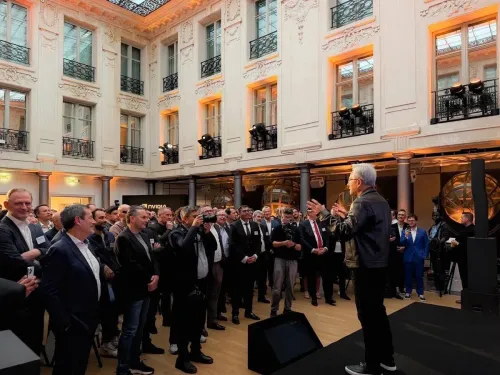
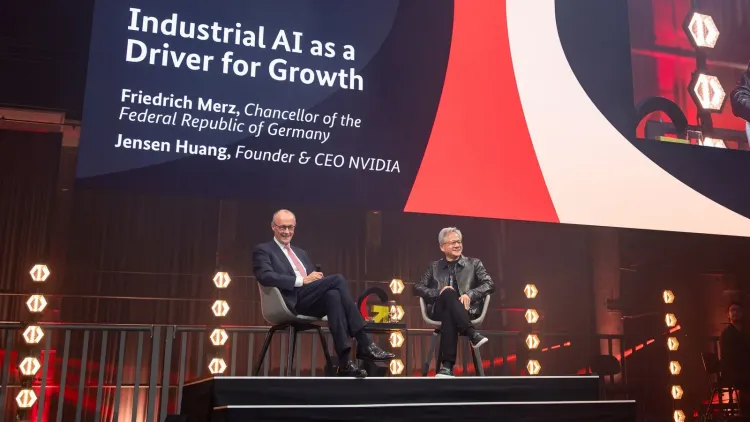
In a high-profile meeting in Berlin on Monday night, Nvidia CEO Jensen Huang sat down with German Chancellor Friedrich Merz to map out a future where centuries of German engineering precision meet the raw acceleration of AI — and the chip giant is putting money behind the vision with a slate of new planned investments in German and European startups.
The Berlin conversation: engineering heritage meets accelerated computing
The meeting between Huang and Chancellor Merz centred on combining Germany's deep manufacturing and automotive expertise with Nvidia's AI infrastructure. Germany has long been the backbone of European industrial output — its automotive giants, precision machine-tool makers, and robotics firms represent decades of domain knowledge that AI platforms can amplify rather than replace. The pairing is deliberate: Nvidia is not pitching a generic cloud product but positioning itself as the compute layer inside legacy industrial workflows.
Germany launched a national AI strategy back in 2018, committing to integrate artificial intelligence across its manufacturing and mobility sectors. That policy framework has matured steadily, and Nvidia's Berlin engagement signals that the private-sector investment cycle is now arriving to match it.
Four startups, four bets on Germany's AI frontier
Beyond the diplomatic imagery, Nvidia announced planned investments in four companies that together sketch an unusually broad industrial canvas. Agile Robots SE targets robotics; Avelios Med brings AI into healthcare; Mirelo AI focuses on creative tools; and Reflex Aerospace takes Nvidia's backing into space technology. The scale and closing timelines for these investments have not yet been disclosed.
Each bet reflects a distinct strand of Germany's industrial identity — automated factories, world-class medical-device manufacturing, a creative-tech sector reaching for global scale, and a European space industry hungry for sovereign capability. Together they suggest Nvidia is not simply selling chips into Germany but attempting to embed itself in the country's next-generation industrial architecture.
Nvidia's Europe playbook: country by country, sector by sector
Germany is the latest node in a broader Nvidia strategy of striking country-level partnerships across Europe to plant its AI platforms inside legacy industries. The approach is consistent: identify an economy with strong domain expertise, align with national policy priorities, and lock in the compute stack before rivals do. France, the United Kingdom, and the Nordics have each seen variations of this playbook, but Germany's automotive and robotics base makes it perhaps the most consequential target yet.
For India, the Berlin move is worth watching closely. Indian manufacturing is accelerating through schemes like Make in India and the Production-Linked Incentive programme, and the automotive sector is electrifying rapidly. The terms Nvidia negotiates with Berlin — on data centres, on embedded AI toolchains, on startup co-investment — will set a template that other industrial economies, including India, will either replicate or scramble to match.
Germany decided to lead. Now the question is how fast everyone else moves.
Point of View
It is co-investing in a country's industrial startup layer to make its compute stack structurally indispensable. Germany's combination of automotive scale, precision robotics, and a credible national AI policy makes it the highest-value European anchor yet. The four-sector spread of investments — robotics, healthcare, creative tools, space — signals that Nvidia is building a diversified industrial moat, not just a data-centre contract. Rivals and policymakers in other manufacturing economies will be benchmarking against whatever preferential architecture Berlin secures.
NationPress
20 Oct 2026
Frequently Asked Questions
What did Jensen Huang discuss with German Chancellor Friedrich Merz in Berlin?
They discussed combining Germany's engineering and automotive heritage with Nvidia's AI platform to advance industrial manufacturing and automotive applications.
Which companies is Nvidia investing in through its Germany initiative?
Nvidia announced planned investments in four companies: Agile Robots SE (robotics), Avelios Med (healthcare AI), Mirelo AI (creative tools), and Reflex Aerospace (space technology).
What is Germany's national AI strategy?
Germany launched a national AI strategy in 2018 aimed at integrating artificial intelligence into its manufacturing, automotive, and industrial sectors.
Why is Germany important for Nvidia's industrial AI plans?
Germany is Europe's largest industrial economy, with world-leading strengths in automotive manufacturing, precision engineering, and robotics — making it a natural partner for embedding AI into legacy industrial workflows.
How does Nvidia's Germany deal affect India?
The terms and AI architecture Nvidia establishes with Germany will set a template for industrial AI partnerships globally, which Indian manufacturing and automotive sectors — growing rapidly under national incentive schemes — will need to match or negotiate on comparable terms.