Nvidia Claims Millionfold AI Performance Leap in 10 Years
Synopsis
Nvidia declared on 21 October 2026 that its extreme co-design strategy — fusing GPU hardware with the CUDA software platform — has accelerated AI performance a millionfold over 10 years, and signalled further gains ahead as competition from custom ASICs intensifies.
Key Takeaways
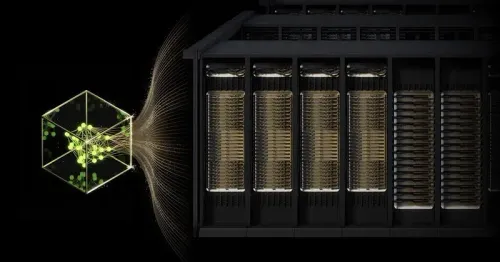
Millionfold claim: Nvidia says its extreme co-design approach has improved AI performance by a millionfold over 10 years .
Co-design engine: The strategy tightly integrates Nvidia's GPU hardware and CUDA software platform , compounding gains across generations.
Architecture lineage: Key milestones include the post- AlexNet 2012 GPU pivot and the 2017 Volta architecture's tensor cores built for AI matrix operations.
Forward signal: The phrase 'not stopping there' points to upcoming architecture announcements and AI revenue disclosures investors and partners will watch closely.
Competitive pressure: Nvidia faces rising competition from custom ASICs developed by hyperscale cloud providers, making performance framing a strategic tool.
A millionfold. That is the number chip giant Nvidia is putting on the table — the scale of AI performance gain it says its extreme co-design approach has delivered over the past 10 years, with a pointed promise that the acceleration is far from over. The company made the declaration on Wednesday, 21 October 2026, amplifying a message that sits at the very heart of its market identity.
What 'extreme co-design' actually means for AI
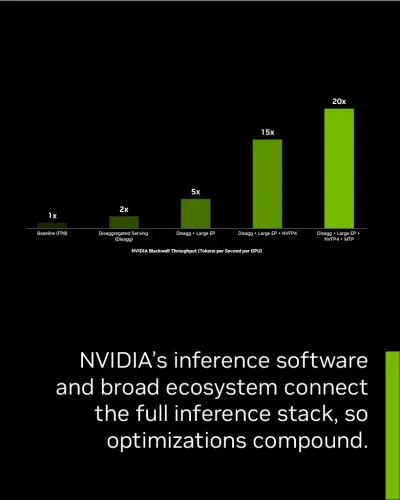
Nvidia's co-design philosophy is the tight, deliberate fusion of its hardware — most visibly its GPUs and AI accelerators — with the CUDA software platform that runs on top of them. The approach means silicon and software are engineered together, each pulling performance from the other rather than operating as separate layers. That interlock is what the company credits for compounding speedups that no single hardware upgrade could achieve alone.
The lineage is traceable. After the 2012 AlexNet breakthrough demonstrated that GPU-accelerated deep learning could outrun traditional computing by orders of magnitude, Nvidia leaned in hard. Its 2017 Volta architecture introduced tensor cores — specialised circuits built specifically for the matrix multiplications that power neural networks. Each successive architecture has layered more of the same logic: build the chip around the workload, then build the software to extract every cycle from the chip.
A market position reinforced by compounding claims
Nvidia has form for framing its progress in orders-of-magnitude terms. The strategy is deliberate: by anchoring the conversation at the level of million-times improvements, the company sets a benchmark that rivals — including the growing field of custom ASICs from hyperscale cloud providers and dedicated AI chip startups — must argue against rather than simply match.
AI researchers, hyperscale cloud operators, and enterprise data centres are the audiences absorbing this message most directly. For them, performance-per-dollar and performance-per-watt are existential procurement decisions, and a millionfold headline — even as a directional claim — shapes how those decisions get framed internally.
The 'not stopping there' signal
The closing phrase in Nvidia's post — 'we're not stopping there' — is the sharpest line in the statement. It functions as a forward signal to investors, partners, and competitors alike, pointing toward architecture announcements and earnings disclosures that will be scrutinised for how much of the company's revenue is now tied to AI inference and training versus its legacy graphics business.
The broader industry pattern is clear: every time Nvidia publishes a new performance milestone, it raises the implied floor for what the next generation must clear. Ten years of millionfold gains is the baseline. The market will now watch for what the next architectural leap quantifies that promise at.
Point of View
But by making the breadth of the installed ecosystem — CUDA, developer tooling, data-centre partnerships — feel insurmountable. With custom ASICs from cloud giants eating at inference workloads specifically, Nvidia's response is to zoom out, reclaim the long arc, and remind the market that co-design at this scale is not something you replicate in a product cycle. The next test is whether the next architecture announcement delivers a specific, quantified leap that sustains the narrative.
NationPress
21 Oct 2026
Frequently Asked Questions
What does Nvidia mean by 'extreme co-design'?
Extreme co-design refers to Nvidia's approach of engineering its GPU hardware and CUDA software platform together simultaneously, so each is optimised for the other, compounding AI performance gains across successive chip generations rather than improving hardware and software in isolation.
Is Nvidia's millionfold AI performance claim verified?
Nvidia stated the millionfold figure in its official post on 21 October 2026 . The company has a documented history of publishing large-scale performance comparisons tied to specific architecture generations, but the precise millionfold figure represents Nvidia's own framing and has not been independently benchmarked at the time of publication.
What is CUDA and why does it matter for AI?
CUDA is Nvidia's parallel computing software platform that allows developers to programme GPU hardware for general-purpose tasks, including AI training and inference. Its wide adoption across research institutions and cloud data centres gives Nvidia a significant software moat that reinforces its hardware sales.
What are ASICs and how do they compete with Nvidia GPUs?
ASICs — Application-Specific Integrated Circuits — are chips designed for a single workload rather than general-purpose computing. Hyperscale cloud providers are building custom AI ASICs to reduce dependence on Nvidia GPUs, particularly for inference tasks, putting pressure on Nvidia to keep demonstrating performance superiority.
What should investors and analysts watch for next from Nvidia?
Key signals include Nvidia's next GPU architecture announcement, earnings disclosures that break out AI-specific revenue share, and any performance benchmarks published against prior generations — all of which will test whether the millionfold decade-long narrative can be extended into the next product cycle.