Nvidia Marks Decades of Partnership With a Single Photo
Synopsis
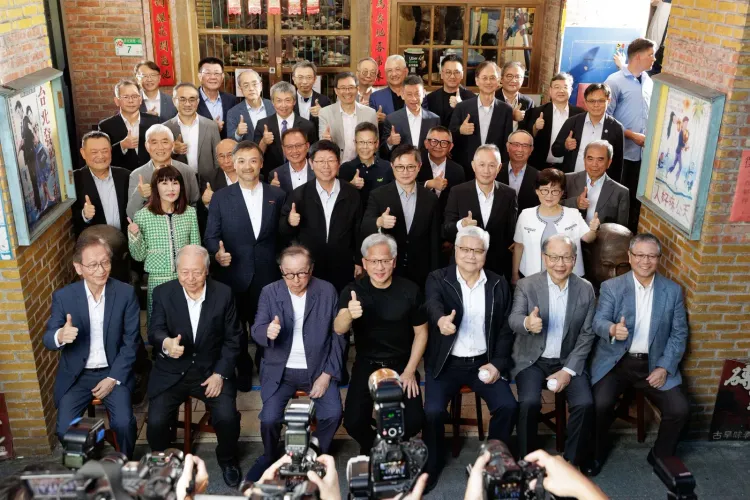
Nvidia marked its multi-decade manufacturing and ecosystem partnerships on 28 May 2026 with a single photograph and the caption 'One photo. Decades of building together.' — a quiet but pointed tribute to the foundry alliances, including with TSMC, that have powered successive GPU generations and the global AI supply chain.
Key Takeaways
Nvidia posted a single photograph on 28 May 2026 with the caption 'One photo.
Decades of building together.' The company was founded in 1993 by Jensen Huang and has spent over three decades building manufacturing and ecosystem partnerships.
TSMC has been Nvidia's primary advanced-chip foundry partner since the late 1990s, enabling successive GPU architectures.
The post coincides with heightened geopolitical scrutiny of U.S.-Taiwan technology cooperation and U.S. semiconductor export controls.
Indian AI developers and data-centre operators are direct downstream beneficiaries of the supply-chain stability these partnerships provide.
Nvidia's next GTC conference is the key event to watch for updates on manufacturing roadmaps and foundry agreements.
Chip giant Nvidia Corporation posted a single photograph on Thursday, 28 May 2026, accompanied by the caption 'One photo. Decades of building together.' — a sparse but pointed tribute to the long-term manufacturing and ecosystem partnerships that have underpinned the company's rise from a graphics-card maker to the world's dominant AI-infrastructure supplier.
Context
Nvidia's post, brief as it is, carries considerable weight given the company's trajectory. Founded in 1993 by Jensen Huang and his co-founders, the company has spent more than three decades cultivating relationships with foundry partners, software developers, and hardware integrators whose collective effort made each successive GPU generation possible. The image — shared without further caption — appears designed to let that history speak for itself.
Central to that history is TSMC, the Taiwanese foundry that has manufactured Nvidia's advanced chips under long-term process-technology collaborations dating to the late 1990s. Without TSMC's leading-edge nodes, successive Nvidia architectures — from Kepler and Pascal through Hopper and Blackwell — could not have reached the performance levels that made them indispensable to AI data centres worldwide.
Policy Backdrop
The post arrives at a moment when U.S.-Taiwan technology cooperation sits at the centre of geopolitical debate. Washington has enacted sweeping export-control measures targeting advanced semiconductors, while simultaneously encouraging allied foundries to expand capacity on American soil. TSMC's Arizona fabs, partly incentivised by the CHIPS and Science Act, represent the most visible expression of that policy push.
For India, the broader semiconductor supply-chain conversation is equally consequential. The government's India Semiconductor Mission and multi-thousand-crore incentive packages are designed to attract exactly the kind of long-cycle, high-trust manufacturing partnerships that Nvidia's post implicitly celebrates. Indian AI developers and data-centre operators are among the end-users most dependent on the GPU supply chains these alliances sustain.
Stakeholders and Impact
Semiconductor firms, AI developers, and cloud-infrastructure providers around the world have a direct stake in the stability of Nvidia's foundry relationships. Any disruption — whether from geopolitical tension, natural disaster, or capacity constraints — ripples quickly through AI training pipelines and inference deployments that now underpin everything from financial services to healthcare diagnostics.
For Indian technology companies and startups building on Nvidia's CUDA platform, the continuity of these partnerships translates directly into hardware availability and pricing. The H100 and B200 GPU clusters that power large-language-model training in India are the downstream product of the very collaborations Nvidia is quietly commemorating.
What's Next
Nvidia's next major public moment is expected to be its annual GTC conference, where Jensen Huang typically outlines the company's roadmap for accelerated computing and AI infrastructure. Observers will watch for any formal announcement of updated manufacturing agreements or next-generation process-node commitments with foundry partners.
The single-image post, stripped of product names or financial metrics, reads less as a marketing exercise and more as a signal of institutional confidence — a reminder that the company's competitive moat is as much about relationships built over decades as it is about any single chip architecture.
Point of View
Five words — is a studied piece of institutional communication, projecting stability and continuity at a moment when semiconductor supply chains are under intense political and regulatory scrutiny. By foregrounding relationships rather than products, the company signals that its competitive advantage is structural and long-cycle, not merely technological. For policymakers in New Delhi pushing the India Semiconductor Mission, the subtext is instructive: the partnerships that built Nvidia took decades to forge, and replicating that ecosystem depth requires sustained, patient investment. The post is a soft reminder that in the chip industry, trust is the hardest input to manufacture.
NationPress
11 Oct 2026
Frequently Asked Questions
What did Nvidia post on 28 May 2026?
Nvidia posted a single photograph on its official X account with the caption 'One photo. Decades of building together.' — a tribute to the long-term manufacturing and ecosystem partnerships behind its growth.
Who is Jensen Huang and what is his role at Nvidia?
Jensen Huang is the co-founder and chief executive of Nvidia Corporation, a position he has held since the company's founding in 1993. He has led Nvidia's transformation from a graphics-card maker into the world's leading AI-infrastructure supplier.
What is Nvidia's relationship with TSMC?
TSMC, the Taiwanese semiconductor foundry, has manufactured Nvidia's advanced chips under long-term process-technology collaborations since the late 1990s. This partnership has enabled successive Nvidia GPU generations, from early graphics cards to current AI accelerators.
Why does Nvidia's partnership history matter for India?
Indian AI developers, startups, and data-centre operators rely heavily on Nvidia GPUs built on the CUDA platform. The stability of Nvidia's foundry and ecosystem partnerships directly affects hardware availability and pricing in India, and informs the government's own semiconductor mission strategy.
What is Nvidia GTC and why is it important?
GTC, or GPU Technology Conference, is Nvidia's annual flagship event where CEO Jensen Huang typically announces new chip architectures, software platforms, and manufacturing roadmap updates. It is the primary venue to watch for news on Nvidia's next-generation AI infrastructure plans.