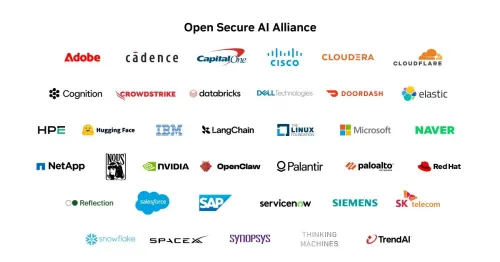
Nvidia's Open Secure AI Alliance Crosses 120 Members

Synopsis
Nvidia's Open Secure AI Alliance has grown past 120 member organisations and is releasing new open-source security contributions alongside proposed SAFE guidelines — a framework for converting confidential AI incident findings into shared, community-wide intelligence.
Key Takeaways
Nvidia's Open Secure AI Alliance now has over 120 member organisations .
The Alliance released new open-source security contributions alongside the milestone announcement on 4 August 2026 .
Proposed SAFE (Shared Adversarial Findings Exchange) guidelines aim to turn private incident findings into actionable community intelligence.
The dual focus on openness and speed signals a rapid-response security culture, not just a static repository.
Open-source licensing means organisations of any size — including Indian AI firms — can adopt the frameworks without cost barriers.
Collective defence is the new frontier in AI security — and chip giant Nvidia is betting that openness, not secrecy, is the sharpest weapon. On Tuesday, 4 August 2026, Nvidia announced that the Open Secure AI Alliance has surpassed 120 member organisations, a milestone the company paired with the release of new open-source security contributions and proposed SAFE (Shared Adversarial Findings Exchange) guidelines designed to turn confidential incident findings into actionable, community-wide intelligence.
What the SAFE guidelines propose to change
At the heart of the announcement are the proposed SAFE guidelines, a framework for converting private, organisation-specific security incident data into structured, shareable intelligence that the broader AI community can act on. The logic is straightforward: when one member encounters a novel attack vector or vulnerability in an AI system, that knowledge — currently siloed — could protect every other member if surfaced responsibly. The guidelines aim to create the trust architecture that makes that sharing possible at scale.
Nvidia's post frames the philosophy plainly: 'Security is strongest when organizations collaborate openly and move quickly.' That dual emphasis — on openness and speed — signals that the Alliance is not just building a repository but a rapid-response culture.
From 0 to 120: the Alliance's growing weight
Crossing 120 members is a credibility inflection point. An alliance at that scale spans hardware vendors, cloud providers, enterprise software firms, and AI-native startups — meaning the shared findings and guidelines carry real-world signal, not just theoretical consensus. The open-source nature of the contributions also means smaller organisations, including Indian AI firms and research institutions, can adopt the frameworks without licensing friction.
The timing matters. As AI infrastructure becomes critical to banking, healthcare, and national security systems globally, the attack surface for adversarial exploits, model poisoning, and data exfiltration has expanded dramatically. Industry-led, open frameworks like this one are increasingly filling the gap that government regulation has not yet covered.
What the new open-source contributions include
Beyond the SAFE guidelines, Nvidia confirmed that the Alliance is releasing additional open-source security tools — though the full technical specification sits behind the linked resource. The combination of proposed standards and working code is significant: standards without implementation are aspirational; code without standards is fragmented. Shipping both together is how adoption actually happens.
For Indian enterprises accelerating AI adoption — from public-sector deployments to fintech and healthtech — the Alliance's outputs offer a ready-made security baseline that does not require building from scratch.
An alliance of 120 and growing, with open code and shared incident intelligence: the race to secure AI infrastructure just got a serious new playbook.
Point of View
Fast-evolving, and poorly understood by any single vendor. A 120-member alliance with open-source tooling is large enough to generate statistically meaningful incident data, which is precisely what makes the SAFE framework credible rather than aspirational. The deeper signal is that Nvidia, as the dominant AI infrastructure provider, is positioning itself as the convener of industry security norms — a role that carries both influence and responsibility as regulatory scrutiny of AI systems intensifies globally.
NationPress
4 Aug 2026
Frequently Asked Questions
What is the Open Secure AI Alliance?
The Open Secure AI Alliance is an industry consortium, now over 120 members strong, focused on collaborative AI security. It shares open-source security tools and frameworks to help organisations defend AI systems against emerging threats.
What are the SAFE guidelines proposed by Nvidia's alliance?
SAFE stands for Shared Adversarial Findings Exchange. The proposed guidelines create a structured process for organisations to convert confidential AI security incident findings into shared intelligence that all alliance members can use to strengthen their defences.
Why is Nvidia involved in AI security collaboration?
As the leading provider of GPUs and AI infrastructure, Nvidia has a direct stake in ensuring AI systems are secure. Coordinating industry-wide security standards also reinforces its position as the central platform for AI development globally.
How can Indian companies benefit from the Open Secure AI Alliance?
Because the Alliance's contributions are open-source, Indian AI firms, startups, and public-sector organisations can adopt its security frameworks and guidelines without licensing costs, giving them access to enterprise-grade AI security baselines.
What does 120 members mean for the Alliance's credibility?
At 120 members, the Alliance spans enough organisations across hardware, cloud, and software to generate real-world incident data at scale. That breadth makes its shared findings and proposed standards practically meaningful rather than theoretical.