What Happened with the PSLV-C62 Mission's Third Stage?
Click to start listening
Synopsis
The PSLV-C62 mission has experienced a significant setback with a third-stage anomaly during its launch. As ISRO investigates the issue, the mission's goal of deploying the EOS-N1 Earth observation satellite and 15 co-passenger satellites hangs in the balance. Stay tuned for updates on this crucial space endeavor!
Key Takeaways
- The PSLV-C62 mission experienced an anomaly in the third stage of rocket separation.
- ISRO has initiated an investigation to analyze the situation.
- The mission aimed to deploy the EOS-N1 satellite and 15 co-passenger satellites.
- PSLV has completed 63 successful flights prior to this mission.
- This mission represents the first launch of 2026 for ISRO.
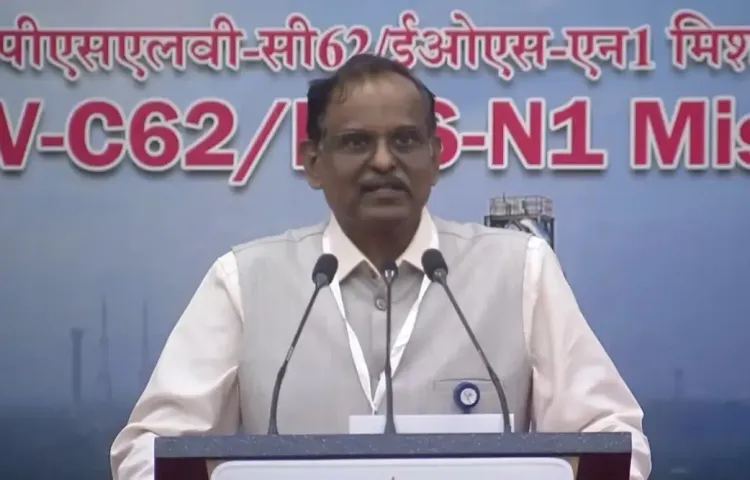
New Delhi, Jan 12 (NationPress) The PSLV-C62 mission, which launched this morning, encountered an anomaly during the third stage of rocket separation, as reported by ISRO Chairman V. Narayanan, who further mentioned that the space agency has initiated an investigation.
The Polar Satellite Launch Vehicle (PSLV) was designed to place the EOS-N1 Earth observation satellite along with 15 co-passenger satellites into a sun-synchronous orbit, successfully lifting off at 10:17 am IST from the
First Launch Pad (FLP) at Sriharikota's Satish Dhawan Space Centre.
In statements to the media post-launch, Narayanan revealed that a setback occurred when a deviation was detected at the conclusion of the third stage.
He noted that the rocket performed flawlessly until the third stage, and the team is diligently analyzing ground data to pinpoint the issue before issuing further updates.
“We initiated the PSLV-C62 EOS-N1 mission. The PSLV comprises four stages: the first stage is a solid motor with two strap-on boosters, the second stage is liquid, the third stage is solid, and the fourth stage is liquid. The performance of the vehicle up until the third stage was in line with expectations,” Narayanan explained.
“Nevertheless, towards the end of the third stage, we registered some disturbances, leading to a deviation in the vehicle's flight path. Consequently, the mission could not proceed as planned. We are now examining data from all ground stations, and we will update you once the analysis is finalized,” he added.
The PSLV-C61 mission, which launched in May 2025, similarly experienced a technical anomaly during its third stage, hindering its ability to reach the intended orbit.
This mission was intended to deploy the EOS-09 Earth Observation Satellite, weighing 1,696 kg, into a 505 km Sun-Synchronous Polar Orbit.
Meanwhile, the PSLV-C62 mission represents the inaugural launch of 2026 and marks the 64th flight of the PSLV.
The EOS-N1, also known as Anwesha, seeks to bolster India’s remote sensing capabilities in areas such as agriculture, urban mapping, and environmental monitoring.
“The PSLV-C62 mission will also showcase KID or Kestrel Initial Technology Demonstrator, a small-scale prototype of a re-entry vehicle being developed by a Spanish startup,” ISRO noted.
The PSLV-C62 / EOS-N1 Mission signifies the ninth dedicated commercial mission executed by NewSpace India Limited (NSIL), the commercial arm of ISRO.
This launch was the fifth utilizing the PSLV-DL variant, which incorporates two solid strap-on boosters.
The PSLV has successfully completed 63 flights, including significant missions like Chandrayaan-1, the Mars Orbiter Mission, Aditya-L1, and the Astrosat Mission. In 2017, PSLV achieved a world record by launching 104 satellites in a single mission.
Point of View
I believe the PSLV-C62 mission's anomaly is a significant concern for India's space ambitions. While setbacks are part of space exploration, the prompt response from ISRO demonstrates their commitment to transparency and accountability. The nation awaits updates as the agency delves into this matter.
NationPress
12/01/2026
Frequently Asked Questions
What is the PSLV-C62 mission?
The PSLV-C62 mission is a space endeavor by ISRO aimed at deploying the EOS-N1 Earth observation satellite and 15 co-passenger satellites into a sun-synchronous orbit.
What anomaly occurred during the PSLV-C62 mission?
An anomaly was detected at the third stage of the rocket separation, leading to a deviation in the vehicle's flight path.
What actions is ISRO taking regarding the anomaly?
ISRO has launched an investigation to analyze ground data in order to understand the issue and provide further updates.
When was the PSLV-C62 mission launched?
The PSLV-C62 mission was launched on January 12, 2026, at 10:17 am IST.
What is the significance of the EOS-N1 satellite?
The EOS-N1, also called Anwesha, aims to enhance India's remote sensing capabilities in agriculture, urban mapping, and environmental monitoring.