What Key MoUs Did India and Germany Sign?
Synopsis
India and Germany have signed pivotal MoUs that bolster their strategic partnership. With bilateral trade surpassing $50 billion, the nations are set to collaborate on renewable energy, climate action, and education. A new Centre of Excellence will enhance technology exchange, paving the way for transformative projects like green hydrogen initiatives.
Key Takeaways
India and Germany have signed several MoUs to strengthen their partnership.
Bilateral trade has crossed $50 billion, marking a historic milestone.
The new Centre of Excellence will focus on technology and innovation.
Collaboration in renewable energy and climate action is a priority.
There are plans for a significant green hydrogen project.
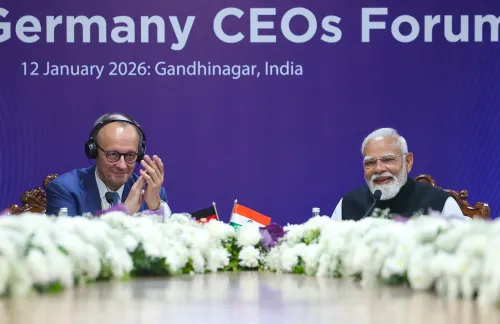
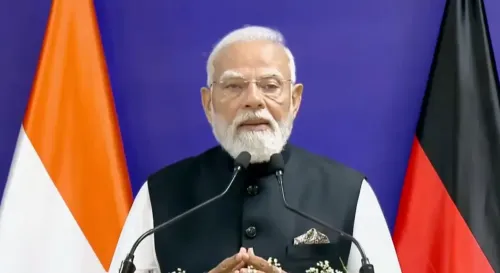
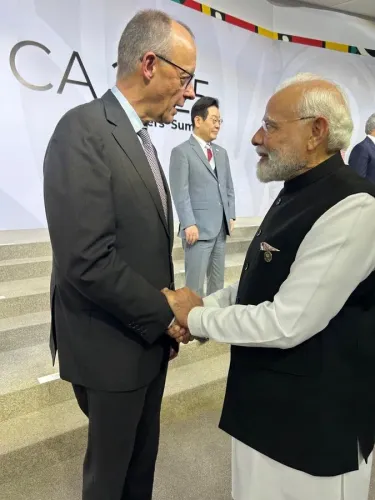
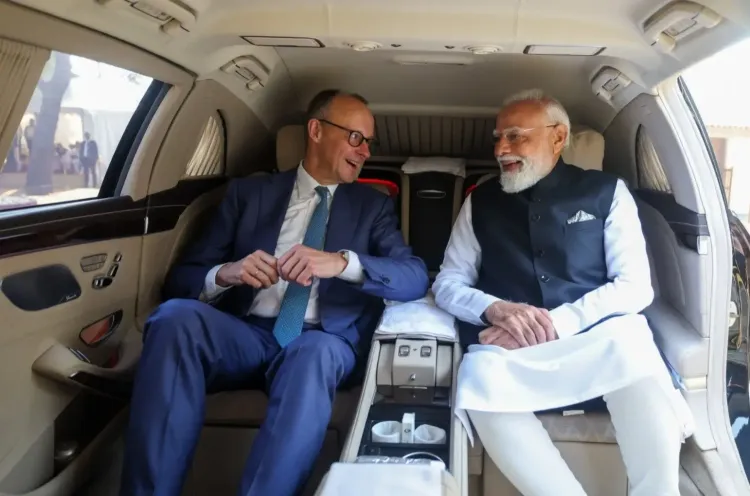
New Delhi, Jan 12 (NationPress) On Monday, India and Germany formalized several Memorandums of Understanding (MoUs) during a meeting attended by Prime Minister Narendra Modi and Chancellor Friedrich Merz, marking a significant enhancement to their strategic alliance.
During a joint press briefing, Prime Minister Modi announced that the bilateral trade between the two nations has surpassed the $50 billion threshold, achieving its highest level to date.
“Over two thousand German enterprises have established a strong foothold in India, demonstrating their steadfast confidence in our nation and the vast opportunities it offers,” PM Modi remarked.
He further noted that collaboration in technology has consistently progressed over recent years, now evident through various joint initiatives and investments.
“India and Germany are united in their commitment to renewable energy and climate action,” the Prime Minister pointed out.
To foster collaboration in these crucial areas, both nations have resolved to establish the India-Germany Centre of Excellence.
This centre will serve as a hub for the exchange of knowledge, technology, and innovation. Both countries are also cooperating on initiatives related to climate, energy, urban development, and mobility.
“A transformative green hydrogen project involving firms from both nations is poised to revolutionize the future of energy,” PM Modi emphasized.
The Prime Minister also underscored the importance of collaboration in supply chains, stating that India and Germany are working together to create secure and reliable systems.
The two leaders also concurred on the need to enhance cooperation in sports and education. “Sports will foster connections between youth from both nations, while a new framework on higher education will bolster academic ties,” PM Modi expressed.
He encouraged German universities to establish campuses in India.
Chancellor Friedrich Merz highlighted the significance of finalizing a free trade agreement between India and the European Union, asserting that such a deal would unlock the full potential of India-Germany economic relations.
Point of View
This latest collaboration between India and Germany stands as a testament to the growing diplomatic relations and mutual trust. The emphasis on renewable energy and educational collaboration highlights a forward-thinking approach that not only benefits both nations but also contributes positively to global efforts against climate change. Such initiatives should be viewed as a pivotal step towards a more sustainable future.
NationPress
4 Oct 2026
Frequently Asked Questions
What are the key areas of collaboration between India and Germany?
The key areas of collaboration include renewable energy, climate action, education, and technology exchange.
What is the significance of the India-Germany Centre of Excellence?
The Centre of Excellence will facilitate knowledge sharing, technology transfer, and innovation between the two countries.
Why is the free trade agreement between India and the EU important?
The free trade agreement will enhance economic relations and unlock greater potential for trade and investment between India and the EU.