Why Are Sensex and Nifty Declining Amid Weak Global Signals?
Click to start listening
Synopsis
The Indian stock market experiences further losses as Sensex and Nifty struggle with global uncertainties. Investors are advised to watch key support levels closely amidst geopolitical tensions and market fluctuations. What does this mean for your investments? Read on to find out.
Key Takeaways
- Sensex down by 168 points, Nifty down by 28 points.
- Foreign fund outflows continue to impact market sentiment.
- Sector performance remains mixed, with metal and pharma indices gaining.
- Immediate support levels identified at 25,050–25,100.
- Geopolitical tensions contribute to market volatility.
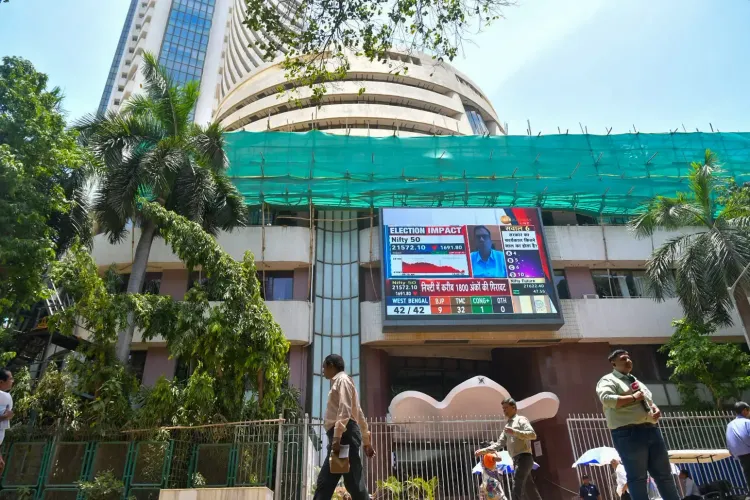
Mumbai, Jan 21 (NationPress) The Indian benchmark indices have continued their downward trend on Wednesday, reflecting ongoing global risk aversion, persistent foreign fund outflows, and mixed corporate earnings signals.
At 9:30 AM, the Sensex fell by 168 points, or 0.20%, settling at 82,012, while the Nifty saw a decline of 28 points, or 0.11%, reaching 25,204.
The major broadcap indices mirrored this trend, with the Nifty Midcap 100 decreasing by 0.18% and the Nifty Smallcap 100 dropping by 0.11%.
Sector-wise, the indices displayed a mixed performance, with Nifty metal and pharma being the standout gainers, up 0.83% and 0.86%, respectively. In contrast, IT and chemicals emerged as major losers, down 0.81% and 1.21%.
Market analysts noted that immediate support is located within the 25,050–25,100 range, while resistance is positioned near 25,350–25,400.
US President Donald Trump has threatened to impose a 200% tariff on French wine and Champagne, according to Vikram Kasat, Head of Advisory at PL Capital.
Experts indicated that the selloff in US markets, prompted by Trump’s renewed Greenland-related remarks, aligns with a risk-off sentiment among investors.
Kasat stated, "If investors were merely shifting to safer assets, we would see a rise in bond prices. Instead, they also fell on Tuesday, pushing yields to their highest level since August."
Furthermore, Greenland’s Prime Minister Jens-Frederik Nielsen urged residents to prepare for a potential military invasion from the US, though he deemed such a situation unlikely.
Another market analyst mentioned that if these tariffs are implemented, Europe might retaliate, leading to a trade war that could adversely affect global trade and intensify selling in stock markets.
In Asian markets, China's Shanghai index rose by 0.36%, and Shenzhen increased by 1.03%. Conversely, Japan's Nikkei fell by 0.56%, while Hong Kong's Hang Seng Index decreased by 0.18%. South Korea's Kospi also eased by 0.36%.
US markets concluded in the negative territory, with Nasdaq declining by 2.39%. The S&P 500 fell by 2.06%, and the Dow decreased by 1.76%.
On January 20, foreign institutional investors (FIIs) sold net equities worth Rs 2,938 crore, while domestic institutional investors (DIIs) were net buyers, acquiring equities worth Rs 3,666 crore.
aar/na
Point of View
It is crucial for investors to maintain a cautious approach. While the ongoing geopolitical tensions and foreign fund outflows pose challenges, it’s important to stay informed and vigilant. The market dynamics are ever-changing, and a strategic mindset can lead to better investment decisions. We advise keeping a close watch on key support levels as the market navigates these turbulent waters.
NationPress
21/01/2026
Frequently Asked Questions
What are the current levels of Sensex and Nifty?
As of now, the Sensex stands at 82,012, down by 168 points, while the Nifty is at 25,204, down by 28 points.
What factors are influencing the market decline?
The decline is primarily driven by persistent global risk-off sentiment, continued foreign fund outflows, and mixed earnings reports.
What support and resistance levels should investors be aware of?
Immediate support is located in the 25,050–25,100 range, while resistance is positioned near 25,350–25,400.
How are international markets affecting the Indian stock market?
International markets are experiencing volatility due to geopolitical tensions, which influences investor sentiment globally and impacts the Indian stock market.
What should investors do in this market scenario?
Investors are advised to stay informed, monitor key levels, and consider a cautious approach amidst the current uncertainties.