Asian Games 2026: Indian athletes train on smart track at SAI Bengaluru
Synopsis
India's Asian Games 2026 squad isn't just training harder — it's training smarter. At SAI Bengaluru's NCOE, a one-of-a-kind smart track captures real-time stride length, split timings, and speed data for eight elite athletes including Avinash Sable and Parul Chaudhary. The same technology helped para-athletes Gavit and Basil go 1-2 at the Commonwealth Games 2026.
Key Takeaways
A national athletics coaching camp is underway at SAI NCOE Bengaluru , running until 8 September , sanctioned by TOPS .
Eight athletes including Avinash Sable , Parul Chaudhary , and Krishan Kumar are among the 73-member Indian athletics contingent for Asian Games 2026 .
The smart track , installed in 2024 , delivers real-time speed, split timings, stride length, and stride frequency via embedded magnetic gates.
Para-athletes Dilip Mahadu Gavit and Mohammed Basil used the same track ahead of CWG 2026 , winning gold and silver in the men's 100m T47.
The system is all-weather, app-enabled, and can be retrofitted onto any synthetic track within a day, according to coach Suresh Kumar .
The Asian Games 2026 in Aichi-Nagoya are scheduled from 19 September to 4 October .
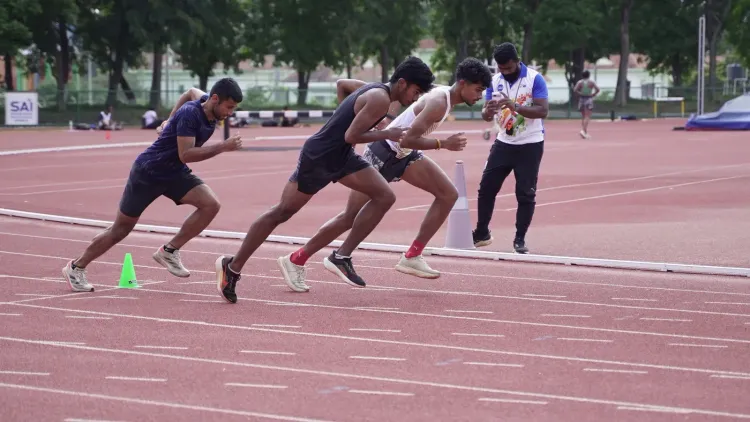
Indian athletes preparing for the Asian Games 2026 in Aichi-Nagoya are leveraging cutting-edge smart track technology at the Sports Authority of India's National Centre of Excellence (NCOE) in Bengaluru, giving coaches real-time access to performance data that was previously impossible to capture manually. The national coaching camp, running until 8 September, is sanctioned by the Target Olympic Podium Scheme (TOPS) and is bringing together eight elite athletes for the final push before the Games.
Who Is Training and What Is at Stake
The camp features 800m runner Krishan Kumar, steeplechase star Avinash Sable, high jumpers Aadarsh Ram and Supriya B, decathlete Thowfeeq N, middle- and long-distance runner Parul Chaudhary, and race walkers Manju Rani and Priyanka. All eight are part of India's approved 73-member athletics contingent — 35 men and 38 women — for the Games, which are scheduled from 19 September to 4 October in Aichi-Nagoya.
How the Smart Track Works
The smart track, installed in 2024, uses magnetic timing gates embedded beneath the surface of the synthetic track — both on the straight and around the curve — to capture live data during every run. According to Suresh Kumar, Coach (Athletics) at SAI NCOE Bengaluru, the system delivers real-time speed readings, split timings at each gate, total timing, stride length, and stride frequency simultaneously.
'This is one of a kind in India,' Kumar said. 'When the athlete runs, we get the real-time speed data. We get the split timings wherever the gates are placed, then the total timing we get, as well as the stride length and the stride frequency. All this data is captured in real time. This helps a lot for the athletes in the training,' he explained.
An accompanying app makes the data immediately accessible for post-session analysis. Notably, the system can be retrofitted onto any existing synthetic track and, according to Kumar, can be installed within a single day.
A Proven Asset for Elite Athletes
The track has already demonstrated its value at the highest level. Para-athletics stars Dilip Mahadu Gavit and Mohammed Basil used it extensively ahead of the Commonwealth Games 2026 in Glasgow, where they claimed gold and silver respectively in the men's 100m T47 category — finishing first and second. The technology replicates electronic competition timing during training, giving athletes a more precise benchmark for their performances.
'The athletes are very happy because they get to understand and find out the real data based on the electronic timing, not just during training but in any competitions that take place here,' Kumar said.
All-Weather Reliability and Coaching Staff
One practical advantage of the embedded system is its resilience to weather. Unlike portable timing equipment that can be disrupted by rain or dust, the magnetic gates remain functional under all conditions. 'We don't have to worry about the weather. We don't have to worry about the wear and tear, nothing. It's just like it's already there. You just need to run over in between that. The real-time data is always available,' Kumar noted.
The camp's coaching panel is equally well-equipped, featuring race-walking coach Ronald Gerd Weigel, jumps coach Sahana Kumari Nagaraj Gobbargumpi, coach Kalyan Chaudhary, and masseuse Meena Sagar Ugale. The combination of elite coaching and sports science infrastructure positions the SAI Bengaluru centre as a critical launchpad for India's medal ambitions at Aichi-Nagoya.
With the Asian Games less than three weeks away, the Bengaluru camp represents India's most technologically advanced pre-competition preparation cycle in athletics to date.
Point of View
At least for the eight athletes present. The real question is scalability: a system that can be installed on any synthetic track within a day has no excuse for remaining confined to one centre. Whether SAI deploys it across regional academies before the 2028 Olympic cycle will be the true measure of institutional intent.
NationPress
1 Sept 2026
Frequently Asked Questions
What is the smart track being used by Indian athletes at SAI Bengaluru?
The smart track is a specialised athletics training surface at SAI's National Centre of Excellence in Bengaluru, installed in 2024, that uses embedded magnetic timing gates to capture real-time speed, split timings, stride length, and stride frequency. It is described by coaches as the only facility of its kind in India, and the data is accessible immediately via an accompanying app.
Which Indian athletes are training at the SAI Bengaluru camp ahead of Asian Games 2026?
The camp includes steeplechase star Avinash Sable, middle- and long-distance runner Parul Chaudhary, 800m runner Krishan Kumar, high jumpers Aadarsh Ram and Supriya B, decathlete Thowfeeq N, and race walkers Manju Rani and Priyanka. All eight are part of India's approved 73-member athletics contingent for the Aichi-Nagoya Games.
When are the Asian Games 2026 scheduled and where will they be held?
The Asian Games 2026 are scheduled to be held in Aichi-Nagoya, Japan, from 19 September to 4 October 2026.
Has the smart track been used successfully before?
Yes. Para-athletes Dilip Mahadu Gavit and Mohammed Basil trained on the same smart track ahead of the Commonwealth Games 2026 in Glasgow, where they finished first and second respectively in the men's 100m T47 category, winning gold and silver medals.
How does the smart track handle weather conditions?
Unlike portable timing equipment, the smart track's magnetic gates are permanently embedded beneath the synthetic surface, making them functional in rain or dusty conditions without any setup or removal required. Coach Suresh Kumar noted that real-time data remains available regardless of weather.