Florian Wiegele: Austria's 2.05m goalkeeper is tallest player in World Cup history
Synopsis
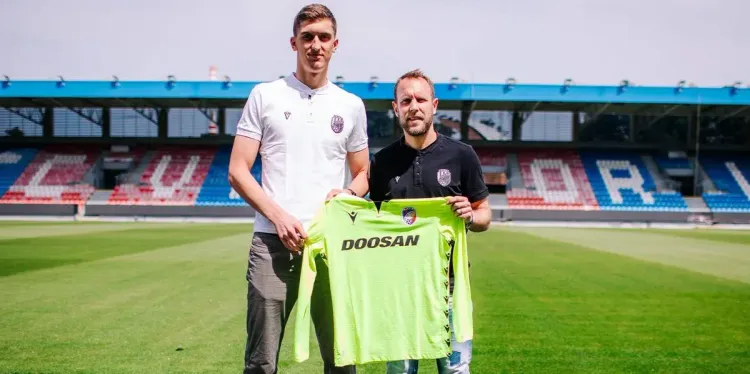
Austria's third-choice goalkeeper Florian Wiegele stands 2.05 metres tall — making him the tallest player in the 96-year history of the FIFA World Cup, edging past Dutch keeper Andries Noppert's Qatar record. He may not start a single match, but his name is already in the record books before a ball is kicked.
Key Takeaways
Florian Wiegele of Austria stands at 2.05 metres (6 ft 9.5 in), making him the tallest player in FIFA World Cup history .
He surpasses the previous record held by Dutch goalkeeper Andries Noppert at 2.03 metres , who featured at the Qatar World Cup .
Wiegele plays club football for Viktoria Plzen in the Czech first division and is Austria's third-choice goalkeeper .
Austria are in Group J alongside defending champions Argentina , Algeria , and Jordan .
The 2026 FIFA World Cup runs from 11 June to 19 July 2026 across 16 cities in the USA, Mexico, and Canada.
Austrian goalkeeper Florian Wiegele is set to become the tallest player ever to feature in the FIFA World Cup, standing at 2.05 metres (6 feet 9.5 inches) — a record in the tournament's 96-year history. Wiegele, who plays club football for Viktoria Plzen in the Czech first division, is part of Austria's squad for the 2026 FIFA World Cup, which kicks off on 11 June 2026.
Breaking a World Cup Record
The previous benchmark for the tallest player at a World Cup was held by Dutch goalkeeper Andries Noppert, who stood at 2.03 metres and featured at the Qatar World Cup. Wiegele edges past him by two centimetres, placing other tall footballing names firmly in his shadow — including England's Peter Crouch at 2.01 metres and Sweden's Zlatan Ibrahimovic at 1.95 metres.
Wiegele's Standing in the Austrian Squad
Despite the record-setting stature, Wiegele is the third-choice goalkeeper in the Austrian setup, behind Alexander Schlager and Patrick Pentz. His only senior international appearance to date came against Ghana in a March friendly. His inclusion in the squad is nonetheless historic, and his chances of featuring in competitive minutes remain limited barring injury to the first two options.
Austria's Group Stage Challenge
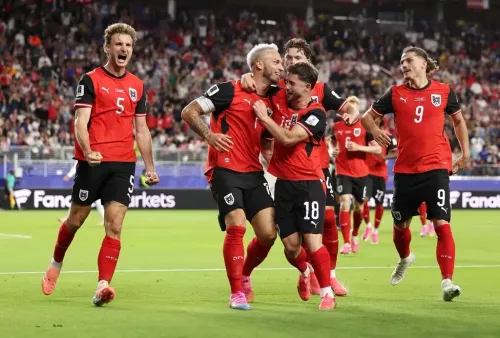
Austria have been placed in Group J of the expanded 48-team tournament, alongside defending champions Argentina, Algeria, and Jordan. Navigating a group that includes the reigning world champions makes Austria's path out of the group stage a formidable one. Notably, the new format means eight third-placed teams also advance, offering a slight buffer — but a slow start against Argentina could still prove decisive.
About the 2026 FIFA World Cup
The 2026 FIFA World Cup is the 23rd edition of the tournament and the first to feature a 48-team format, expanding from the previous 32-team structure. Matches will be played across 16 host cities — 11 in the United States, 3 in Mexico, and 2 in Canada — from 11 June to 19 July 2026. The expanded group stage features 12 groups and 72 group-stage matches, with every result carrying heightened consequence under the new structure.
With the competition now broader and more unpredictable than ever, Austria's historic squad selection adds a footnote to a tournament already full of firsts.
Point of View
But it underscores a broader shift in how squads are assembled for the expanded 48-team format — depth matters more than ever. Austria's inclusion of a third-choice keeper with a single international cap speaks to squad-building pragmatism, not just headline-chasing. The real story is Group J: any Austrian goalkeeper, record-tall or not, will be tested by the presence of defending champions Argentina. Whether Wiegele ever takes the field is almost beside the point — the record is already his.
NationPress
16 Sept 2026
Frequently Asked Questions
Who is Florian Wiegele and why is he making World Cup history?
Florian Wiegele is an Austrian goalkeeper who stands at 2.05 metres, making him the tallest player ever to be part of a FIFA World Cup squad in the tournament's 96-year history. He plays club football for Viktoria Plzen in the Czech first division.
Who held the record for tallest World Cup player before Wiegele?
Dutch goalkeeper Andries Noppert held the previous record at 2.03 metres, having featured at the 2022 FIFA World Cup in Qatar. Wiegele surpasses him by two centimetres.
Will Florian Wiegele actually play at the 2026 World Cup?
Wiegele is Austria's third-choice goalkeeper, behind Alexander Schlager and Patrick Pentz, making his chances of competitive game time limited. His only senior international cap came in a March friendly against Ghana.
Which group is Austria in at the 2026 FIFA World Cup?
Austria have been drawn into Group J alongside defending champions Argentina, Algeria, and Jordan — one of the more challenging groups in the expanded 48-team tournament.
What is the format of the 2026 FIFA World Cup?
The 2026 FIFA World Cup is the first to use a 48-team format, featuring 12 groups and 72 group-stage matches, with eight third-placed teams also advancing to the knockout rounds. It is hosted across 16 cities in the United States, Mexico, and Canada, running from 11 June to 19 July 2026.